
For a long time, the term "Edge Router" was instinctively associated with an enterprise Internet egress gateway—responsible for basic NAT, employee access authentication, and rudimentary perimeter security. But today’s "network edge" has been radically reshaped. Behind the modern edge sit not just office PCs, but massive server farms, containerized clusters, and high-throughput AI workloads. At the other end, connectivity is no longer tied to a single ISP; it extends across multi-cloud environments, geo-distributed data centers, and external partner networks.
Edge Router vs. Border Router: From "Location" to "Role"
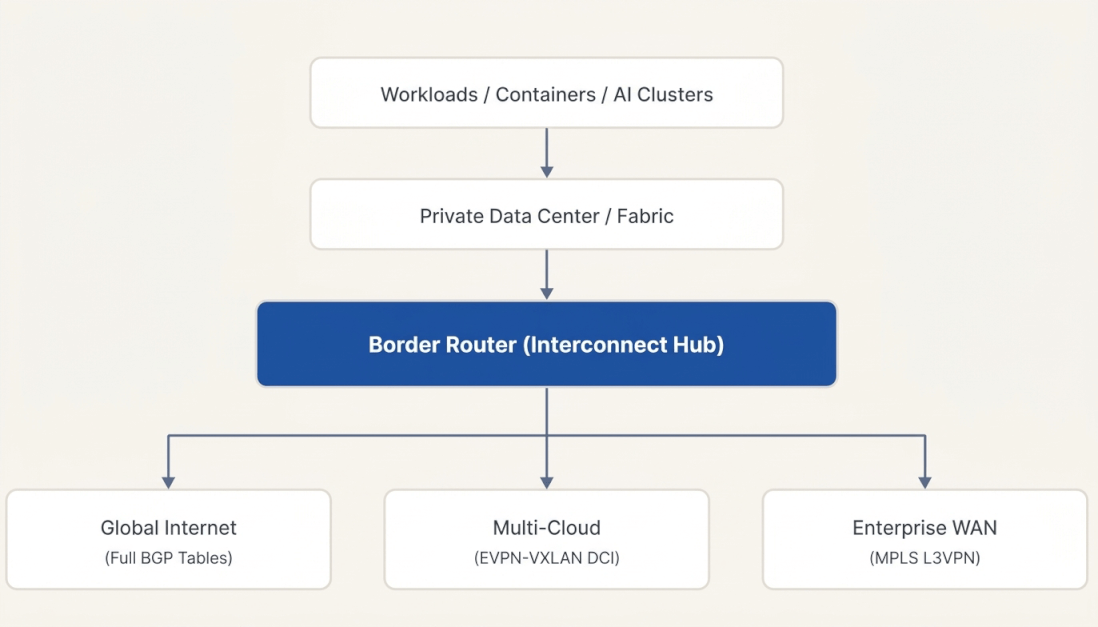
When discussing interconnection among data centers, clouds, WANs, service providers, and third-party networks, "Border Router" is a far more precise definition. An Edge Router emphasizes physical deployment location (sitting at the boundary between internal and external networks), whereas a Border Router defines protocol and interconnection capabilities (driving high-speed route exchange and policy enforcement across distinct Autonomous Systems / AS domains and multi-tenant fabrics).
As the network edge evolves into a critical crossroads between disparate network domains, the traditional "egress point" must transform into a high-performance Interconnect Hub:
Where Do Modern High-Performance Routers Fit?
Not every network demands a high-performance router. For an enterprise with a single Internet uplink and a straightforward topology, a conventional Internet Gateway is often plenty. A high-performance routing platform proves its worth when addressing large-scale topologies, massive bandwidth, intricate routing policies, multi-domain environments, secure segmentation, subscriber management, or extensive multi-site mesh connectivity.
Where does a true Border Router actually deploy? Below are 5 core deployment scenarios for modern Border Routers, exemplified by the Asterfusion RT Series.
01 — Data Center & Cloud Border Router: The Interconnect Hub for Distributed Compute Fabrics
In modern data centers and cloud infrastructures, the nature of the network edge has fundamentally shifted: traffic crossing the perimeter is no longer dominated by office endpoints, but by bare-metal servers, virtual machines, Kubernetes container clusters, and highly concurrent AI training and inference workloads.
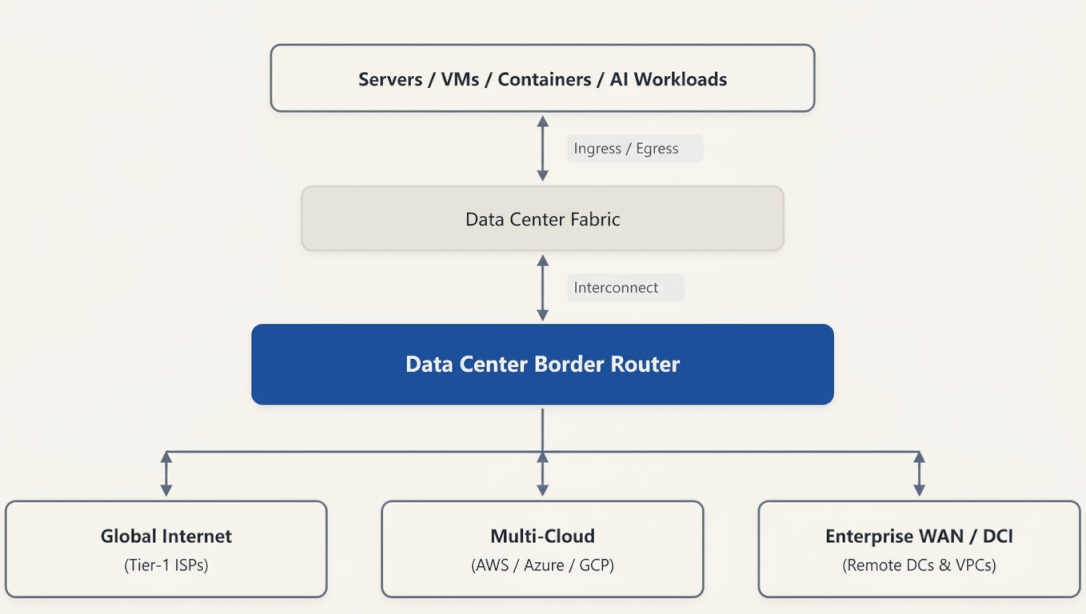
Serving as the critical gateway for data center egress and ingress, the Data Center Border Router governs inter-domain routing where disparate networks converge. It directly interfaces with Tier-1 transit providers, public and private cloud VPCs, geo-distributed branch locations, and third-party AI compute partners.
Faced with micro-bursts and massive north-south traffic volumes, the architectural mandate has escalated: it is no longer about whether endpoints can browse the Internet, but how tens of thousands of distributed workloads can achieve deterministic, high-throughput, and ultra-low-latency interconnects across hybrid, topologically complex external networks.
Key Capability Requirements:
Massive Route Scale: Hardware-level capacity to hold millions (2M–4M+) of IPv4/IPv6 BGP global prefixes (Full Routing Tables), paired with sub-second route convergence and granular BGP path attribute policy filtering.
High-Density Line-Rate Performance & Deep Buffering: High-density 100G/400G interfaces combined with deep packet buffers to absorb cross-domain burst congestion and maintain non-blocking line-rate forwarding.
Cross-Domain Multi-Tenant Segmentation (DCI): Native support for EVPN-VXLAN DCI and MPLS L3VPN to seamlessly stitch and isolate tenant VRFs across distinct administrative domains.
High Availability & Deterministic Multipathing: Large-scale 256-way ECMP for load distribution, coupled with hardware-accelerated BFD for millisecond-level fault detection and rapid convergence to ensure mission-critical compute remains uninterrupted.
02 — Enterprise Hybrid & Multi-Cloud Border Router: The Hub for Corporate Multi-Cloud Interconnection
Today, it is rare for an enterprise to concentrate its core business within a single machine room. Core databases might reside on an on-premises private cloud or IDC, elastic computing and AI inference might rely on AWS, Azure, or Google Cloud, and branch offices and R&D centers are scattered across various locations.
Consequently, enterprise networks are evolving from traditional "hub-and-spoke" models to complex topologies where multiple clouds coexist:
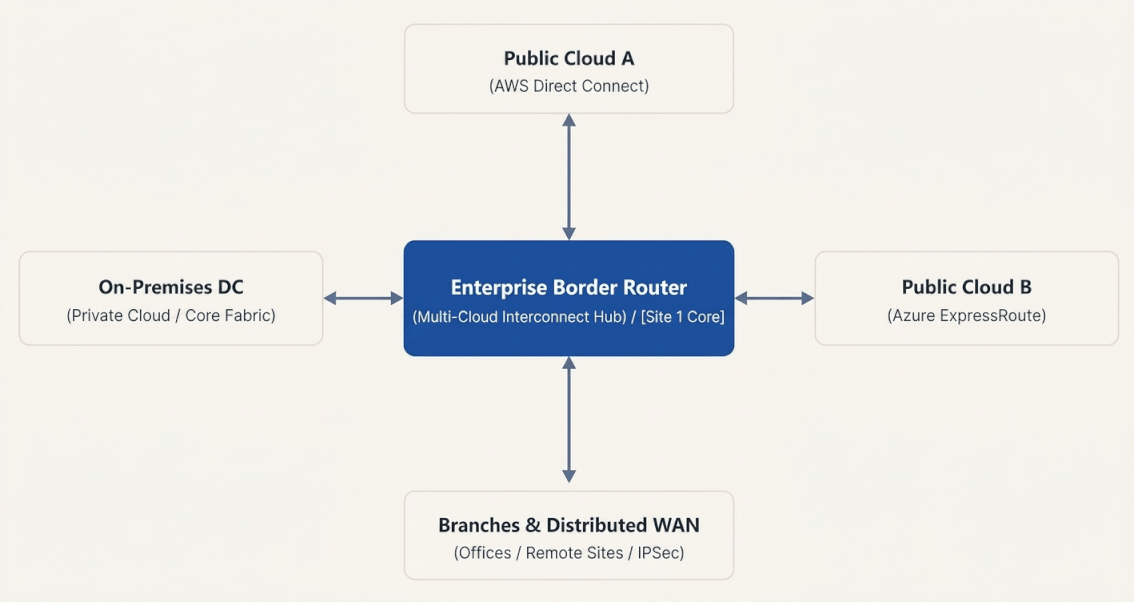
Multi-cloud interconnection is by no means a simple "linking of lines." Heterogeneous cloud environments and private facilities are rife with different network segmentations, fragmented routing strategies, and siloed security domains. The enterprise border hub faces five rigorous challenges:
Network Segment and Route Interconnection: Establishing dynamic peering interconnections and path optimization across dedicated lines (Direct Connect / ExpressRoute) from different cloud vendors.
Business Multi-Tenant Isolation: Ensuring end-to-end logical isolation when different business VPCs, such as R&D, finance, and production, extend across clouds.
Controllable Routing Strategies: Precisely controlling Route Redistribution and Filtering to avoid routing loops and sub-optimal paths.
Key Business SLA: Preventing high-throughput cross-cloud data backups from crowding out production transaction traffic.
High Availability and Fault Self-Healing: Achieving millisecond-level smooth failover when any cloud vendor's line jitters or is interrupted.
The Enterprise Border Router is precisely the "traffic scheduling master control" situated at the intersection of local data centers, public cloud dedicated lines, and the enterprise WAN.
Key Capability Requirements:
Multi-Domain BGP Routing Orchestration: Supporting large-scale BGP neighbor establishment, possessing flexible and powerful Community tagging, AS-Path filtering, and policy-based route redistribution capabilities, and perfectly connecting with dedicated line gateways from all major mainstream cloud vendors.
Cross-Cloud Multi-Tenant Slicing (VRF-Lite / EVPN): Realizing end-to-end business isolation across the entire network based on VRF, completely eliminating routing conflicts caused by overlapping IP segments (Overlapping IP) between different cloud environments and different business lines.
High Throughput and Line-Rate Encryption/Decryption: Providing elastic bandwidth access at 10G/25G/100G, combined with hardware line-rate IPsec/MACsec tunneling capabilities, ensuring large-scale data migration across public networks/dedicated lines is both secure and free from performance cliffs.
Carrier-Grade High Availability and Smooth Convergence: Deeply combining BFD, ECMP, and rapid route convergence technologies to achieve imperceptible traffic shifting when a failure occurs on multi-cloud dedicated lines, thereby guaranteeing the continuity of hybrid cloud business.
03 — Secure Multi-Branch / WAN Interconnection: High-Performance, Secure Fabric for Distributed Sites
Modern enterprises have long extended their reach to every corner of the globe. Beyond the core data center at headquarters, companies now possess distributed branch offices, R&D centers, smart factories, retail outlets, and an increasing number of remote work sites scattered across different regions.
The hardcore challenge for distributed WAN architecture is determining how to weave these fragmented physical edge nodes into a unified corporate "network fabric" efficiently, stably, and securely.
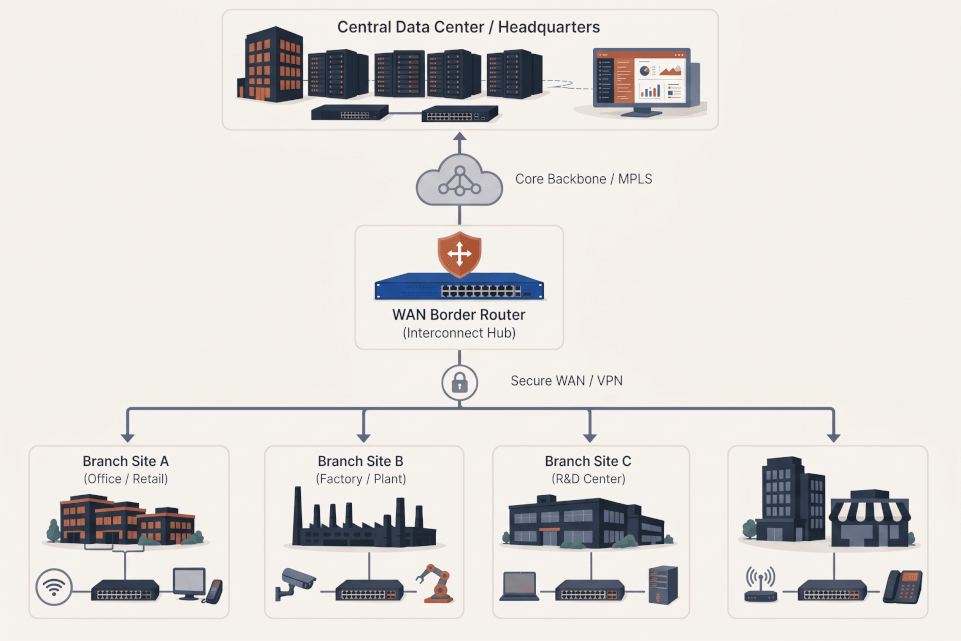
From Simple "Internet Access" to Complex "Intelligent Interconnection"
A single, isolated small store might only need one broadband line to satisfy its business requirements. However, when an enterprise operates a dozen or more sites, the network's gravitational field changes entirely.
At this point, the network must solve more than just how branches "connect to the Internet"; it must also address:
Geo-distributed, Multi-domain Interconnection: How multiple branch nodes can concurrently access DC core services, public cloud compute, and Headquarters management policies with high performance.
Branch Mesh Communication: How to allow direct, low-latency Mesh communication between different branches (e.g., two smart factories).
Massive Encrypted Tunnels Overwhelming CPUs: When a dozen or more sites concurrently establish IPsec VPN tunnels, the CPUs of ordinary gateways can become instantly overwhelmed processing encryption/decryption, resulting in business packet loss and network paralysis.
In this high-complexity technical fog, standard Internet gateways are no longer sufficient. Positioned at the Headquarters or DC egress, the WAN Edge Router / Interconnect Hub must evolve into an architectural centerpiece capable of concurrently managing "high-performance routing throughput" and "hardcore security encryption."
The more distributed an enterprise network becomes, the more this hub must provide stable and controllable full-network traffic management capabilities:
Key Capability Requirements:
Hardware-grade IPsec Tunnel Aggregation: The core Hub must possess hardware-level (based on dedicated chips or DPU hardware acceleration engines) encryption/decryption capabilities. This ensures it can process massive volumes of encrypted tunnel packets at wire speed under multi-Gbps throughput, preventing performance cliffs.
End-to-End Business Network Slicing (VRF / EVPN): Over a single physical link, there must be strict logical isolation based on business attributes (e.g., separating office, R&D, and production OT networks). Even if a single branch node is attacked, the risk is contained within its specific VRF slice.
SD-WAN Capable Multi-WAN Link Orchestration: Supporting hybrid access from heterogeneous links including MPLS, Internet, and 4G/5G. Leveraging powerful BGP/OSPF dynamic routing policies and Traffic Policies to intelligently optimize the best transmission path based on application priority and latency sensitivity.
Carrier-Grade High Availability & Smooth Convergence: Branch networks often exist in unstable environments. The core Hub must support hardware-grade BFD (Bidirectional Forwarding Detection) and ECMP (Multi-Path) technologies to detect link jitter in milliseconds and perform smooth traffic switchovers, guaranteeing business continuity.
04 — Carrier-Grade NAT (CGNAT)
Facing millions of concurrent broadband and mobile subscribers alongside severe IPv4 exhaustion, service providers rely on CGNAT (Carrier-Grade NAT, also known as Large-Scale NAT / LSN) to enable high-density multiplexing of scarce public IPv4 address pools across massive private network user bases.
At its core, CGNAT scales standard enterprise NAT to an operator grade: multiplexing IP resources while enforcing strict session isolation and regulatory traceability.
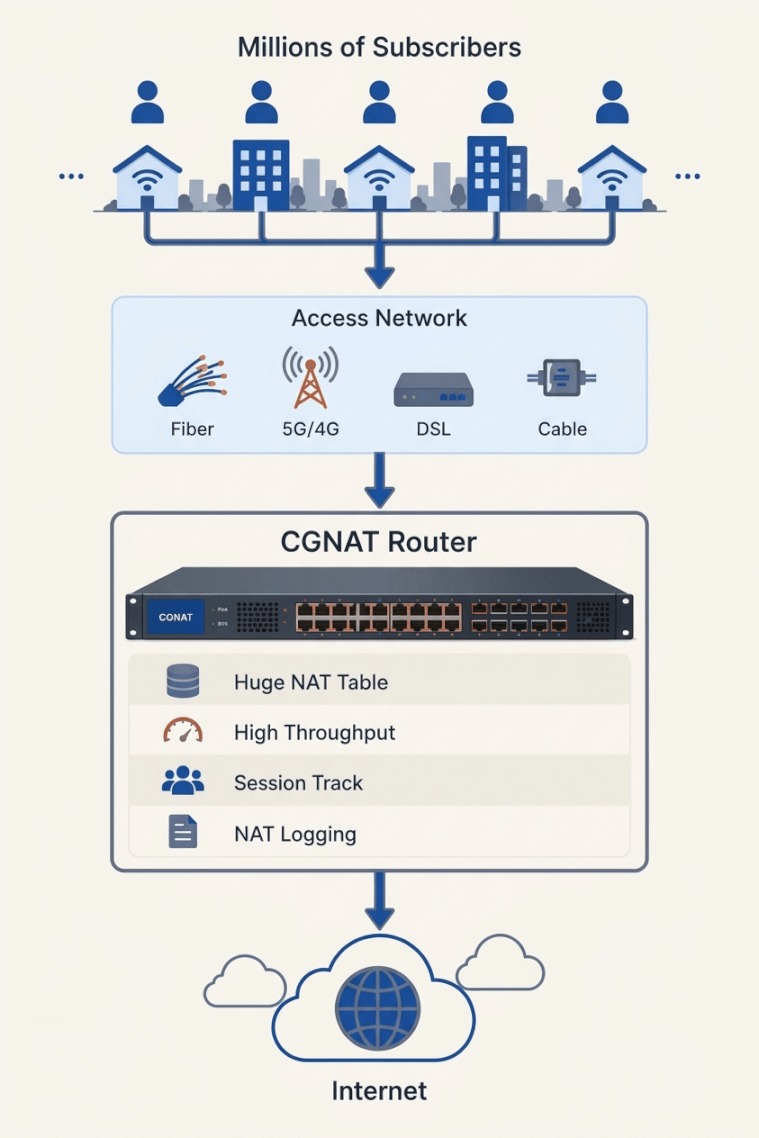
Multiple subscribers share the same public IP via dynamic port blocks:
Subscriber A → 203.0.113.10:50001
Subscriber B → 203.0.113.10:50002
Subscriber C → 203.0.113.10:50003
To satisfy lawful intercept, compliance mandates, and cybersecurity attribution, CGNAT platforms must maintain hundreds of millions of concurrent session states while forwarding traffic at wire speed with sub-microsecond latency, all while reliably exporting 5-tuple mappings and precise timestamps.
Core Traceability Scenario:
"Which specific private-network subscriber originated traffic using public IP X and port Y at a designated UTC timestamp?" This operational reality raises the hardware baseline far beyond that of standard enterprise gateways. A CGNAT platform must deliver:
Carrier-Grade Concurrency & Throughput: Hardware-accelerated forwarding and table offloading to prevent state table exhaustion and avalanches during massive spikes in concurrent connection setups.
Optimized Traceability & Log Export: Native support for Port-Block Allocation (PBA) or high-throughput IPFIX/NetFlow stream export, eliminating the bandwidth and storage bottlenecks caused by traditional, high-volume Syslog.
Within a CGNAT architecture, the router ceases to be a simple egress gateway—it becomes critical infrastructure underpinning address multiplexing, connection persistence, and regulatory compliance.
05 — Broadband Network Gateway (BNG) for Subscriber Management + AAA + HQoS + Broadband Access
The Broadband Network Gateway (BNG)—traditionally known as a BRAS—serves as the critical policy and subscriber aggregation anchor bridging the access network and the service provider’s IP core. Deployed at POPs, Central Offices (COs), or metro aggregation hubs, the BNG allows network operators to aggregate, authenticate, isolate, and manage tens of thousands of residential and enterprise subscriber sessions over a unified, multi-tenant network infrastructure.
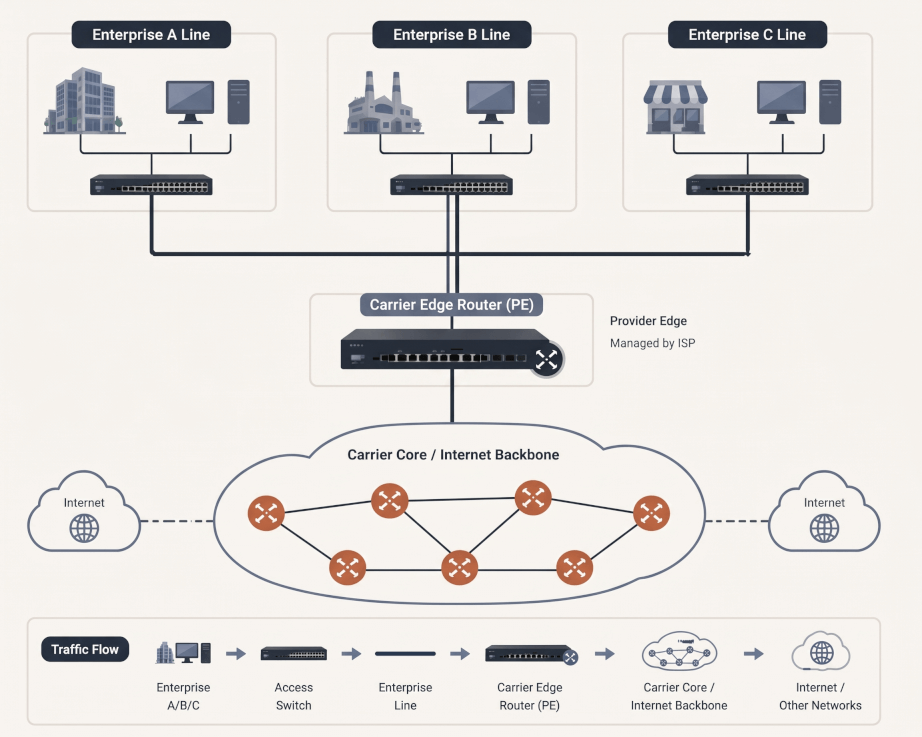
Unlike conventional routers that focus strictly on stateless, destination-based forwarding, a BNG is a subscriber-aware service engine. Its primary responsibilities include:
Session Termination & Address Assignment: High-density PPPoE and IPoE session termination with dynamic IPv4/IPv6 address and prefix delegation.
AAA Integration & Dynamic Policy: Real-time interworking with RADIUS servers for AAA, dynamically applying per-subscriber ACLs, rate limiting, and accounting policies upon session initiation.
Hierarchical QoS (HQoS): Multi-level scheduling, queuing, and shaping across physical ports, subscriber sessions, and application CoS queues to guarantee strict SLAs.
Multi-Tenant Service Isolation: Enforcing strict traffic separation using VLAN tagging, VRF instances, and MPLS encapsulation across enterprise and broadband tiers.
While a standard router simply asks:"What is the destination IP, and what is the next-hop interface?"
A BNG must resolve:"Which active subscriber session owns this packet? What SLA entitlements apply? What bandwidth limit, shaping hierarchy, and billing profile must be enforced right now?"
Consequently, a production-grade BNG requires more than wire-speed forwarding and large routing tables; it must deliver carrier-class control-plane scaling, high-frequency state synchronization, and fine-grained hardware offloading to effortlessly sustain tens of thousands of stateful subscriber lifecycles.
Architectural Insight: The Convergence of Edge Router and Border Router
Functionally and protocol-wise, BNG and CGNAT embody the purest definition of the Service Edge—they are deeply subscriber-aware, maintaining millions of complex, stateful session tables. Yet topographically, they sit at the network's outermost boundary, demanded to forward aggregate line-rate traffic on par with a Border Router.
In essence, they handle the fine-grained, stateful grunt work of the Edge while occupying the physical footprint and wire-speed demands of the Border. Rather than forcing rigid categorical labels, the modern open networking architecture recognizes BNG as the organic convergence of Edge intelligence and Border throughput.
Five Core Gateway Scenarios: Roles, Bottlenecks & Hardware Demands
Scenario No. & Name | Strategic Positioning & Deployment | Core Pain Points & Problems Solved | Key Protocols & Technologies | Critical Hardware Specs & Performance Bottlenecks |
01 — DC & Cloud Border Router | DC Perimeter / DCI Edge | Absorbing massive compute micro-bursts; ensuring deterministic, ultra-low-latency interconnects for tens of thousands of distributed workloads | Global BGP Full Routing Table, EVPN-VXLAN DCI, MPLS L3VPN, 256-way ECMP, BFD | 2M–4M+ hardware FIB scale, high-density 100G/400G line-rate forwarding, and deep packet buffers to absorb cross-domain burst congestion |
02 — Enterprise Multi-Cloud Border | Enterprise Cross-Cloud Egress / Cloud-Onramp Hub | Fragmented routing policies across heterogeneous clouds, overlapping IP subnets, and bulk data backups crowding out production traffic | Fine-grained BGP policies (Community/AS-Path), VRF-Lite, EVPN, QoS/HQoS traffic slicing | Hardware line-rate IPsec/MACsec encryption/decryption (preventing throughput cliffs), sub-second failover over multi-cloud circuits (BFD/ECMP) |
03 — Secure Multi-Branch / WAN Hub | Enterprise HQ / Core DC Egress | Gateway performance cliffs under concurrent VPN tunnels, high complexity in branch mesh peering, and inefficient hybrid link utilization | IPsec VPN, VRF isolation slicing, BGP/OSPF, SD-WAN intelligent multi-path steering (MPLS/Internet/5G) | Dedicated ASIC/DPU crypto-offloading (sustaining line-rate multi-Gbps tunnel crypto without exhausting CPUs), millisecond-level link-jitter failover |
04 — Carrier-Grade NAT (CGNAT) | Service Provider Edge / Egress Hub | Severe IPv4 exhaustion; strict mandates for lawful intercept, regulatory compliance, and deterministic subscriber attribution | RFC 6598, NAPT, Port-Block Allocation (PBA), high-throughput IPFIX/NetFlow stream export, Deterministic NAT | Hundreds of millions of concurrent session states (State Table), anti-avalanche state protection under high setup rates, and high-rate hardware log offloading to eliminate Syslog bottlenecks |
05 — Broadband Network Gateway (BNG) | POP Node / Metro Aggregation / Central Office (CO) | Transitioning from stateless packet forwarding to subscriber-centric lifecycle control; solving access authentication, dynamic billing, and SLA enforcement | PPPoE/IPoE termination, AAA (RADIUS), Hierarchical QoS (HQoS), VRF/MPLS, IPv4/IPv6 Dual-Stack | Carrier-grade control-plane subscriber scaling, multi-level hierarchical traffic shaping engine, and CUPS (Control and User Plane Separation) architecture |
From Connectivity Commoditization to Temporal Consistency: The Hardcore Evolution of Next-Generation Edge Routers
Examining the five core scenarios above reveals a fundamental paradigm shift at the modern network edge (whether Edge or Border): what sits behind the perimeter is no longer human users browsing the web, but highly collaborative distributed machines and compute fabrics.
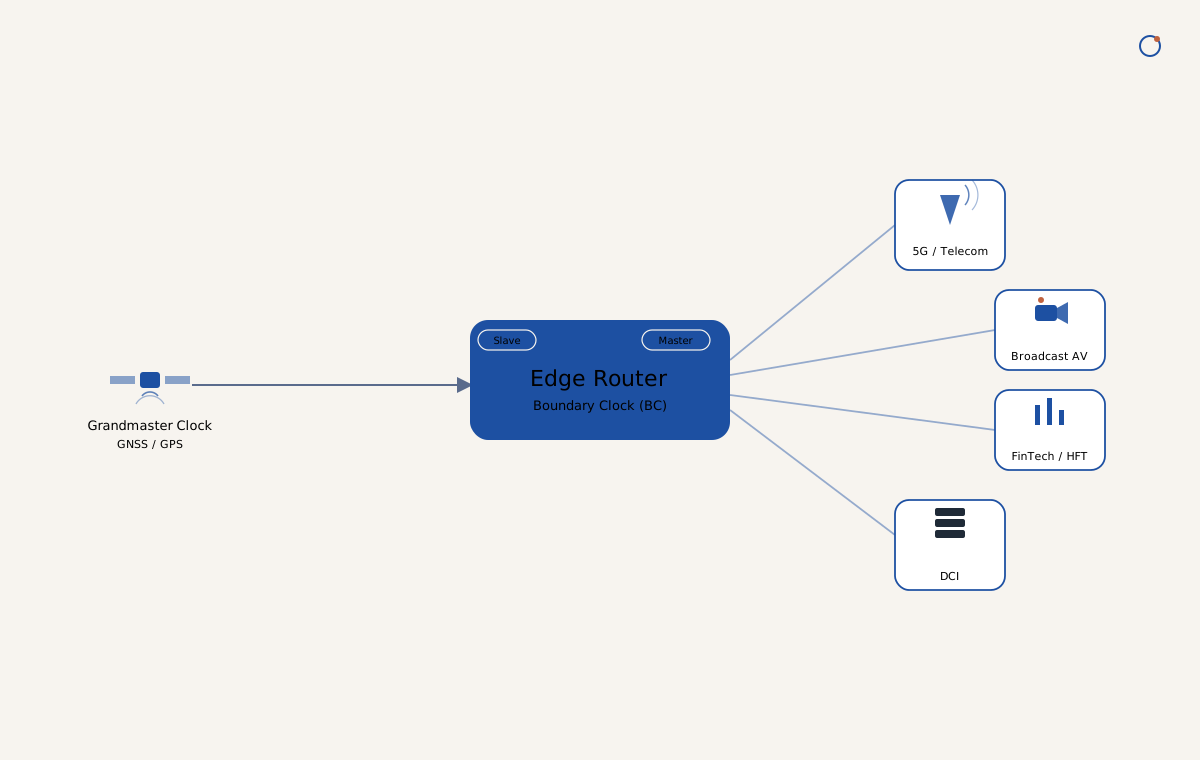
Once edge routers have fully resolved throughput, massive routing tables, and multi-tenant segmentation, the next emerging physical bottleneck is no longer "can they connect," but rather data consistency and causality alignment across geo-distributed systems.
Merely acting as an efficient "packet forwarder" and "isolation policy enforcer" is far from enough in the era of machine-to-machine collaboration:
Traditional NTP’s millisecond-level (ms) error margin is meant for human perception. In an era of compute scheduled in microseconds or even nanoseconds, millisecond-scale clock jitter is a recipe for disaster.
Time equals system throughput: Time equals system throughput and business continuity: In mass media and ultra-low-latency interactive live streaming, multi-angle camera feeds, distributed edge media mixing, and frame-accurate audio-video sync depend entirely on hardware-grade nanosecond timestamps to eliminate stream tearing and lip-sync drift; distributed cross-cloud databases are forced to introduce long-tail wait windows to guarantee causal consistency; AI clusters suffer from broken causality during cross-domain gradient synchronization and network-wide telemetry due to timestamp skew; 5G private networks and edge UPFs require TDD air interfaces strictly kept within microsecond-level phase error thresholds to avoid catastrophic inter-cell interference; and quantitative trading alongside strict compliance mandates legally requires nanosecond-precision audit trails.
If an edge or border router positioned at these critical convergence points can only forward packets—harboring its own clock skew and queuing jitter—it instantly becomes a "chronological black hole" that breaks temporal continuity, bringing expensive upper-layer distributed compute collaboration to a halt.