

/
32 x 400Gb QSFP-DD Packet Broker
48MB
Packet Buffer
12.8 Tbps
Broker Throughput
4.5K
Wildcard Filter
The PX732Q-M is a 1U network packet broker
that delivers 32× 400G QSFP-DD ports plus 2× 10G SFP+ for 12.8 Tbps of processing capacity, with a forwarding rate of 5.6 Bpps and 48MB of packet buffer for non-blocking core-layer performance. Built on the Marvell Prestera Falcon ASIC and running PB-APP, It is a containerized packet broker application on AsterNOS(Enterprise SONiC) that filters, replicates, and load-balances traffic without a dedicated NPB appliance. Each 400G port breaks out to 4×100G, and 100G connections break out further to 4×25G or 4×10G — so a single switch can fan out to a large number of downlink connections, supporting dense server and aggregation-switch access without a separate breakout tier.
PB-APP: packet broker as a containerized application
PB-APP runs as a container on AsterNOS rather than as a separate operating system, so the switch retains its Enterprise SONiC L2/L3 stack while adding dedicated traffic-orchestration logic. Configuration, rule management, and visualization are handled through a Web UI with drag-and-drop policy workflows and real-time hit counters, alongside CLI, RESTful API, SNMP, Syslog, and Prometheus/Grafana integration for teams standardizing on existing O&M tooling.
Role-based port isolation
Each of the data ports is assigned one of four roles — Network, Service, Tool, or Hybrid — separating production traffic ingress, service-chained inline paths, and tool-facing egress on the same device. This isolation model prevents analysis traffic from being reinjected into the production path.
Deep multi-tunnel parsing
PB-APP decapsulates GRE, VXLAN, GTP-U, MPLS, ERSPAN, IPinIP, CFP, and PPPoE tunnels, then matches inner-layer 5-tuple fields for filtering and load-balancing decisions — supporting visibility into overlay and mobile-core traffic without an upstream decapsulation step.
Multi-dimensional precision ACL
Ingress and egress filtering spans L2, L3, L3V6, EX, EM, and EMV6 rule types, matched against 5-tuple, VLAN, MAC, port range, TCP flags, VNI, DSCP, and inner/outer IP fields, with any combination of fields supported per rule. Rules can be reprioritized, searched, and batch-managed from the Web UI, with hit counters tracked per rule and per policy.
Traffic replication, forwarding, and load balancing
Matched traffic can be mirrored (local SPAN, RSPAN, or ERSPAN to an L3 port), replicated to single ports, LAGs, or combined port+LAG groups, or forwarded/dropped by ACL match. Hardware truncation to 128 bytes reduces the volume sent downstream. Four LAG modes — Flexible, Static, Weight, and Standby — distribute output across tool ports, with custom hash keys, symmetric hashing, and configurable hash seeds to balance probe bandwidth.
Nanosecond timestamping
PB-APP appends packet-level nanosecond timestamps using IEEE 1588v2 PTP synchronization, giving downstream analysis tools a common time reference for performance profiling, security auditing, and fault demarcation.
Passive and inline deployment
The PX732Q-M supports both passive mode, tapping SPAN/RSPAN/ERSPAN sources without sitting in the data path, and inline mode, where the packet broker sits directly between core and edge devices to chain traffic through IPS or firewall tools — reducing the optical transceiver count required for a comparable dedicated-appliance deployment.
PB-APP Software
PB-APP is Asterfusion's Network Packet Broker application, running as a containerized service on AsterNOS — Asterfusion's enterprise SONiC distribution — directly on standard switching silicon. It brings full NPB traffic orchestration to open, disaggregated hardware: aggregation, filtering, replication, and load balancing at line rate, configured and monitored through an intuitive Web UI. PB-APP ships preloaded with a perpetual software license.
Interface Features
Header Stripping & Hash Capabilities
Traffic Filtering & Matching (Ingress/Egress)
Forward Policy & Load Balancing
Rule & Policy Management
Mgmt & Monitoring
Marvell® Prestera® Falcon 2.0T–12.8T (Prestera 98CX85xx family)
The CX-N-V2 data center switch family is built on Marvell’s 9th-generation, 16nm Prestera Falcon packet processors, scaling from 2.0 Tbps leaf platforms through 3.2 Tbps spine/leaf designs to 12.8 Tbps high-radix spine switches within the same merchant-silicon architecture. Falcon pairs large shared L2/L3 forwarding and LPM tables with a globally shared, dynamic-threshold packet buffer for superior microburst absorption under heavy east-west load. Exposing the standard SAI and TAM APIs, it is what lets open SONiC-based AsterNOS run consistently across the entire CX-N-V2 line — with no proprietary forwarding stack and no feature licensing.
Architecture & performance
9th-generation, 16nm Marvell Prestera Falcon — 2.0 Tbps to 12.8 Tbps wire-speed switching across the 98CX85xx family
Large shared tables: 128K MAC, 288K IPv4 / 144K IPv6 prefixes, high-scale multi-tenant L2/L3
Globally shared packet buffer with dynamic thresholds for microburst (µBurst) absorption
Cut-through switching and dynamic load balancing (DLB) across the fabric
Virtualization & overlays
eBridge unified virtualization architecture with hardware-based interface/domain virtualization
Programmable header editor: hardware-accelerated VXLAN, VXLAN-GPE, Geneve and NSH
MPLS and IPv6 segment routing for flexible transport
RDMA, telemetry & openness
RoCEv2-aware congestion management for lossless RDMA storage and AI/ML traffic
In-band network telemetry built into the data path — sFlow, IPFIX, remote port analysis
Open Switch Abstraction Interface (SAI) + Telemetry & Monitoring (TAM) APIs — merchant-silicon foundation for SONiC/AsterNOS
| Network packet broker family datasheet | Network Packet Broker Datasheet (PDF) |
| Quick start guide for AsterNOS CLI | AsterNOS Documentation |
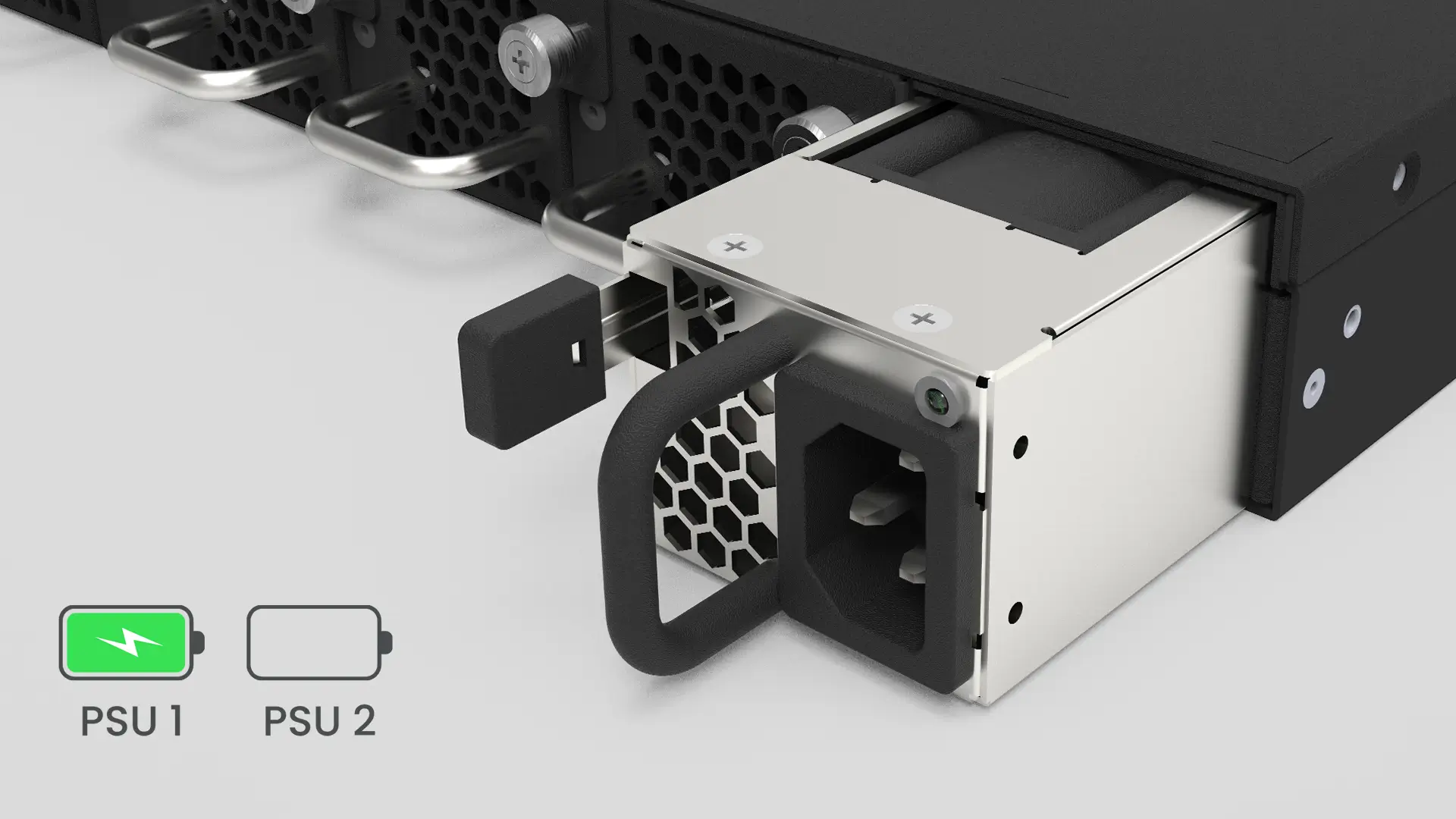
The dual 1+1 hot-swappable power supplies ensure continuous operation by allowing replacement without system shutdown.
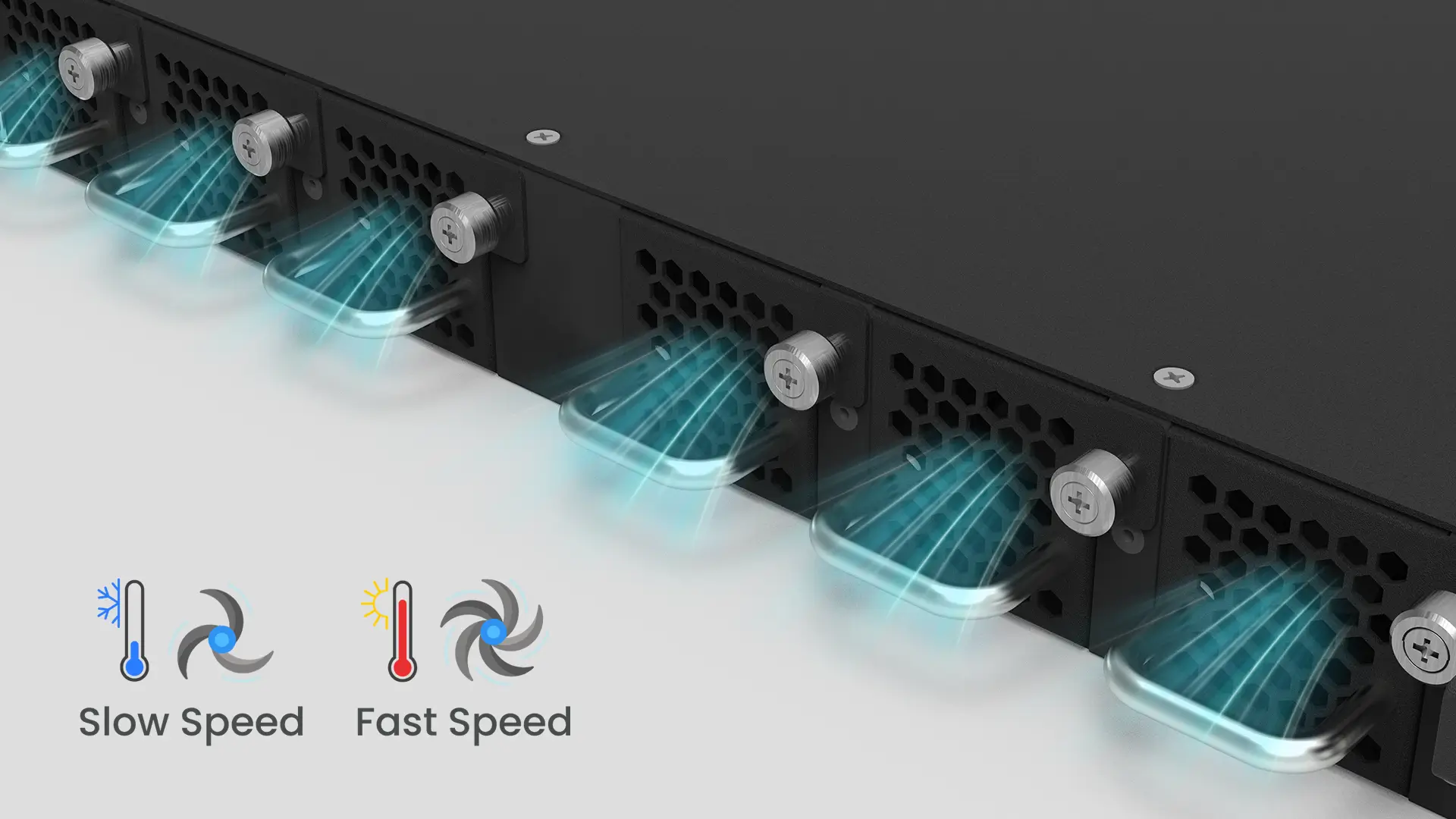
Equipped with 5+1 hot-swappable fan modules, the system delivers reliable cooling performance, maintaining stability and efficiency under demanding workloads.
| CERTIFICATE |  ISO 9001 ISO 9001 |  ISO 14001 ISO 14001 |  ISO 45001 ISO 45001 |  ISO 27001 ISO 27001 |  FCC FCC |  CE CE |
| SCOPE | Quality management system | Environmental management | Occupational health and safety | Information security management | US radio frequency compliance | EU health, safety and environmental compliance |