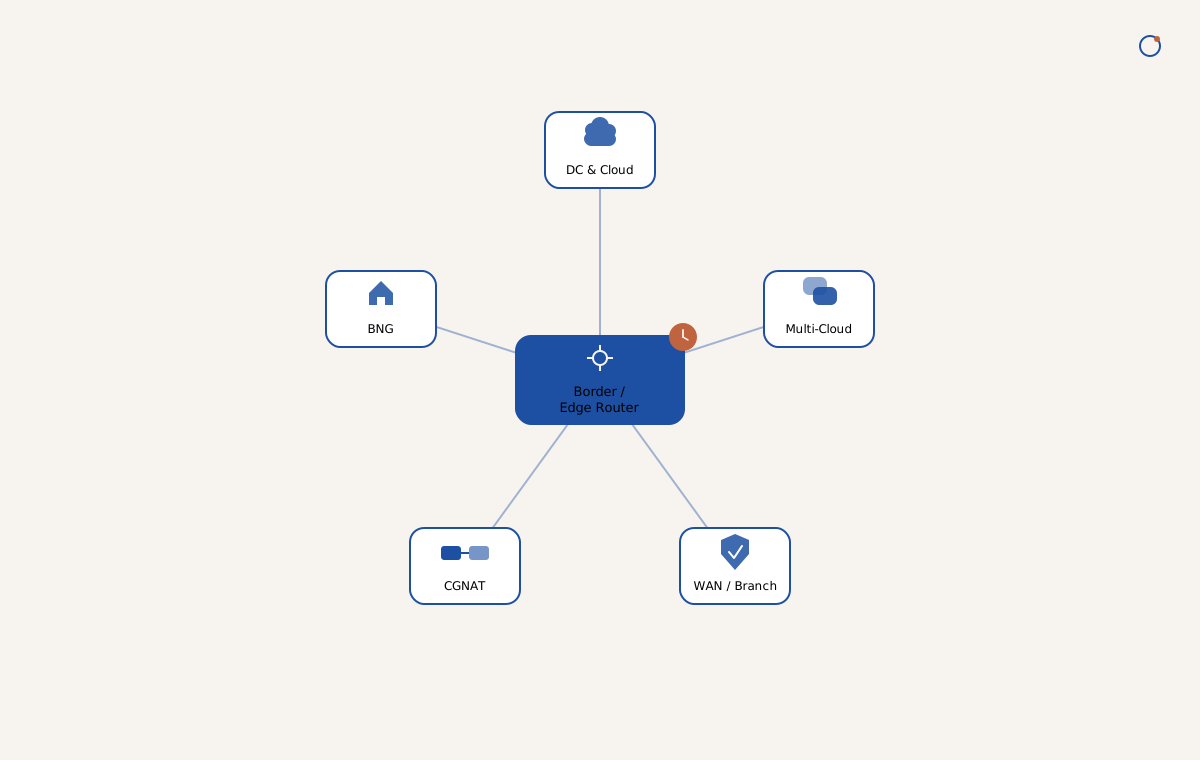

In our previous article, we explored the evolving role of Edge Routers and Border Routers, as well as five core deployment scenarios for Border Routers: DC & Cloud Border Router, Enterprise Multi-Cloud Border, Secure Multi-Branch/WAN Hub, CGNAT, and BNG.
Although these scenarios serve different environments, they share one common characteristic: the modern network edge is becoming a critical convergence point for increasingly distributed systems.
As traditional challenges such as throughput, routing scale, network segmentation, and traffic policies are increasingly addressed, a new question emerges:
What happens when distributed systems need not only to communicate, but also to operate according to the same clock? This is where PTP (Precision Time Protocol) comes into play.
Why Do Edge Routers Need to Support PTP?
The core mission of a traditional Edge Router is routing, network connectivity, and perimeter security, while time synchronization is typically handled by NTP, which is sufficient for everyday applications such as office networking, web access, and file transfers. However, as networks increasingly connect distributed, low-latency, and time-sensitive applications—such as broadcasting and live streaming, 5G private networks, industrial automation, financial trading, and data center interconnects—millisecond-level software-based time synchronization is no longer enough.
NTP synchronization accuracy can be affected by operating system scheduling, CPU load, network latency, packet queuing, and jitter. PTP (Precision Time Protocol), by leveraging mechanisms such as hardware timestamping, can provide nanosecond-level time synchronization.
As a result, modern Edge Routers need to answer not only “Where should the packet go?”, but also “When did the packet arrive?”
The Edge Router is evolving from traditional Routing + Security to Routing + Security + Precision Timing—connecting different networks while also participating in and distributing precise time, rather than becoming a “clock black hole” at the network boundary.
By natively supporting IEEE 1588v2 PTP, an Edge Router can enable network connectivity, service delivery, and precision time synchronization to work together on a single platform.
Which Edge Router Scenarios Urgently Require High-Precision Timing?
1. 5G Private Networks & Telecom Edge
5G TDD requires extremely tight phase synchronization between base stations (RU/DU), with an error typically kept within 100 nanoseconds. Otherwise, severe inter-cell interference and call drops can occur.
Router Role: Edge Routers at enterprise network exits must support the transport and termination of carrier-grade timing profiles across the WAN, ensuring stable cellular network operation. Support for ITU-T G.8275.1 / G.8275.2 allows the router to act as a Boundary Clock (BC) and transparently distribute nanosecond-level timing between the fronthaul/backhaul and aggregation layers, potentially reducing the need for costly standalone GPS-based timing infrastructure.
2. Broadcast & Professional AV over IP
In SMPTE ST 2110 IP-based production environments, uncompressed 4K/8K video and multi-channel audio streams are transported over IP networks. Any clock drift can result in audio/video synchronization issues, video tearing, or audio glitches.
Router Role: Edge Routers help maintain precise synchronization across studios, outside broadcast vehicles, and production centers, enabling seamless switching at precisely aligned sampling points. Native support for SMPTE 2059-2 and AES67 enables sample-accurate synchronization across production facilities and studio edges.
3. FinTech & High-Frequency Trading
High-frequency trading (HFT) and distributed matching systems are often deployed across geographically dispersed locations. Financial regulations, including EU MiFID II and U.S. SEC Rule 613, impose strict requirements on the accuracy of event timestamps to ensure transaction ordering, traceability, and regulatory compliance.
Router Role: An Edge Router can apply hardware timestamps at the physical port as packets enter the network, providing highly accurate and traceable timing for geographically distributed trading events.
4. Data Center Interconnection (DCI)
Core Challenge: Distributed databases, storage systems, and cross-cluster AI training across multiple data centers—particularly in Active-Active or multi-active architectures—depend on strict temporal consistency to maintain system coordination and reduce synchronization and locking overhead.
Router Role: Edge Routers connected through DWDM or Dark Fiber can run PTP to compensate for timing variations across wide-area links, providing distributed systems across multiple data centers with a globally synchronized timing domain.
How Does PTP Work in an Edge Router?
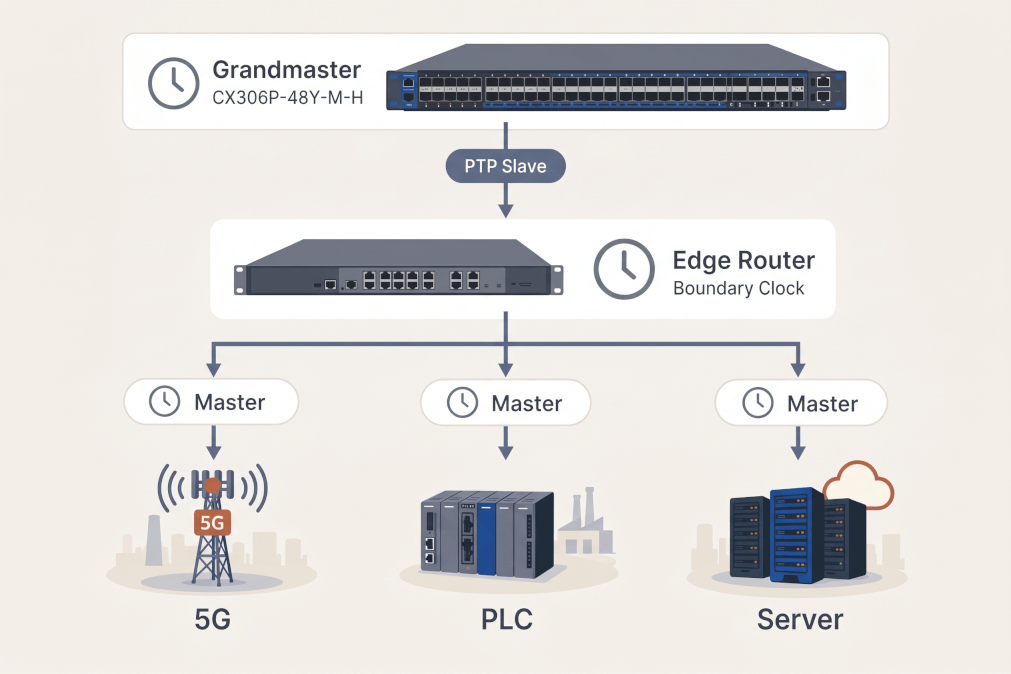 In a PTP-enabled network, time synchronization is not simply a matter of “sending a timestamp packet from Device A to Device B.” Instead, PTP relies on different Clock roles working together to establish a deterministic timing hierarchy across heterogeneous devices.
A typical end-to-end timing architecture consists of:
Grandmaster Clock (GM): The reference time source for the entire network, typically connected to GNSS/GPS to obtain an absolute time reference.
Edge Router: Positioned at the network boundary, the Edge Router receives high-precision timing from the upstream network, locks its local clock to that reference, and then distributes the synchronized timing to downstream devices.
In a typical enterprise or campus network, the Edge Router connects upstream to the carrier network or data center and downstream to internal switches, 5G base stations, industrial control equipment, or edge servers. With PTP enabled, the Edge Router does more than route large volumes of traffic and enforce network security—it also becomes an active participant in the network-wide time synchronization process.
Flexible Clock Modes: Defining the Edge Router's Role Based on Network Topology
Supporting PTP does not mean that an Edge Router is limited to a single fixed role. Its PTP functionality can natively support different Clock operating modes, allowing the router to adapt to the actual network topology and deployment requirements.
Operating as a Boundary Clock (BC) — The Primary Model for Cross-Network Boundaries
In this mode, the Edge Router acts as a timing relay and isolation hub. A Boundary Clock has multiple PTP ports: one or more ports synchronize with the upstream timing source, while other ports distribute synchronized timing to downstream devices.
The key value of a BC is its ability to terminate WAN-induced timing impairments. When the Edge Router is deployed at a network boundary, it performs two timing functions:
Upstream, as a PTP Slave: The router receives PTP messages from the Grandmaster, filters out the effects of WAN-induced delay and jitter, and synchronizes its local hardware clock.
Downstream, as a PTP Master: Using its synchronized local clock as the reference, the router generates and distributes new, low-jitter PTP timing messages to downstream switches, 5G base stations, industrial equipment, or other devices.
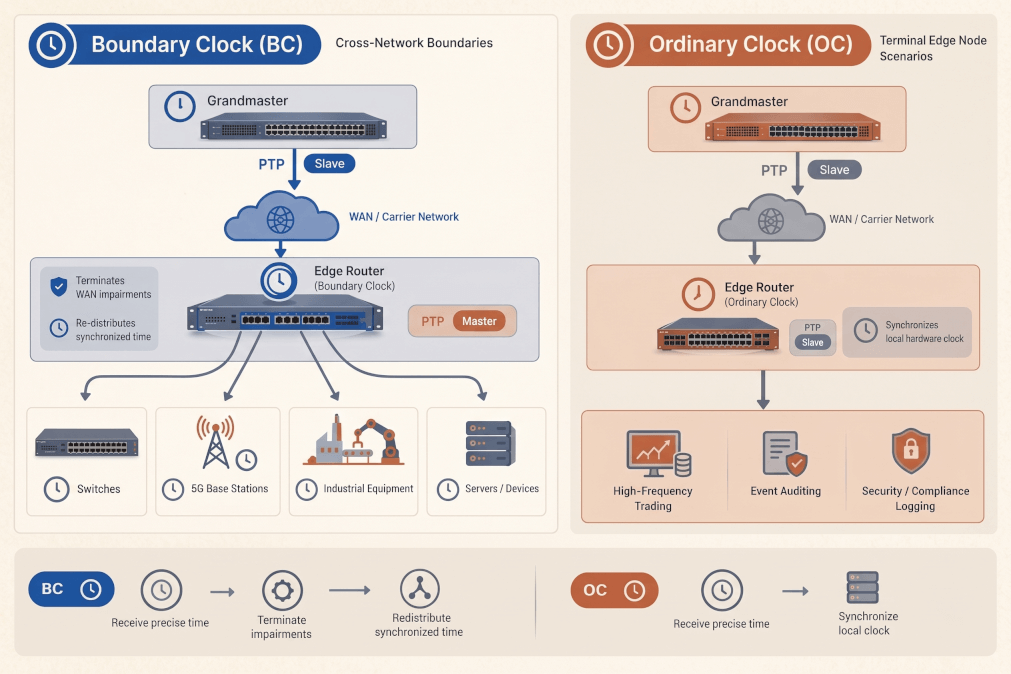 Operating as an Ordinary Clock (OC) — Terminal Edge Node Scenarios
In this mode, the Edge Router acts as a timing endpoint or local master clock, participating in PTP through a single PTP port.
Typically operating as a Slave OC, the router receives high-precision timing from the upstream network and uses it to synchronize its own hardware clock. This provides an accurate, hardware-level nanosecond timing reference for applications such as high-frequency trading, event auditing, and security/compliance logging.
In simple terms:
BC: Receives precise time, terminates timing impairments, and redistributes synchronized time.
OC: Receives precise time and synchronizes itself.
Hardware-Level PTP Synchronization in an Edge Router
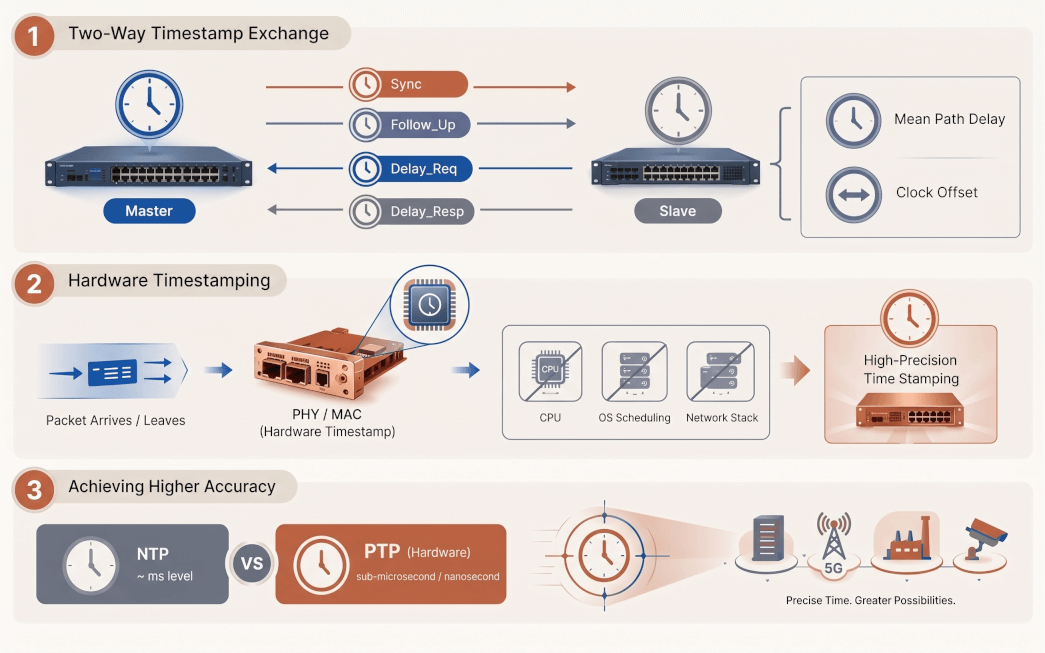 The core of PTP lies in its two-way timestamp exchange mechanism. The Master and Slave periodically exchange Sync, Follow_Up, Delay_Req, and Delay_Resp messages to accurately calculate the Mean Path Delay and Clock Offset between the two clocks.
For an Edge Router with hardware timestamping, timestamps are generated directly at the PHY/MAC hardware level as packets enter or leave the network interface. This largely bypasses operating-system scheduling, CPU load fluctuations, and software network-stack queuing delays.
As a result, hardware-based PTP can achieve sub-microsecond and, in optimized implementations, nanosecond-level synchronization accuracy, far beyond what traditional NTP can typically provide.
What Is the Fundamental Difference Between a PTP Edge Router and a PTP Switch?
Many network engineers may ask: “If modern switches can also support PTP, why do we need PTP support on Edge Routers?”
The answer is clearly not that “routers are better at time synchronization than switches.” In fact, many modern switches are equally capable of handling PTP traffic.
The fundamental difference lies in where they are positioned in the network and the responsibilities they perform.
PTP Switches are typically deployed at the access, aggregation, or data center layer. Their primary role is to provide high-speed Layer 2/Layer 3 forwarding within a relatively controlled, low-latency LAN environment, while using Transparent Clock (TC) or Boundary Clock (BC) functions for localized time distribution.
By contrast, a PTP Edge Router—focused on cross-network connectivity, complex service delivery, and timing reconstruction at network boundaries—is deployed at critical convergence points such as enterprise exits, WAN boundaries, 5G backhaul networks, and multi-cloud/DCI interconnections.
Here, the router operates across different networks, autonomous systems (ASes), and administrative domains. While distributing precise timing, it must also handle multiple network functions on the same platform, including BGP/OSPF dynamic routing, MPLS/EVPN tunneling, 100G hardware-accelerated IPsec encryption, and granular HQoS policies.
In other words, a PTP Switch primarily distributes and maintains timing within a network, while a PTP Edge Router must reconstruct, preserve, and distribute precise timing across network boundaries—while simultaneously performing the routing, security, tunneling, and traffic-engineering functions required at those boundaries.
Dimension | PTP Switch | PTP Edge Router |
|---|---|---|
Typical Deployment Location | Access / Aggregation / Data Center Internal | Enterprise Edge / WAN / DCI / Carrier Edge |
Core Responsibilities | Local Switching + Timing Distribution | Cross-Domain Routing + Perimeter Security + Timing Synchronization (Routing + Security + Timing) |
Primary Connection Scope | Intra-LAN devices within a single administrative domain | Heterogeneous networks across distinct Autonomous Systems (AS) and management boundaries |
Supported PTP Clock Modes | TC (Transparent Clock) / BC | BC (Boundary Clock) / OC (Ordinary Clock) |
Core Protocol Stack | L2/L3 Switching | BGP / OSPF / EVPN-VXLAN / MPLS / IPsec / HQoS / CGNAT |
Timing Role | Low-jitter intra-LAN clock distribution | Boundary clock lock, WAN jitter termination, and cross-network time distribution |
For modern Edge Routers, supporting PTP is not simply a matter of adding another protocol feature. The real challenge is this: when a router is simultaneously handling large-scale Layer 3 routing, VPN, NAT, QoS, and other network services, how can it deliver high-precision time synchronization without affecting normal packet forwarding?
Achieving this requires close coordination between the network operating system, data plane, and underlying hardware platform. The RT Series is designed around this architecture.
How the Asteraix RT Series Delivers High-Precision PTP at the Network Edge
The RT Series is powered by Marvell OCTEON 10 CN102/CN103 DPUs and runs AsterNOS-VPP, network operating system designed for routing platforms.
AsterNOS-VPP combines a SONiC-based control plane with a DPDK-accelerated VPP forwarding plane, enabling high-performance Layer 3 routing, firewall, VPN, NAT, and other network services through VPP.
At the same time, the RT Series natively supports IEEE 1588v2 Precision Time Protocol (PTP), with an official specification of sub-microsecond timing accuracy. It supports multiple industry-standard PTP profiles, including G.8275.1, G.8275.2, SMPTE 2059-2, and AES67, as well as both Boundary Clock (BC) and Ordinary Clock (OC) roles.
How RT Series Achieves Nanosecond-Level PTP
For an Edge Router, high-precision time synchronization cannot simply rely on a software stack running on a general-purpose CPU. When the device simultaneously handles large-scale routing, VPN, security policies, and high-speed packet forwarding, factors such as CPU scheduling, system load, and packet queuing can affect synchronization accuracy. Achieving nanosecond-level PTP therefore requires coordinated design across the network operating system, data plane, and hardware timestamping layer.
The RT Series is powered by Marvell OCTEON 10 CN102/CN103 DPUs and runs AsterNOS-VPP, which combines a SONiC-based control plane with a high-performance DPDK/VPP data plane. This architecture enables large-scale Layer 3 routing, VPN, NAT, QoS, and other network services while supporting hardware-assisted PTP.
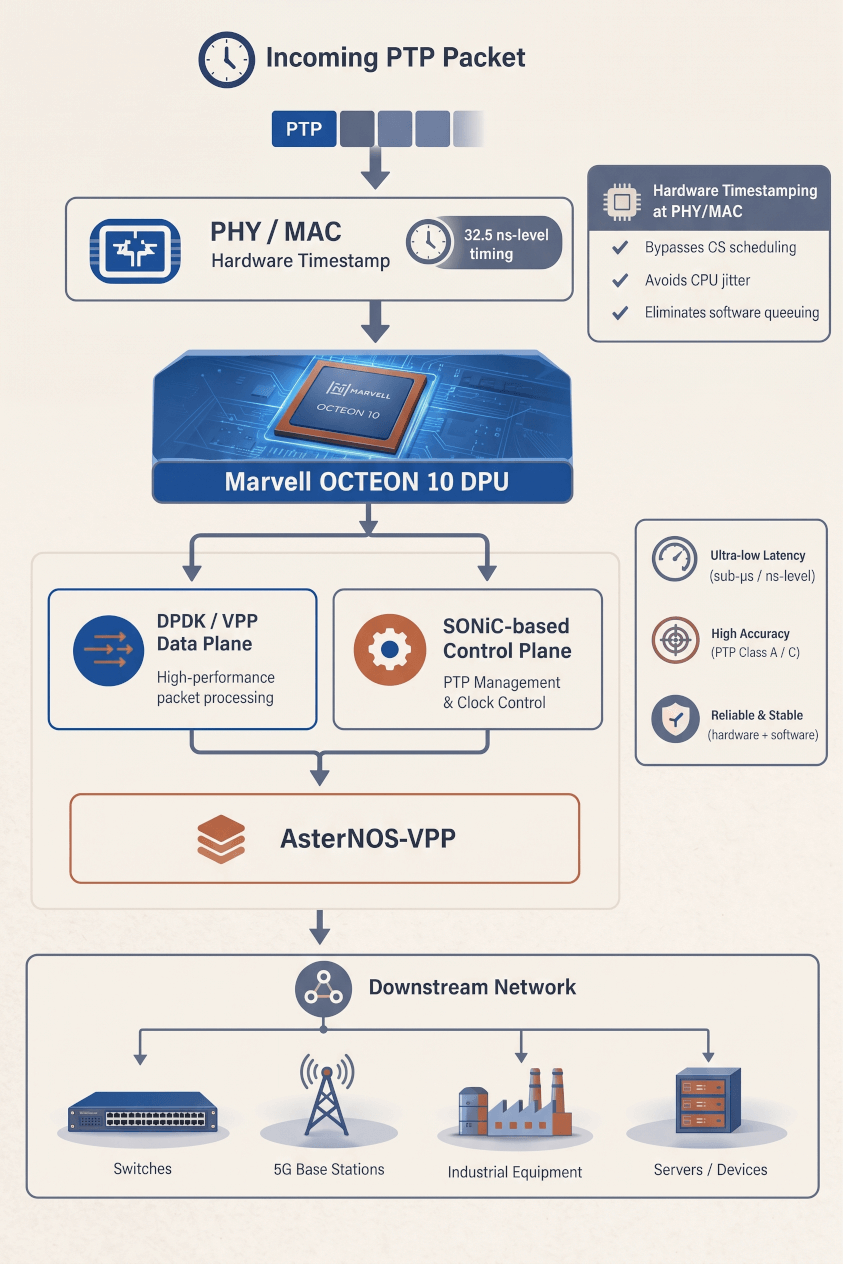 During PTP operation, high-precision timestamps are generated at the hardware level, reducing the impact of OS scheduling, CPU load, and packet queuing on synchronization accuracy. The OCTEON 10 DPU provides high-performance packet processing, while AsterNOS-VPP manages network control, routing, and PTP states and policies. Based on this hardware-assisted architecture, the RT Series can achieve approximately 32.5 ns-level PTP synchronization accuracy, making PTP an integral part of the Edge Router's packet-processing architecture rather than simply a software-based function.
In simple terms:Hardware provides the precision.The DPU provides the performance.AsterNOS-VPP provides the control.This architecture enables the RT Series to combine high-performance routing and nanosecond-level time synchronization within a single Edge Router platform.
Multiple PTP Profiles and Clock Roles
Modern networks have different timing requirements.
Enterprise networks, 5G networks, and professional audio/video networks may use completely different PTP profiles. A truly multi-purpose Edge Router therefore needs to support not only IEEE 1588v2, but also industry-specific timing standards.
The RT Series supports:
IEEE 1588v2 — General-purpose high-precision network time synchronization
ITU-T G.8275.1 / G.8275.2 — PTP profiles for telecom networks
SMPTE 2059-2 — IP-based professional broadcast and media networks
AES67 — Professional IP audio networks
The RT Series also supports both Boundary Clock (BC) and Ordinary Clock (OC) roles.
As a result, it can operate as a Boundary Clock at a network boundary, receiving timing from an upstream Grandmaster and distributing synchronized timing to downstream devices. It can also operate as an Ordinary Clock, directly synchronizing its local clock to an upstream timing source.
In networks that require frequency synchronization, PTP can also work alongside technologies such as SyncE, enabling networks to meet requirements for frequency, phase, and time synchronization.
Precision Timing Without Sacrificing Routing Performance
For an enterprise Edge Router, supporting PTP should not come at the expense of its core routing and security capabilities.
On the contrary, a truly valuable PTP Edge Router must continue to handle large-scale network services while delivering precise time synchronization. This is another key advantage of the RT Series.
Million-Scale Routing Capacity
Based on AsterNOS-VPP, the RT Series provides large-scale IPv4/IPv6 routing capabilities:
16 GB memory: Up to 1.2 million IPv4/IPv6 routing table entries
32 GB memory: Up to 4 million routing table entries
This enables the platform to handle routing tasks across enterprise WANs, Internet Edge, and Data Center Interconnect (DCI) environments, while also supporting deployments that require large BGP routing tables and multi-tenant network architectures.
Hardware-Accelerated Network Security
For network security, the OCTEON 10 DPU provides hardware-accelerated cryptographic capabilities, enabling the RT Series to deliver high-performance packet forwarding while running security services such as IPsec and WireGuard VPN.
According to the RT Series product specifications, the platform supports 50 Gbps–200 Gbps of IPsec/WireGuard encrypted throughput, depending on the model.
This means the RT Series is not simply a “PTP Router.”
Instead, it integrates:large-scalerouting,hardware-accelerated security and precision timing into a single open Edge Router platform.
From Connectivity Gateway to Timing Gateway
Traditional Edge Routers primarily answer one question: Where should the packet go? But as 5G, industrial automation, professional IP video, data center interconnection, and other time-sensitive applications continue to evolve, the network edge needs to answer another question:What time should the network operate on?
The RT Series, through the combination of AsterNOS-VPP + Marvell OCTEON 10 DPU + IEEE 1588v2 PTP, addresses both questions on a single platform.
This represents the evolution of the next-generation Edge Router from a simple Connectivity Gateway toward a: High-Performance Routing +Hardware-Assisted Security + Nanosecond-Level Timing Gateway.