1. Introduction: Beyond Basic Packet Forwarding
When evaluating enterprise or data center switches, many network engineers rely on simple datasheets listing port density and line rate. In modern AI compute clusters, high-frequency trading (HFT) and distributed storage fabrics (NVMe-oF), raw line rate is only part of the equation.
A switch that performs adequately under uniform, low-bandwidth web traffic can become a severe bottleneck when subjected to AllReduce collective communication, ECMP hash collisions or microburst congestion.
This guide breaks down how to analyze network switch performance across seven critical metrics. It uses specifications from modern high-radix switches, such as the AI RoCE fabric switches, to show what each number means for fabric behavior.
2. The 7 Critical Switch Performance Metrics
2.1 Switching Capacity (Tbps / Gbps)
Switching capacity (or backplane bandwidth) measures the total amount of data the switch’s internal switching matrix can process per second. In the figures used in this guide, capacity is counted in one direction: the sum of all port speeds. Some vendors double the figure to count both directions, so always confirm the basis before comparing products.
Formula: Switching Capacity = Total Ports × Port Speed (one direction) Example: 128 × 800G = 102.4 Tbps |
• 800G high-radix spine: the CX864E-N offers 51.2 Tbps of switching capacity through 64 × 800G ports, and it supports up to 512 × 100G ports. Because the capacity equals the combined speed of all ports, the fabric can carry every port at full rate.
• 400G, 200G and 100G tiers: the CX732Q-N (32 × 400G) and CX664D-N (64 × 200G) each offer 12.8 Tbps, the CX564P-N (64 × 100G) offers 6.4 Tbps and the CX532P-N (32 × 100G) offers 3.2 Tbps. These give leaf and aggregation layers a bandwidth fan-out that can be designed without oversubscription.
2.2 Forwarding Rate (PPS / Mpps / Bpps)
Switching capacity measures bit volume. Forwarding rate, measured in packets per second, shows how many packet headers the switch ASIC pipeline can process each second.
The industry benchmark for line-rate forwarding uses the smallest Ethernet frame (64 bytes) plus 20 bytes of physical-layer overhead (8-byte preamble and 12-byte interframe gap), 84 bytes in total:
Line-rate calculation: Line-rate PPS per 1G port = 1,000,000,000 bps ÷ (84 bytes × 8 bits/byte) ≈ 1,488,095 pps (1.488 Mpps) Scaling to high-speed ports: 100G ≈ 148.8 Mpps; 400G ≈ 595.2 Mpps; 800G ≈ 1.19 Bpps |
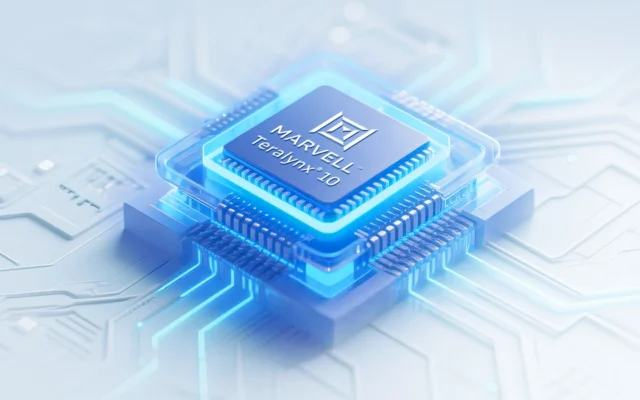
Forwarding rates: the CX864E-N, built on the Marvell Teralynx 10 ASIC, has a forwarding rate of 28,800 Mpps (28.8 Bpps). The Teralynx 7 based CX732Q-N, CX664D-N and CX564P-N have 7,600 Mpps, and the CX532P-N has 6,300 Mpps.
To read a forwarding-rate figure, compare it with the 64-byte line-rate PPS of the full port count. If the stated rate is lower than that figure, the switch reaches full line rate from a larger average packet size onward, so check the number against your own packet-size mix.
2.3 Port-to-Port Latency and Forwarding Mode
Latency is the time between a packet entering an ingress port and leaving an egress port. Switches operate in two primary modes:
• Store-and-forward: the switch buffers the entire frame, verifies the Frame Check Sequence (FCS) for CRC errors and then forwards it. Latency varies with packet size.
• Cut-through: the switch inspects only the destination MAC/IP header and starts forwarding the payload before the entire packet has arrived. Latency stays constant regardless of packet size.
Cut-through forwarding: ingress packet → header lookup → egress begins (no waiting for the full payload) |
Latency in AI workloads: in distributed AI training (Megatron-LM, DeepSpeed), synchronization barriers such as AllReduce wait for the slowest participant. The CX864E-N has a cut-through latency of approximately 560 ns, while the CX732Q-N, CX664D-N, CX564P-N and CX532P-N have approximately 500 ns.
Port-to-port latency sets the floor. Tail latency in a real fabric is shaped mostly by congestion and hash collisions, which is why the buffer, lossless transport and load-balancing metrics below matter as much as the base figure.
2.4 Packet Buffer Size and Dynamic Queueing
Packet buffer size is one of the most important and most overlooked metrics in loss-sensitive networks (RoCEv2, NVMe-oF). When several ingress ports send traffic to a single egress port at the same time (incast), the switch relies on its packet buffer to absorb the temporary microburst.
• Shallow buffer pitfall: insufficient buffer space causes packet drops during microbursts, which triggers TCP retransmissions or PFC (Priority Flow Control) pause frames in RoCEv2 fabrics.
• On-chip shared buffer: the CX864E-N has 200+ MB of packet buffer, and the CX732Q-N, CX664D-N, CX564P-N and CX532P-N have 70 MB. A larger buffer gives the switch more room to absorb microbursts, and the actual result depends on the traffic pattern and buffer configuration.
Because the buffer is shared across ports and queues, look at how it is partitioned and which thresholds the network operating system exposes, not only at the headline figure in megabytes.
2.5 MAC Address, ARP and Route Table Capacity
A switch maintains hardware forwarding tables (TCAM/SRAM) to map the network topology. Insufficient table capacity forces the switch to flood unknown unicast traffic or drop routes. Key parameters to check in the datasheet:
• MAC address table size: crucial for Layer 2 fabrics.
• L3 host and longest-prefix-match (LPM) tables: vital for BGP-EVPN overlays that carry IPv4/IPv6 host routes and prefixes.
• VLAN and VXLAN tunnel endpoints (VTEPs): enable multi-tenant isolation across cloud data centers.
2.6 Lossless Transport: PFC, ECN and Buffer Watermarks
In traditional Ethernet, packet loss is tolerated. In AI and storage fabrics running RoCEv2, packet loss can sharply reduce GPU Model FLOPs Utilization (MFU). Evaluating a switch means checking its hardware-level lossless features:
• PFC (Priority Flow Control, IEEE 802.1Qbb): sends pause frames per CoS queue to prevent buffer overflow.
• ECN (Explicit Congestion Notification): marks IP headers at configured buffer thresholds (Kmin / Kmax) to signal senders (SmartNICs) to slow down before PFC triggers.
• Hardware DLB / adaptive routing: dynamically spreads elephant flows across ECMP paths to prevent single-link hash collisions.
Check the datasheet and the network operating system release notes to see which of these features the exact model supports.
2.7 Visibility and Hardware Telemetry (Beyond Legacy SNMP)
Traditional SNMP polling, typically every 30 to 60 seconds, cannot see microburst congestion that lasts only a few microseconds. SNMP remains useful for configuration queries and low-frequency polling, but modern fabric analysis needs hardware-level visibility, where supported:
• gNMI / gRPC streaming telemetry: streams interface counters and CPU metrics in near real time.
• In-band Network Telemetry (INT) and Mirror on Drop (MOD): capture buffer queue depth during microbursts and export metadata about dropped packets.
3. Summary: Benchmark Performance Matrix (AI RoCE Series)
Specifications of the Asterfusion CX-N Series models covered in this guide. Switching capacity is shown in one direction (ports × port speed).
Metric | |||||
Port configuration | 64 × 800G OSFP, 2 × 10G SFP+ | 32 × 400G QSFP-DD, 2 × 10G SFP+ | 64 × 200G QSFP56, 2 × 10G SFP+ | 64 × 100G QSFP28, 2 × 10G SFP+ | 32 × 100G QSFP28, 2 × 10G SFP+ |
Switching capacity | 51.2 Tbps | 12.8 Tbps | 12.8 Tbps | 6.4 Tbps | 3.2 Tbps |
Forwarding rate | 28,800 Mpps | 7,600 Mpps | 7,600 Mpps | 7,600 Mpps | 6,300 Mpps |
Cut-through latency | ~560 ns | ~500 ns | ~500 ns | ~500 ns | ~500 ns |
Packet buffer | 200+ MB | 70 MB | 70 MB | 70 MB | 70 MB |
Switching ASIC (Marvell) | Teralynx 10 | Teralynx 7 | Teralynx 7 | Teralynx 7 | Teralynx 7 |
4. Conclusion
Analyzing network switch performance requires moving beyond simple port counts. By evaluating switching capacity, line-rate PPS, cut-through latency, packet buffering, lossless features and hardware telemetry, architects can design resilient network fabrics for demanding AI, cloud and enterprise workloads.