
Nearly every difference between single-mode and multimode fiber traces back to one structural fact: core diameter. This one difference determines how light travels through the core, which in turn determines transmission distance, available bandwidth, light source type, and equipment cost. This guide first explains that chain of cause and effect, then lays out the criteria for choosing between the two.
1. Why Core Diameter Is the Root Difference
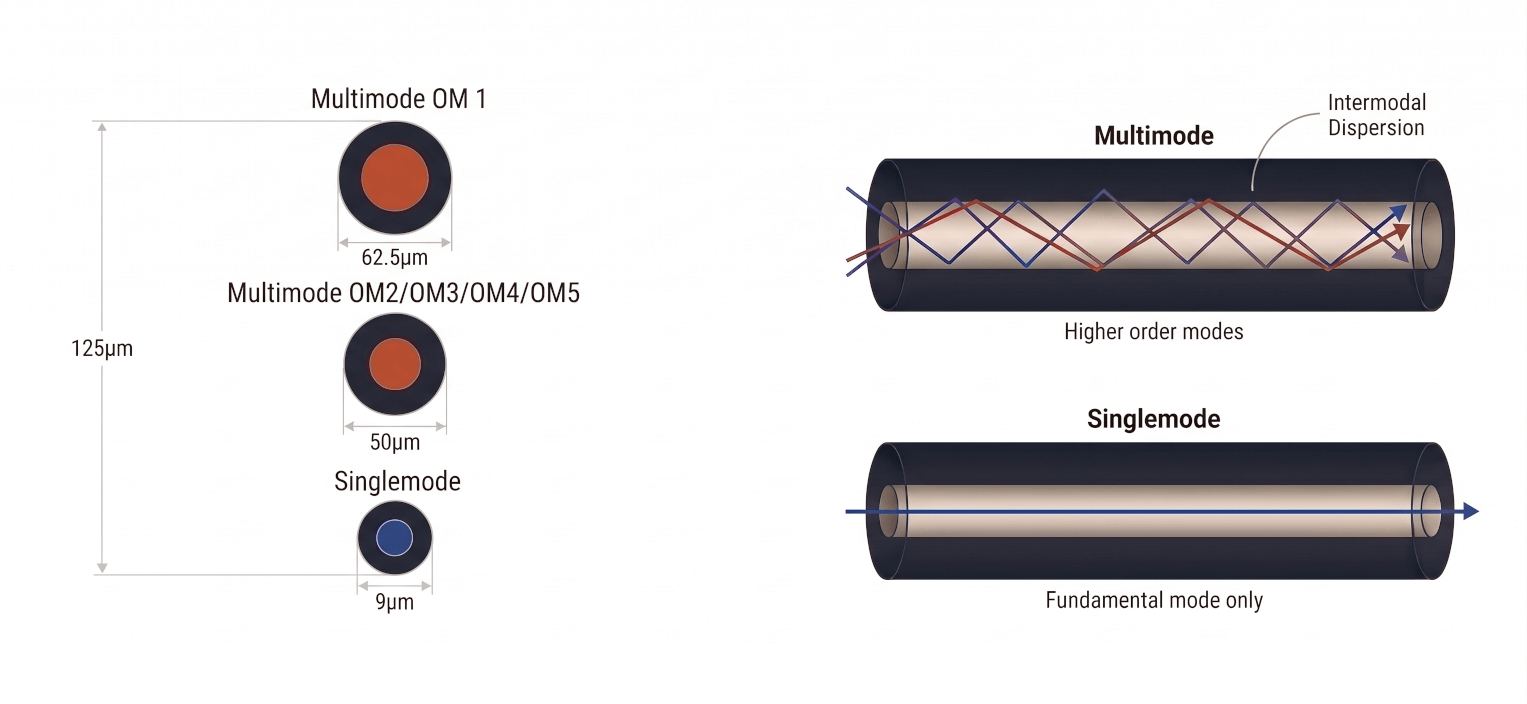
Single-mode fiber has a core diameter of about 8-10 microns, narrow enough to support only one propagation path (mode) of light. Multimode fiber has a core diameter of 50 or 62.5 microns, wide enough for light to travel along multiple paths at once. Both types share the same 125-micron cladding diameter; the difference is confined to the core.
These multiple paths are not equal in length, so light traveling along different paths arrives at the far end at slightly different times. This effect is called modal dispersion. Over longer distances, the gap between arrival times grows, causing the signal to blur and overlap, which limits multimode fiber's effective transmission distance and maximum usable bandwidth. Single-mode fiber has only one propagation path, so this limitation does not apply, allowing it to maintain a clear signal over tens of kilometers or more.
This can be summarized as a chain:
core diameter → number of propagation modes → degree of modal dispersion → transmission distance and bandwidth ceiling.
The distance and bandwidth differences discussed later all stem from this mechanism rather than being independent parameters.
Multimode fiber is further divided into grades — OM1 through OM5 — based on core specification and supported bandwidth. Higher grades generally support higher speeds and longer distances, but remain subject to the same modal dispersion mechanism and cannot match the reach of single-mode fiber.
2. Downstream Effects of the Core Difference
2.1 Light source
Single-mode fiber's narrow core requires a light source with a small, well-directed beam to couple efficiently into the core, which is why lasers are used, typically at 1310 nm or 1550 nm. Multimode fiber's wider core is more tolerant of beam divergence, so it commonly uses 850 nm VCSELs; some legacy links still use 1300 nm wavelengths and LED sources.
2.2 Equipment cost
The price gap between single-mode and multimode cable itself has narrowed considerably. The real cost difference lies in the transceivers — single-mode modules require more precise lasers and tighter alignment, making them more expensive than multimode modules of the same speed. Multimode modules also tend to draw less power than single-mode ones; in data centers with hundreds or thousands of links, this power difference adds up to a meaningful amount of power and cooling cost.
2.3 Installation difficulty
The narrower the core, the less room there is for alignment error. This is why installing and maintaining single-mode fiber typically requires more experienced technicians, while multimode fiber's wider core allows for looser alignment tolerances, lowering the skill threshold for both installation and later maintenance.
2.4 Visual identification
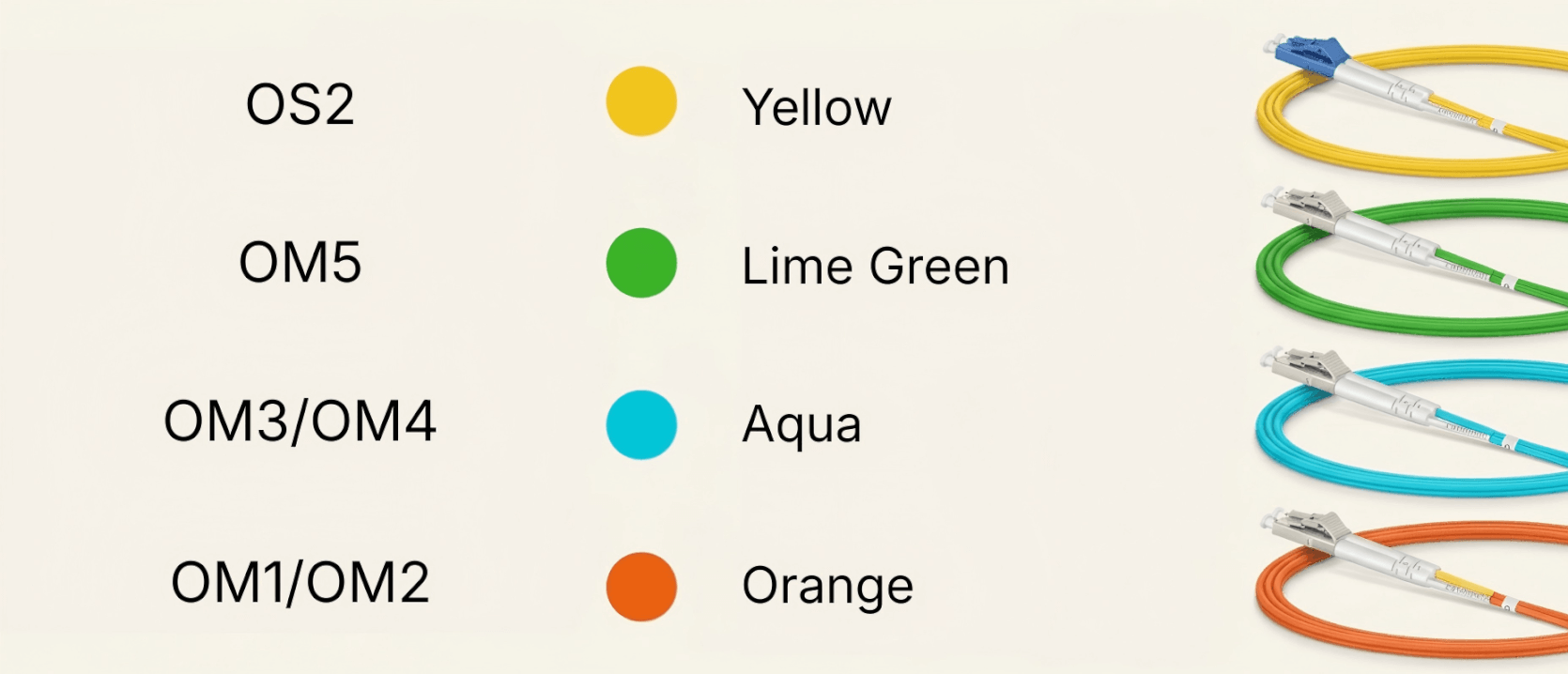
As an industry convention for on-site identification, single-mode fiber jackets are typically yellow, while multimode jackets are color-coded by OM grade — orange for OM1/OM2, aqua for OM3/OM4, and lime green for OM5. This is a labeling convention, not a physical property of the fiber itself.
3. How to Decide Which One to Use
3.1 Distance First, Then Budget
Distance is the first filter. The industry's rough dividing line falls around 500-600 meters. Within that range, multimode fiber generally has a lower upfront cost and a lower operational barrier, making it the more economical choice. Beyond that range, modal dispersion degrades multimode signal quality to the point of being unusable, leaving single-mode fiber as the only option regardless of budget.
In other words, once distance exceeds the threshold, there is no longer a choice to weigh. Budget, bandwidth, and maintenance capability only become relevant trade-offs when distance falls within the threshold.
3.2 Trade-offs Within the Distance Threshold
Consideration | Favors Multimode | Favors Single-Mode |
|---|---|---|
Current bandwidth needs | Already sufficient, unlikely to grow significantly soon | Expected to require several upgrades in the coming years |
On-site maintenance capability | No dedicated fiber technicians | Stable, experienced technical team in place |
Initial budget | Limited, aiming to control upfront spend | Willing to accept higher upfront cost for long-term stability |
Scale of deployment | Large number of links, where power and cooling matter | Fewer links, where power differences have limited impact |
3.3 Deciding by Network Tier
Different tiers of a network have inherently different distance and bandwidth requirements, so selection can be organized by tier rather than by an exhaustive list of industry use cases:
Access layer / within a building: Connections from end devices to switches, or cabling within a rack, typically span under 100 meters. Multimode fiber meets these needs at lower cost.
Distribution layer / within a campus: Connections between buildings or within a single campus can range from tens to several hundred meters, requiring a judgment call based on the exact distance relative to the threshold.
Core layer / wide-area links: Connections between data centers, or across cities and regions, generally exceed multimode fiber's effective range, leaving single-mode fiber as the only viable option.
Standards bodies such as IEEE, TIA, and ISO/IEC continue to designate multimode fiber as the recommended solution for short-reach connections in new Ethernet standards, suggesting that multimode's cost advantage at the access layer — and in parts of the distribution layer — is likely to persist for some time.
4. Limitations of Each Approach
Once a choice is made, it helps to understand the limitations that come with it, so they can be planned for in advance.
Single-mode fiber's limitations center on upfront cost and technical requirements: equipment costs are higher, which can strain budgets on smaller projects; installation and troubleshooting depend on experienced technicians and specialized equipment; and if actual link distances are short, single-mode fiber's performance advantage goes unused while its higher cost remains.
Multimode fiber's limitations emerge as distance increases: modal dispersion causes signal degradation that worsens with distance and cannot be compensated for once the effective range is exceeded; its bandwidth ceiling is lower than single-mode fiber's, so unexpected growth may require replacing the link with single-mode fiber later, adding a second round of installation cost; and this distance and bandwidth ceiling also limits design flexibility when the network is later expanded.
In short, neither option is categorically "better" — each is suited to a different range of distance and scale. The starting point for selection is always the actual transmission distance and anticipated growth, with the decision following from those two factors.