
Why Timing Matters in 5G?
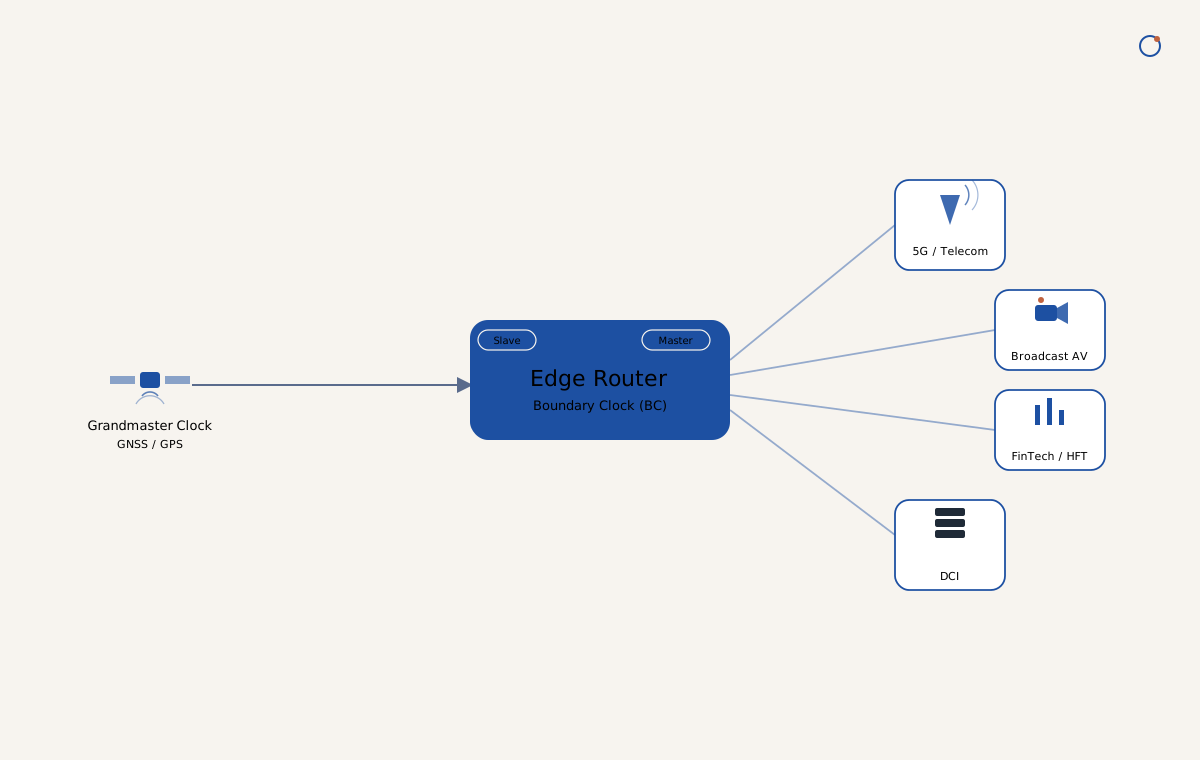
In traditional data networks, a delay of a few milliseconds in packet delivery merely causes an imperceptible lag in web page loading. In 5G wireless networks, however, time alignment precision escalates to sub-100 nanoseconds or even tens of nanoseconds (where one nanosecond is one-billionth of a second). Why are the requirements so extreme? Because core 5G technologies—such as Beamforming and TDD uplink/downlink switching—demand that multiple antenna units operate in absolute lockstep. If the timing error between antennas exceeds 100 nanoseconds, radio signals interfere with each other in midair. As a result, users may experience full signal bars alongside a drastic drop in network speed, or the base station may even trigger a protective shutdown.
5G Synchronization Challenge: How PTP + SyncE Ensure Deterministic Timing
However, Ethernet (packet networks) is naturally asynchronous: packet lengths vary, network congestion occurs unpredictably, and switch queuing processing times fluctuate. All these factors introduce unpredictable latency and Packet Delay Variation (PDV) to timing signal delivery.
To deliver deterministic time over inherently non-deterministic Ethernet cables, the industry introduced two critical protocols:
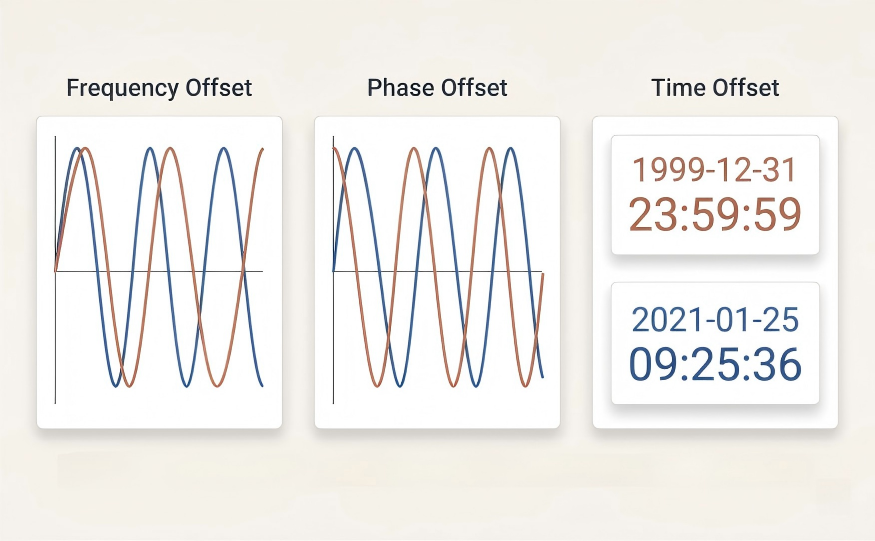
• SyncE (Synchronous Ethernet): Operates at the physical layer to synchronize frequency across the network (Frequency Synchronization).
• IEEE 1588v2 PTP (Precision Time Protocol): Operates over packet transmission to synchronize absolute time and phase across network elements (Phase and Time-of-Day [ToD] Synchronization).
In practice, PTP and SyncE are typically deployed together: SyncE provides frequency stability, while PTP provides absolute time and phase accuracy.
Open O-RAN Disaggregated Architecture: How CU / DU / RU Redefine 5G Base Stations
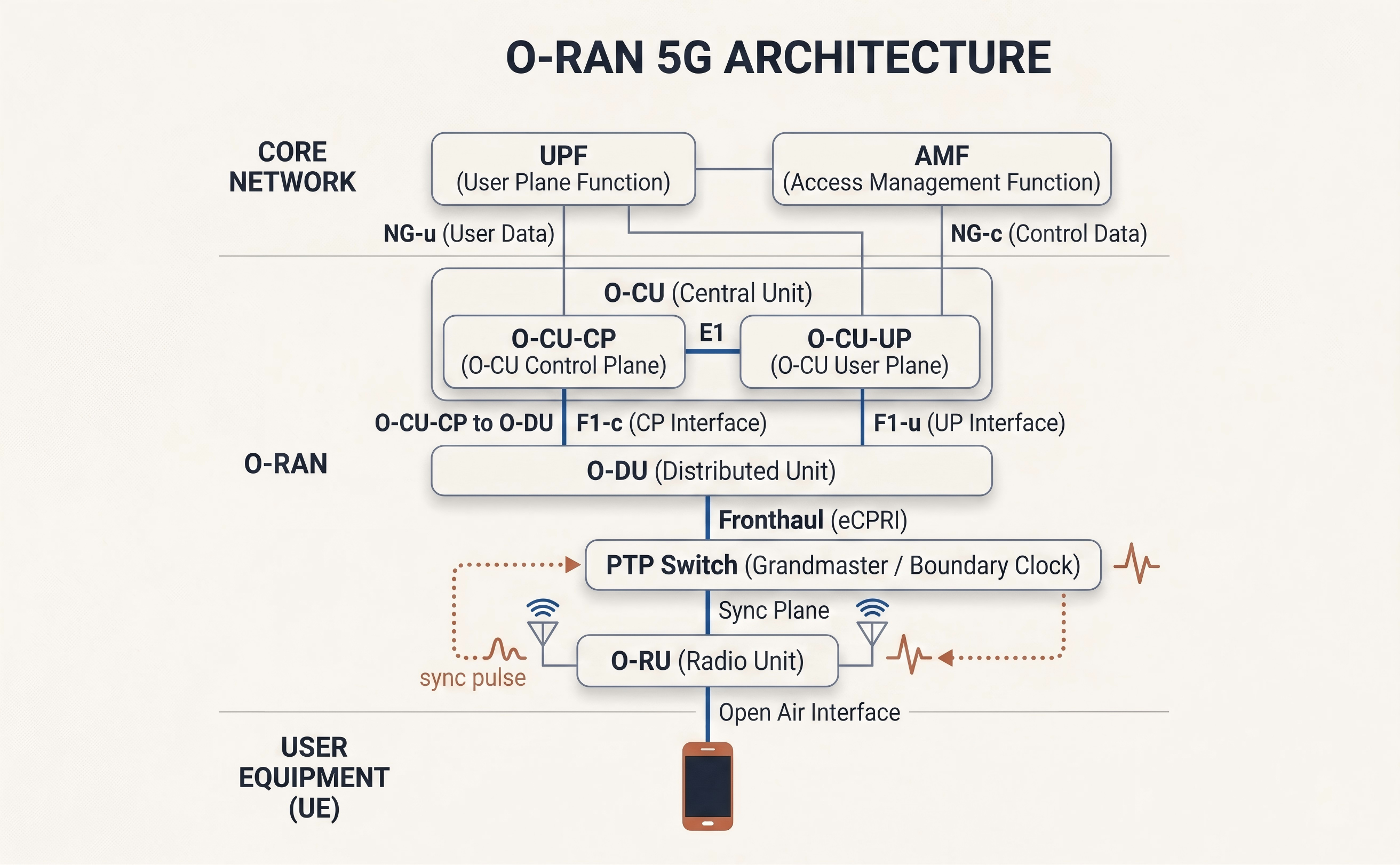
Under the O-RAN open architecture, traditional base stations are disaggregated into CUs, DUs, and RUs.
O-RAN Core Components at a Glance
Component | Role | Core Functions | Physical Deployment Location | Network Connections |
CU(Central Unit) | Network Brain | User Management, Network Policies, Mobility Control. | Core Center / Cloud Data Center Centralized deployment covering large areas to significantly reduce CapEx and OpEx. | Upstream: 5G Core (5GC)Downstream: DU (via Midhaul Network, 3GPP Split 2) |
DU(Distributed Unit) | On-site Controller | Radio Scheduling, Beamforming Calculation, MIMO Processing. | Aggregation / Edge SiteDeploys a few kilometers from antennas to satisfy sub-millisecond, real-time compute requirements. | Upstream: CU (via Midhaul)Downstream: RU (via Fronthaul Network, O-RAN Split 7.2) |
RU(Radio Unit) | Radio Transceiver | RF Transmission, Digital ↔ RF Signal Conversion. | Cell Site (Frontline)Distributed at cell towers, street poles, indoor ceilings, subways, etc. (wherever UEs/phones are). | Upstream: DU (via Fronthaul)Downstream: Mobile Devices / UEs (via RF waves) |
Architecture Advantages: This disaggregated design—“Centralized Brain, Edge Controller, Frontline Antennas”—embodies the true essence of O-RAN. It not only eliminates traditional vendor lock-in from proprietary base stations, but also provides the network with exceptional deployment agility and scalability. Meanwhile, the Fronthaul network bridging the DU and RU serves as the primary domain for PTP switches to deliver nanosecond-level precision timing and high-density power transport.
Synchronization Challenges in 5G Fronthaul
The network segment bridging the DU and RU is defined as the Fronthaul Network.
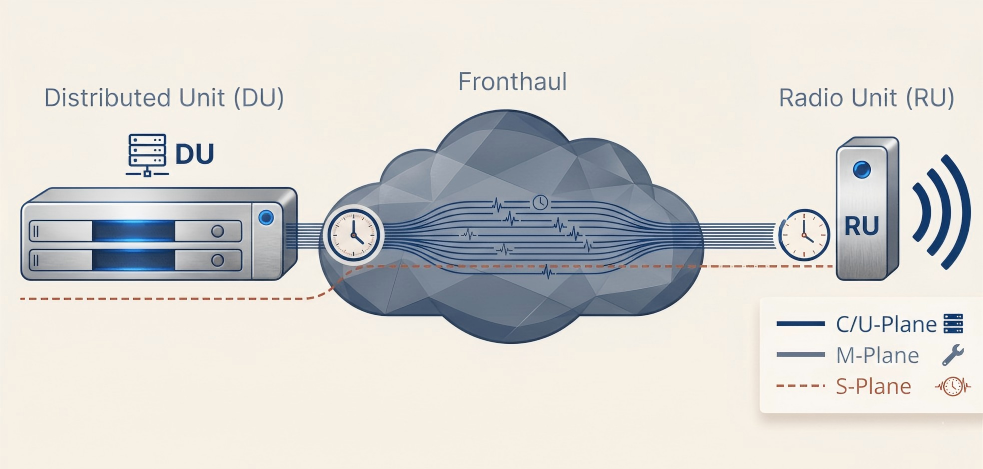
Across the transmission link connecting the DU and RU, the O-RAN Alliance formally defines four clock distribution topologies (LLS-C1 through LLS-C4):
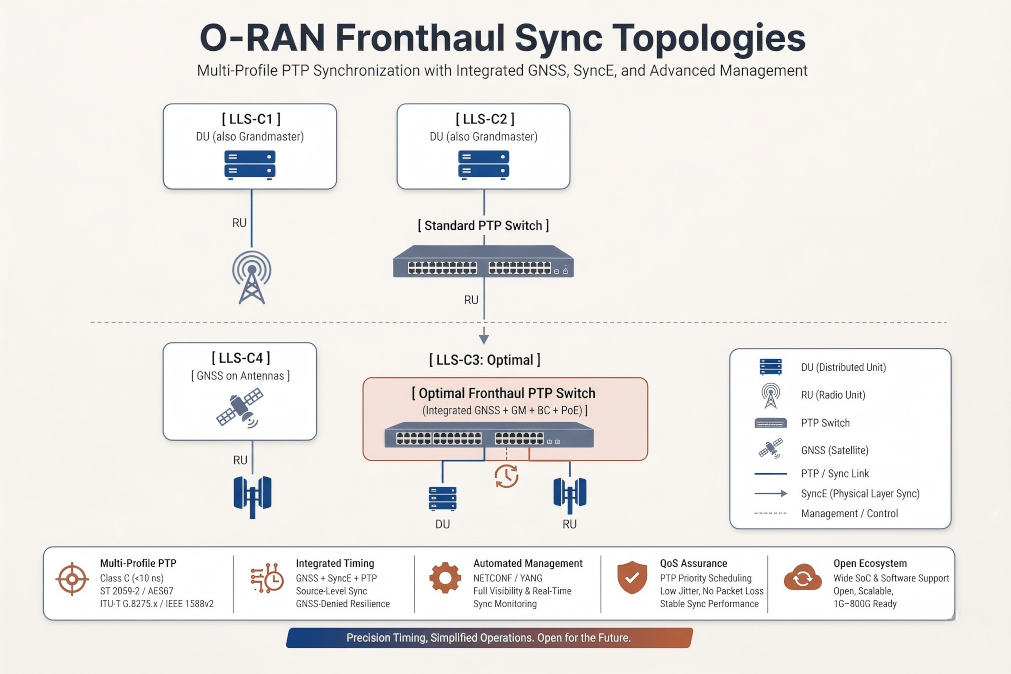
LLS-C1 (Direct DU-to-RU Connection): Straightforward but offers poor scalability, as physical ports on the DU cannot accommodate a high density of small cells.
.png)
LLS-C2 (DU as Grandmaster with Switch Forwarding): Places an excessive processing load on the DU, making timing prone to jitter if intermediate switches experience network congestion.
.png)
LLS-C3 (Centralized Fronthaul Timing — The Optimal Solution): Deploys a dedicated PTP switch with integrated Grandmaster (GM) capabilities between the DU and RU to deliver unified, high-precision clock distribution.
.png)
LLS-C4 (Local GPS per RU Antenna): Extremely cost-prohibitive and completely unviable in indoor, subterranean, or subway environments due to satellite signal loss.
.jpg)
Asteraix PTP switches for 5G O-RAN
Enabling Nanosecond-Level Precision Synchronization in Fronthaul Networks
In 5G networks based on the O-RAN Alliance architecture, the fronthaul places unprecedentedly strict demands on time synchronization. The connection between the RU and DU requires not only high-speed data transmission, but also nanosecond-level time and phase alignment to support critical technologies such as Beamforming and TDD scheduling
To address this challenge, We introduces a new generation of PTP switch solutions. By integrating GNSS, SyncE, and PTP capabilities into a single platform (CX306P-48S-M-H), it builds a high-precision, low-complexity timing network. Verified in live customer network deployments, this solution reliably meets critical 5G synchronization requirements.
All-in-One Timing Hub: Convergence of GNSS, SyncE, and PTP
Traditional 5G synchronization architectures often force a trade-off:
Direct GNSS Per-Site Scheme: Requires antenna deployment at every site, making it impractical for indoor, subway, and similar environments.
External Grandmaster Scheme: Involves numerous devices, long timing paths, high costs, and increased potential points of failure.
We adopts an all-in-one design philosophy: embedding the GNSS receiver, SyncE, and IEEE 1588v2 PTP directly into a single switch platform, delivering three core advantages:
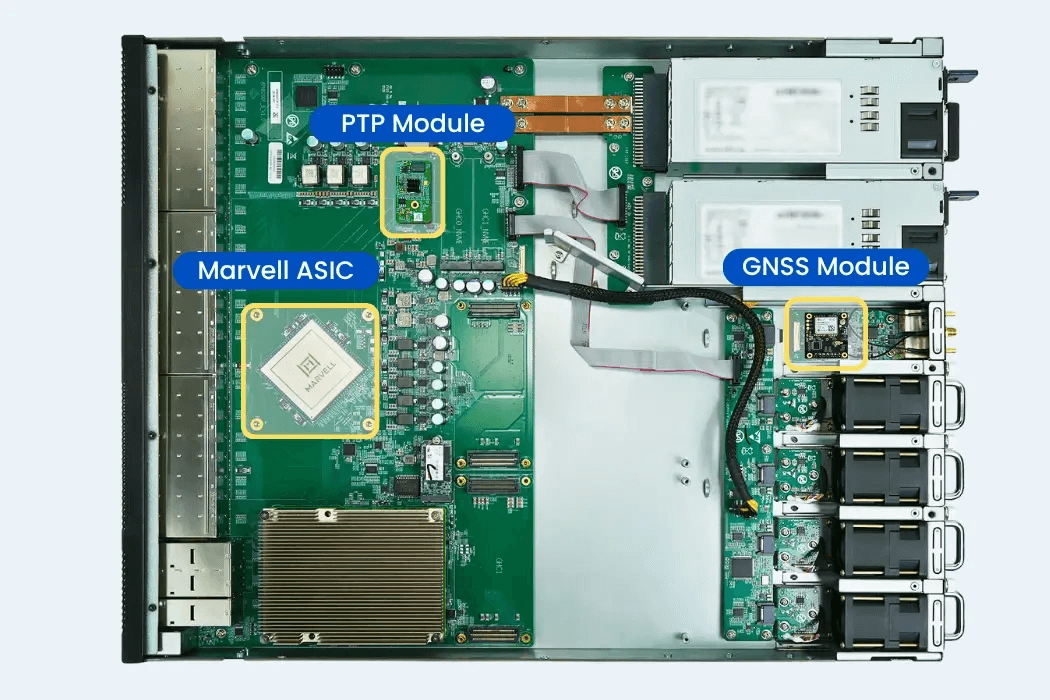
Source-Level Synchronization: Establishes a high-precision time source directly at the access layer.
Adaptability to Weak-GNSS Environments: Functions as an operational local timing hub even in areas devoid of satellite signals, such as underground malls and subways.
Simplified Architecture: Eliminates standalone SyncE devices and external clock sources, reducing deployment complexity.
Simultaneously, reducing the number of devices in the synchronization chain significantly enhances overall reliability and lowers operational risks.
Dual-Domain & Multi-Profile Support: Adapting to Complex O-RAN Deployments
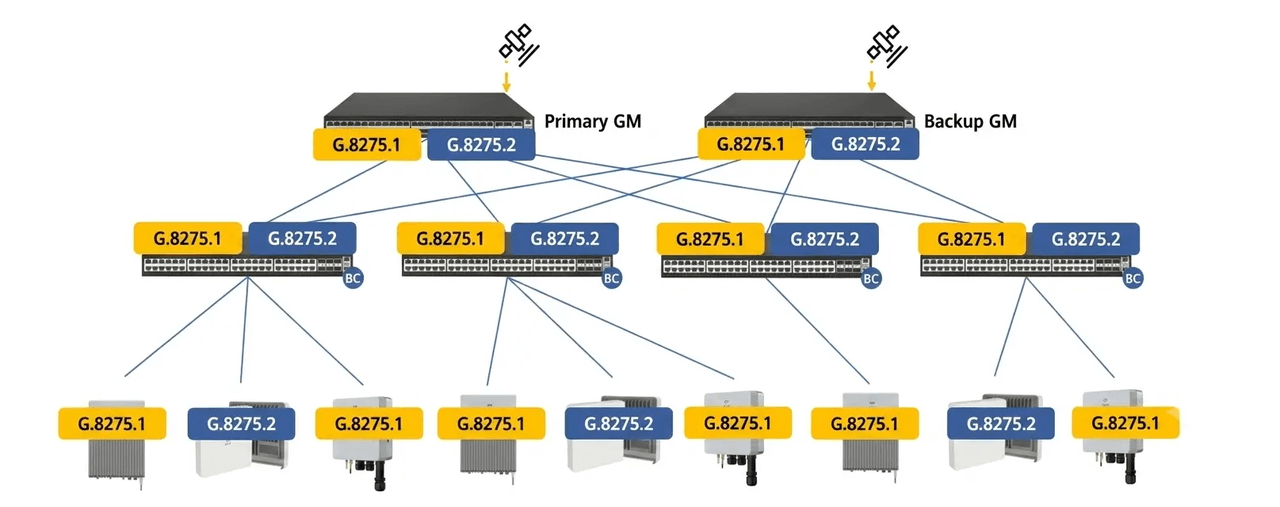
In real-world O-RAN networks, multi-vendor equipment co-deployment is standard practice, posing higher demands on synchronization systems.
Different standards serve distinct purposes:
ITU-T G.8275.1: Delivers high precision, but requires full-path time synchronization support across the network.
ITU-T G.8275.2: Offers greater flexibility, suitable for partially timing-aware network environments.
Asteraix PTP switches support:
Multiple PTP Profiles (G.8275.1 / G.8275.2, etc.)
Simultaneous Multi-Domain Operation (Dual-Domain capability)
This achieves seamless interoperability with RUs/DUs from different vendors, smoothly evolving and upgrading the network without reconstructing the existing synchronization infrastructure. This capability allows operators to flexibly deploy varied synchronization architectures within a single network, realizing true Open RAN.
Automated Operations & Global Visibility via NETCONF/YANG
In 5G networks, achieving nanosecond-level precision is just the foundation; visibility and manageability are equally crucial. Our switches support standardized management protocols:
YANG Data Models
Open APIs
These enable seamless integration with CUs, DUs, RUs, and O-RAN controllers, empowering the network with centralized configuration, monitoring, and management. Ultimately, this delivers end-to-end time synchronization visibility, enabling operators to track synchronization quality in real time via a unified control platform, quickly isolate issues, and perform optimizations.
QoS Guarantee Mechanism: Ensuring Priority for PTP Traffic
Traffic congestion is inevitable in live networks, especially during heavy loads on fronthaul links. If PTP packets contend for resources with standard data traffic, it leads to:
Increased latency jitter
Packet loss
Degradation of synchronization accuracy
Asteraix addresses this through a robust QoS mechanism featuring:
Priority scheduling for PTP traffic
Fine-grained queue management
Hardware-level forwarding guarantees
This ensures that synchronization traffic gains prioritized passage even under heavy congestion, keeping latency stable and controllable while preserving timing accuracy.
Embracing an Open Ecosystem (Enterprise SONiC + O-RAN DNA)
The fundamental value of the PTP switch extends beyond mere data forwarding: it establishes a unified, nanosecond-level time baseline between the DU and RU.
As an open network device natively aligned with O-RAN principles, the PTP switch comes pre-installed with the enterprise-grade Enterprise SONiC (AsterNOS) operating system and natively supports standard NETCONF / YANG models.
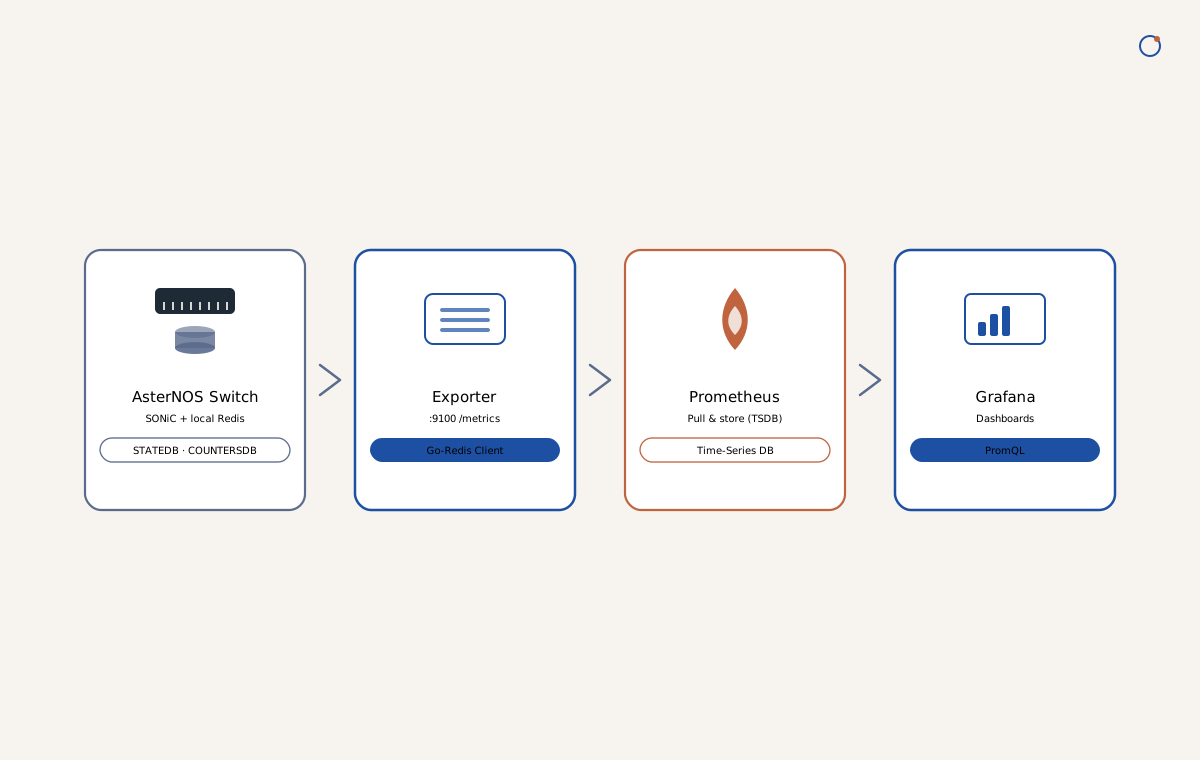
Real-time Visual Telemetry: Network administrators can monitor clock offsets, link latencies, and synchronization statuses for every RU in real time from a unified controller console, eliminating traditional "timing black boxes."
Zero Vendor Lock-In: Breaks technical barriers imposed by proprietary, closed-source legacy vendors, enabling seamless interoperability across heterogeneous, multi-vendor O-RAN environments.
Business Value via Simplified Architecture: By replacing multiple standalone devices with a single-box solution (combining Ethernet switching, timing, PTP, and PoE), it helps operators and private network clients significantly cut initial capital expenditures (CAPEX) while drastically lowering long-term operating expenses (OPEX) through automated O&M.