

Abstract
Offloading Layer 7 proxy workloads to high-performance user-space network stacks is an architectural imperative for modern edge gateways operating at scale. When integrating Nginx L7 processing into the AsterNOS-VPP platform, a deliberate and, at first glance, counter-intuitive engineering decision was made: the deeply intrusive VCL (VPP Communication Library) zero-copy approach was rejected in favour of the LDP (LD_PRELOAD) mechanism.
This post examines the architectural rationale behind that decision, provides a detailed technical exposition of the LDP data path, and demonstrates how AsterNOS-VPP achieves hardware-accelerated forwarding performance without sacrificing binary compatibility, security agility, or ecosystem openness.
1. Background and Problem Statement
Contemporary enterprise edge gateways must simultaneously satisfy two objectives that have historically been in tension: delivering the raw packet-processing throughput demanded by high-concurrency workloads, and preserving the operational agility required to maintain, extend, and rapidly patch production software.
The VPP (Vector Packet Processing) framework, operating in user-space and leveraging DPDK poll-mode drivers, provides exceptional forwarding performance by bypassing the Linux kernel network stack entirely. However, integrating an application-layer proxy such as Nginx into this environment introduces a non-trivial architectural challenge: the proxy must interact with a network I/O subsystem that no longer exposes a standard POSIX socket interface.
Two integration strategies exist. Their trade-offs span not only raw performance, but also module extensibility, security patch velocity, and operational complexity — dimensions that are frequently underweighted in benchmark-driven architectural discussions.
Scope This post focuses on integrating the Nginx HTTP/reverse-proxy daemon with the AsterNOS-VPP data plane. The architectural analysis and trade-offs described herein apply equally to other POSIX-compliant application-layer daemons operating in user-space network environments.
2. Architectural Options for VPP–Nginx Integration
When coupling an L7 application proxy with a VPP data plane, architects must choose between two fundamentally different integration philosophies.
2.1 Path A — VCL Architecture (Source-Intrusive Integration)
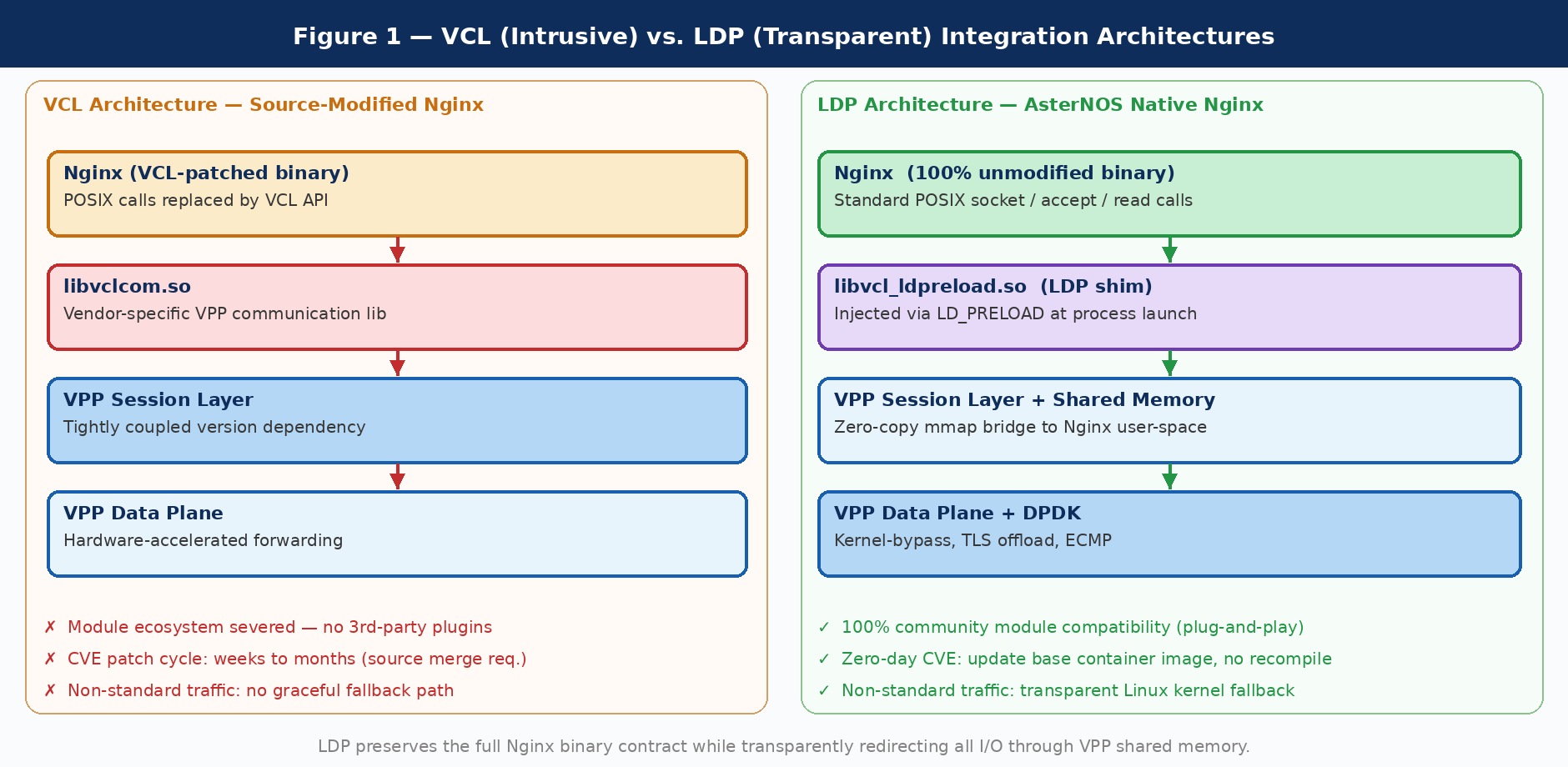
The VCL approach requires modification of Nginx’s core network logic at the source-code level. Standard POSIX socket calls (socket(), accept(), read()) are replaced wholesale with VCL API calls, creating a tight binary coupling between the application and a specific version of the VPP communication library.
- Primary use case: Closed, vertically integrated appliance environments such as 5G Core UPF nodes or High-Frequency Trading (HFT) infrastructure, where microsecond-level latency is the overriding constraint and operational flexibility is a secondary concern.
- Critical limitation: The VCL binary dependency severs the application from the broader open-source ecosystem. Third-party Nginx community modules become incompatible unless individually adapted by the vendor. More critically, when a zero-day vulnerability is disclosed, remediation is gated on the vendor’s ability to merge updated source code and recompile the entire Nginx–VCL stack — a process that can extend to weeks or months.
2.2 Path B — LDP Architecture (Transparent Interception)
The LDP (Linux Data Plane) approach, implemented via the Linux LD_PRELOAD mechanism, takes a fundamentally different stance: the Nginx binary is never modified. Instead, a lightweight interception shim (libvcl_ldpreload.so) is injected into the Nginx worker process at launch time, transparently redirecting POSIX socket calls to the VPP session layer.
This architecture accepts a marginal and measurable overhead at the syscall interception boundary in exchange for three engineering properties that are of material value in production enterprise deployments: full binary compatibility, zero-day patch agility, and graceful fallback for non-standard traffic.
3. The LDP Architecture: Technical Design and Engineering Value
By adopting the LDP approach, AsterNOS-VPP delivers three concrete engineering properties that directly address the operational constraints of enterprise gateway deployments.
3.1 100% Native Binary Compatibility
The most consequential property of the LDP architecture is that the system operates an entirely unmodified, upstream Nginx binary. No custom toolchains, no source-level patches, and no version-locked recompilation cycles are required. Existing Nginx server block configurations — including location directives, rewrite rules, upstream proxy definitions, and module configurations — are portable without modification.
For operators migrating existing reverse proxy infrastructure, this translates directly to preserved configuration assets and elimination of regression testing overhead associated with binary substitution. The AsterNOS CLI exposes a unified interface for importing Nginx configurations, maintaining the standard Nginx management experience while transparently leveraging VPP acceleration at the data plane layer.
Operational Implication: Any Nginx community module that functions with a standard upstream binary — including WAF modules (ModSecurity), GeoIP databases, JWT authentication handlers, and custom Lua scripts — operates without modification under the LDP architecture. The AsterNOS platform imposes zero constraints on the Nginx module ecosystem.
3.2 Zero-Day CVE Response Agility
In production security operations, the velocity at which a critical vulnerability can be remediated is often as operationally significant as the technical severity of the vulnerability itself. Under a VCL-based architecture, patching a disclosed Nginx CVE requires the platform vendor to obtain the upstream patch, apply it to the VCL-modified source tree, validate the merged codebase, recompile, and distribute a firmware update — a process with realistic timelines of weeks to months.
Under the LDP architecture, the Nginx binary is entirely decoupled from the VPP integration layer. Remediating a disclosed Nginx vulnerability requires only updating the base Nginx container image. No custom code merging, no VCL compatibility validation, and no VPP version dependency resolution is required. The patch window collapses from weeks to the time required to pull a new container image and issue a hot-reload signal.
3.3 Transparent Fallback to Kernel Network Stack
Enterprise intranet environments characteristically carry heterogeneous traffic, including out-of-band management flows, non-standard L4 protocols, and legacy application traffic that may not conform to the session patterns expected by VPP’s forwarding pipeline. The LDP shim handles this class of traffic through a transparent fallback mechanism.
When the LDP shim intercepts a syscall associated with a flow that does not satisfy the criteria for VPP acceleration, it transparently redirects that flow to the native Linux kernel network stack. This occurs without operator intervention, without secondary development effort, and without disruption to concurrently accelerated flows. The contrast with VCL — which lacks an equivalent fallback path and requires explicit handling of non-standard flows — is operationally significant.
4. Technical Deep-Dive: LD_PRELOAD Syscall Interception
The LDP mechanism exploits a standard Linux dynamic linker feature: LD_PRELOAD specifies one or more shared libraries to be loaded into a process’s address space ahead of all other libraries, including libc. Functions defined in the preloaded library take precedence over identically named functions in subsequently loaded libraries.
4.1 Injection and Interception
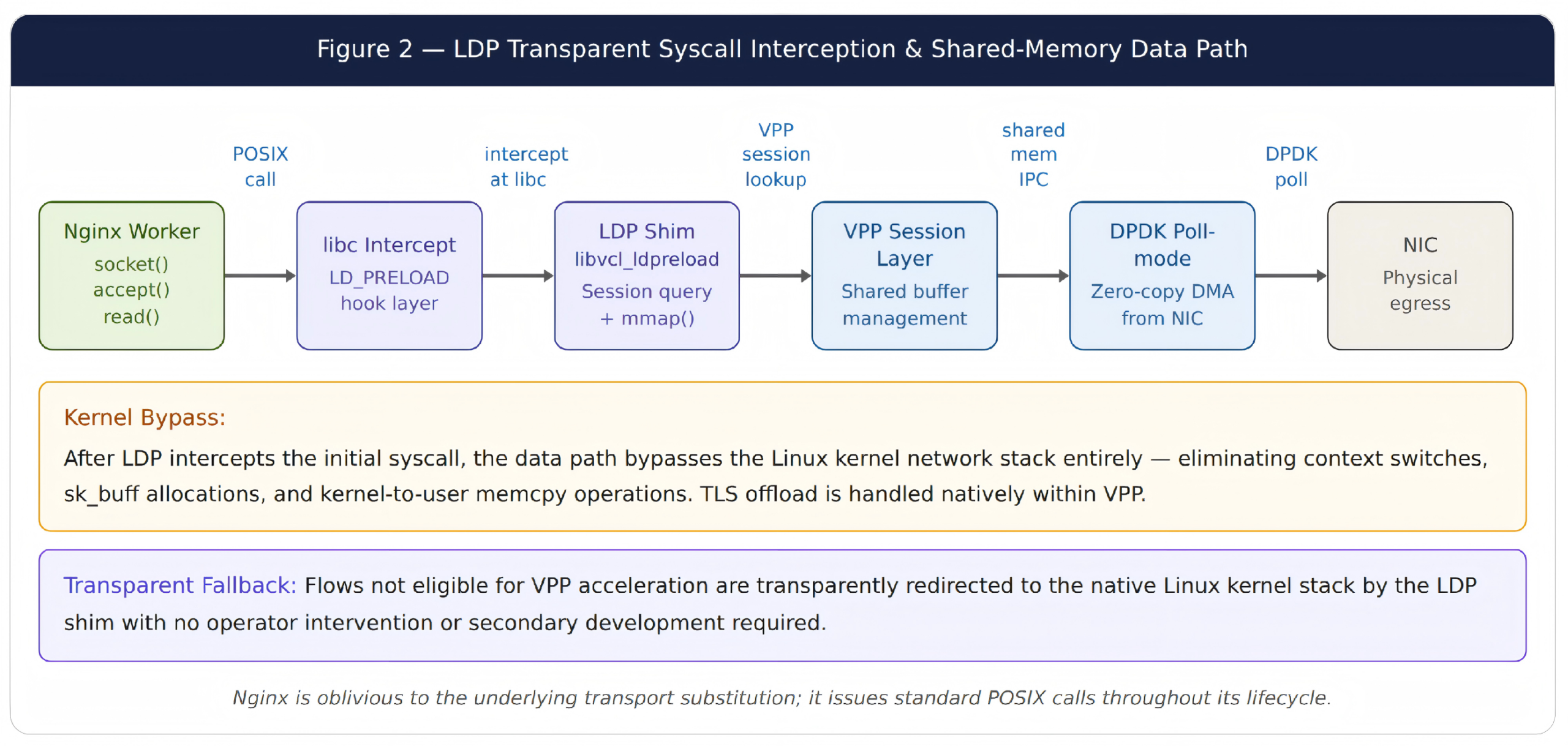
When an Nginx worker process is launched under AsterNOS-VPP, the orchestration layer sets LD_PRELOAD=libvcl_ldpreload.so in the process environment. The dynamic linker loads this interception library before libc, establishing hooks on standard socket-related symbols.
When Nginx subsequently issues a socket(), accept(), or read() syscall, control is intercepted at the libc symbol boundary and redirected to the LDP shim implementation. From Nginx’s perspective, it is interacting with a standard Linux kernel; the underlying transport substitution is entirely opaque.
4.2 VPP Shared-Memory Transport
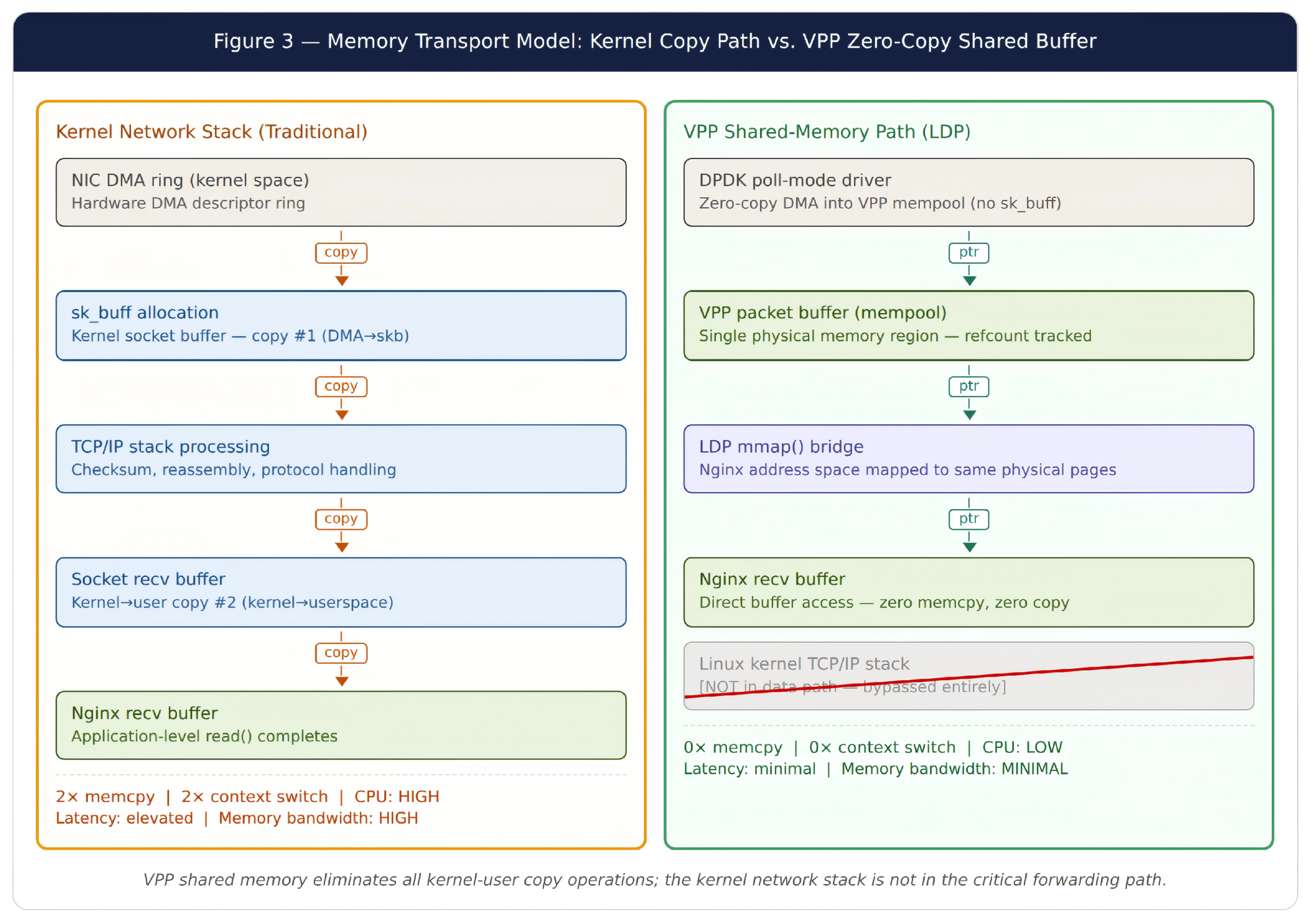
Following syscall interception, the LDP library establishes communication with the VPP main process via a high-bandwidth shared memory region. The shim queries the VPP session layer to retrieve the buffer descriptor for arriving packet data, then maps the corresponding physical memory pages directly into Nginx’s user-space address space via mmap().
This mechanism eliminates the sk_buff allocation, kernel-to-user copy, and context-switch overhead that characterise the conventional kernel network stack path. The actual packet processing — including TLS cryptographic offloading and L4 session management — is performed natively by VPP’s user-space protocol stack.
4.3 Quantifying the Overhead Differential
The marginal overhead introduced by LDP relative to VCL arises from two sources: the additional function call dispatch at the libc symbol boundary, and the shared-memory IPC round-trip to the VPP session layer. In practice, both are sub-microsecond operations and are inconsequential relative to the dominant latency contributions of TLS negotiation and L7 protocol parsing.
For the closed appliance use cases where VCL’s absolute throughput ceiling is operationally relevant — 5G UPF, HFT order routing — the overhead differential may justify the architectural lock-in. For enterprise gateway workloads, where workload diversity, security agility, and operational continuity are the primary constraints, the LDP trade-off is unambiguously favourable.
5. Operational Interface: Native Nginx Management via SONiC CLI
A persistent concern among network engineers evaluating user-space network stack integrations is operational complexity: does enabling a kernel-bypass data path require manual configuration of memory mappings, environment variable injection, or VPP session layer parameters?
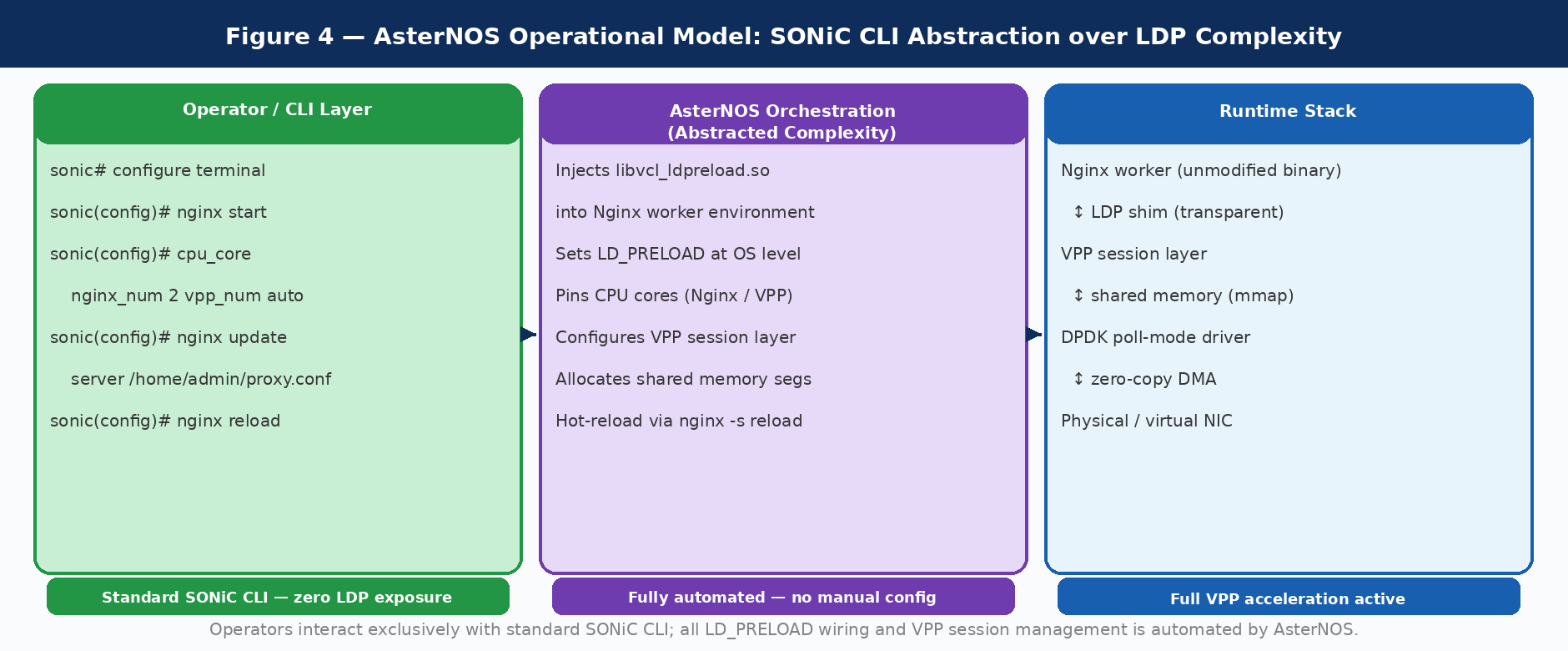
On AsterNOS-VPP, the answer is no. The LDP mechanism is fully automated by the AsterNOS orchestration layer. Operators interact exclusively through the standard SONiC CLI; all LD_PRELOAD configuration, shared memory segment allocation, and CPU core affinity management are handled transparently.
5.1 Configuration Reference
Initialise Nginx and allocate dedicated CPU core resources:
sonic# configure terminal
sonic(config)# nginx start
sonic(config)# cpu_core nginx_num 2 vpp_num auto
Import existing Nginx server block configuration:
sonic(config)# nginx update server /home/admin/proxy.confApply configuration changes with a hot reload (zero traffic interruption):
sonic(config)# nginx reload| Operational Note The cpu_core directive accepts an auto parameter for VPP core allocation, which enables AsterNOS to dynamically assign cores based on current load distribution. Manual override is supported for deployments with specific NUMA or isolation requirements. |
6. Comparative Architecture Analysis
6.1 VCL vs. LDP: Feature Matrix
| Evaluation Dimension | VPP + VCL (Intrusive) | AsterNOS-VPP (LDP) |
| Primary Design Goal | Closed appliance — maximise peak benchmark metrics | Open platform — maximise ecosystem agility and maintainability |
| Nginx Binary | Modified — VCL API replaces POSIX calls | Unmodified — 100% upstream binary |
| Module Compatibility | Poor — vendor must adapt each 3rd-party module | Excellent — all community modules plug-and-play |
| CVE Patch Cycle | Slow — full source merge and recompile required | Instant — update base container image only |
| Non-Standard Traffic | Weak — no graceful fallback path | Strong — transparent fallback to Linux kernel stack |
| Operational Complexity | High — custom toolchains, version-locked libraries | Low — standard SONiC CLI; LDP wiring fully automated |
| Deployment Agility | Low — tightly coupled to vendor release cycle | High — independent Nginx and VPP lifecycle management |
6.2 Decision Framework
The choice between VCL and LDP is not a performance question in isolation; it is a risk management question. The relevant risk dimensions are:
- Security patch velocity: How quickly can a disclosed CVE be remediated without vendor dependency?
- Ecosystem lock-in: What is the cost of adopting a required community module post-deployment?
- Traffic heterogeneity: Does the deployment environment contain non-standard flows requiring graceful handling?
- Absolute throughput ceiling: Is sub-microsecond latency a hard operational requirement, or is it a benchmark artefact?
For enterprise gateway deployments — which typically score high on the first three dimensions and low on the fourth — the LDP architecture is the technically superior choice.
7. Conclusion
The prevailing assumption that user-space network stack integration requires a binary choice between peak throughput and ecosystem openness is a false dichotomy. The LDP architecture, as implemented in AsterNOS-VPP, demonstrates that hardware-accelerated forwarding performance can be delivered without imposing the module incompatibility, CVE patch latency, and operational complexity that characterise source-intrusive integration approaches.
By transparently intercepting POSIX socket calls at the libc symbol boundary and redirecting I/O through VPP’s shared-memory session layer, AsterNOS-VPP achieves kernel-bypass performance with a 100% unmodified Nginx binary. The operational implications are concrete: unrestricted access to the Nginx community module ecosystem, zero-day vulnerability remediation without source-code dependencies, and transparent fallback for non-standard traffic flows.
The marginal throughput differential between LDP and VCL is a real but narrow gap — one that is operationally irrelevant for the workload profiles encountered in enterprise L7 gateway deployments. The operational and security dividends of architectural openness, by contrast, compound continuously over the deployment lifetime of the system.
Summary AsterNOS-VPP’s adoption of the LDP architecture reflects a deliberate engineering philosophy: performance is a necessary but not sufficient condition for enterprise infrastructure. Maintainability, security agility, and ecosystem interoperability are first-class requirements, not post-hoc optimisations. The LDP integration delivers all four.