
In vendor slide decks and technical white papers, Edge Routers and Border Routers are frequently conflated—often with vendors slapping both labels onto the very same box. Yet, strip away the marketing jargon and look into the actual architecture of data centers, metro networks, and enterprise WANs, and you will find a clear engineering divide between their core focus and operational bottlenecks.
The fundamental distinction lies in where their architectural gravity pulls: an Edge Router tackles stateful service complexity and access granularity, whereas a Border Router is built for topological boundary control and route-scale throughput.
Deciding which one you actually need comes down to where your network’s true bottleneck lies: in the intricacies of inbound service flows, or the scale of backbone routing tables. This article breaks down those differences so you can pinpoint the exact fit for your infrastructure.
Without further ado, let's look at the comparison table:
Edge Router and Edge Router 's Core Positioning & Scenario Differences
Dimension | Edge Router (Service Edge) | Border Router (Domain Boundary) |
Typical Location | Physical/user front-end of the network (e.g., enterprise branches, campus egress, telco Metro/PE edge) | Interconnect point between two independent network domains (e.g., AS borders, DC perimeters, cloud on-ramps) |
Core Responsibilities | Service onboarding & policy enforcement (user auth, multi-WAN access, security encryption, traffic shaping) | Route exchange & boundary isolation (large-scale BGP routing, inter-domain policy control, protocol translation) |
Typical Formats | WAN Edge appliances, SD-WAN gateways, BNG/BRAS, PPPoE gateways | ASBR (Autonomous System Boundary Router), DC Border Leaf/Spine, Internet Gateway (IGW) |
Target Workloads | End users, LAN endpoints, distributed branch/site-to-hub traffic | External networks (e.g., Transit ISPs, IXPs, public cloud VPCs, peering partners) |
Next, let's dissect the differences in their technology stacks and core capabilities.
Edge Router Responsible for Depth of Features & Service Diversity
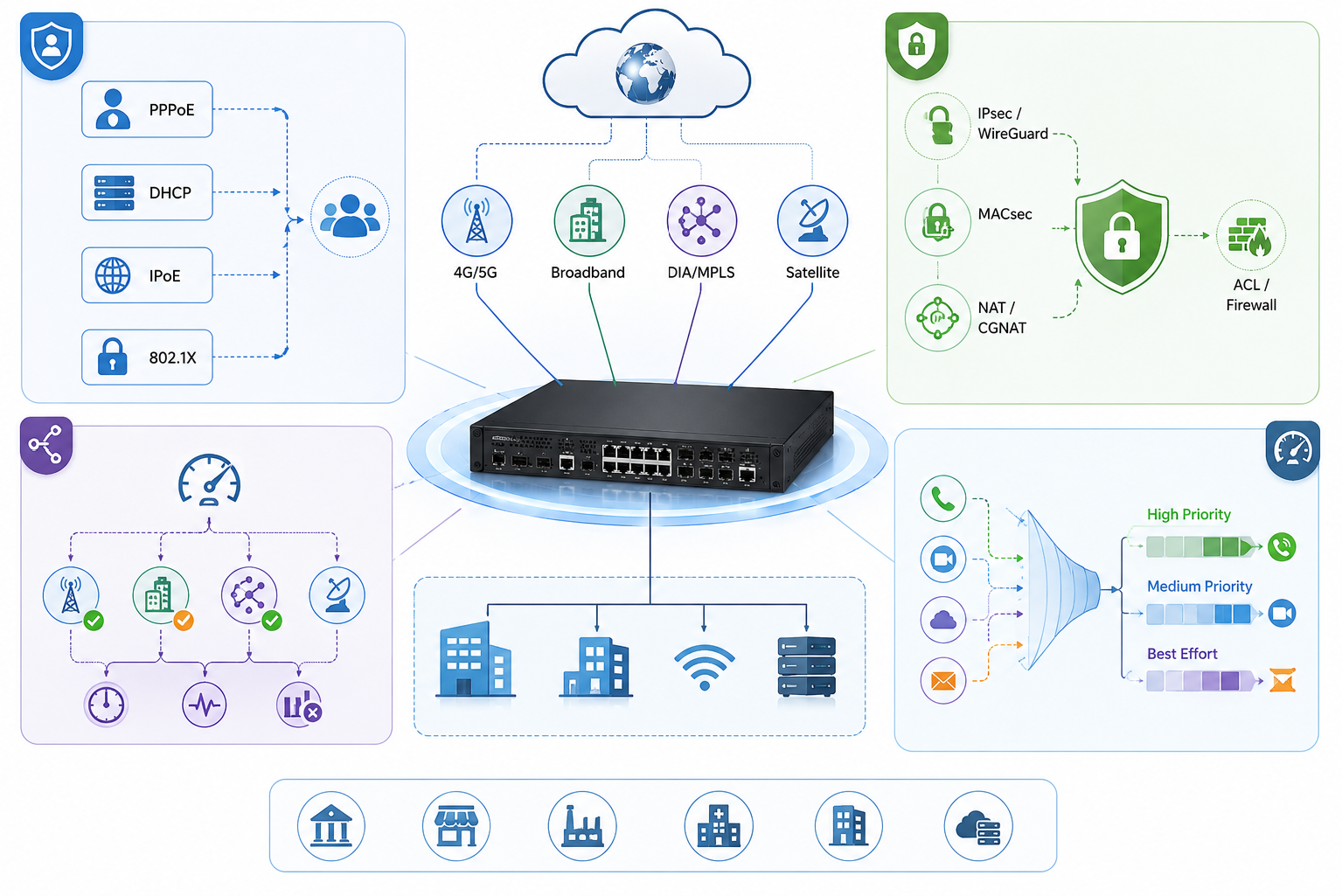
Positioned at the "first hop" or the "last mile" of network traffic, an Edge Router handles complex service types and diverse physical links:
Robust Access & Authentication: Terminates or relays subscriber onboarding protocols, including PPPoE, DHCP Server/Relay, IPoE, and 802.1X.
Hardened Security & Encryption: Terminates high-density IPsec / WireGuard secure tunnels for massive branch interconnects, alongside MACsec, high-concurrency NAT/CGNAT translation, and application-aware ACL firewall policies.
Intelligent Multi-Link Steering (Multi-WAN / SD-WAN): Executes dynamic failover and load balancing based on real-time SLAs—latency, jitter, and packet loss—across hybrid uplinks (e.g., 4G/5G, broadband, and dedicated DIA/MPLS lines).
Granular QoS & Traffic Shaping: Enforces precise bandwidth rate limiting, congestion management, and priority queuing under constrained WAN uplinks to protect mission-critical voice and business apps.
Border Router: Route Scale & Interconnect Control
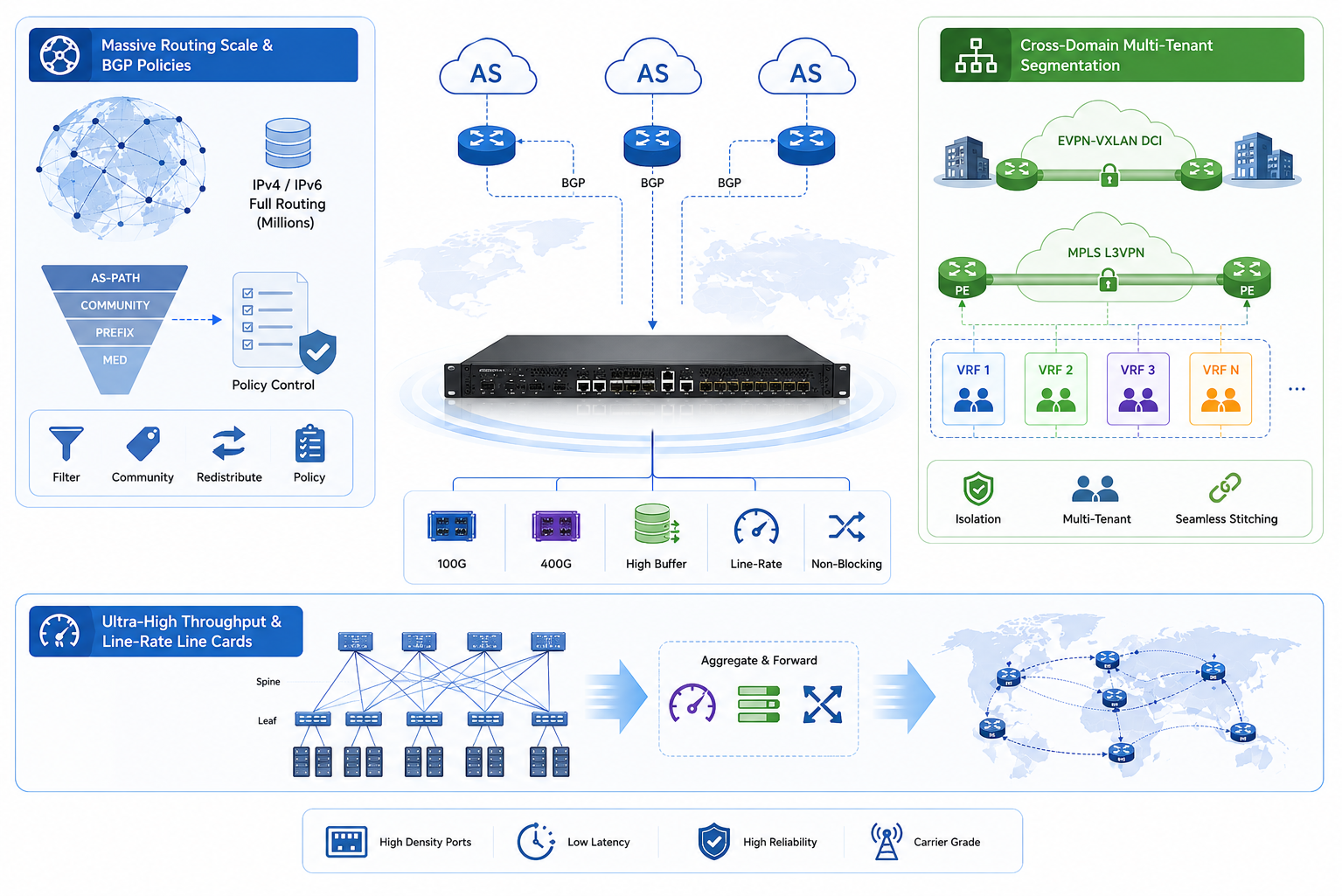
Sitting at the intersection of network "arteries," a Border Router is unburdened by per-user subscriber authentication; instead, it focuses on macroscopic Autonomous System (AS) and inter-domain interconnection:
Massive Routing Scale & BGP Policies: Typically holds global IPv4/IPv6 Full Routing Tables (millions of prefixes), demanding immense processing capacity for BGP path attribute filtering, Community tagging, and route redistribution.
Cross-Domain Multi-Tenant Segmentation: Runs EVPN-VXLAN DCI (Data Center Interconnect) and MPLS L3VPN, stitching and isolating tenant VRFs seamlessly across distinct administrative domains.
Ultra-High Throughput & Line-Rate Line Cards: Aggregates cross-domain traffic across entire data centers or enterprise backbones, prioritizing high-density interfaces (e.g., 100G/400G), deep packet buffers, and non-blocking line-rate forwarding to eliminate boundary drop bottlenecks.
Typical topology of Border Router and Edge Router
Let's look at a typical topology to see where each sits within the same large-scale enterprise architecture:
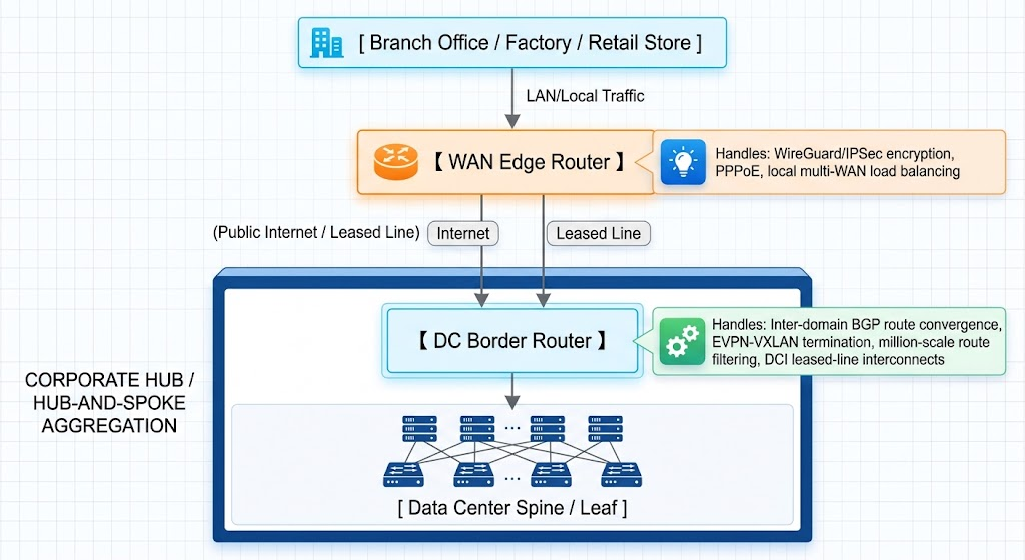
This topology represents an end-to-end enterprise network architecture where distributed branch edges securely connect across the WAN to the enterprise's private cloud data center (DC Border / Fabric).
The Edge Router is the "front desk receptionist and security guard": It manages all the messy, granular details. It verifies employee badges (identity authentication), slaps "Express" or "Standard Mail" tags on parcels based on priority (QoS prioritization and rate limiting), locks confidential documents into armored cases (VPN encryption), and ushers them out the door.
The Border Router is the "cross-border customs checkpoint and cargo port": It handles bulk freight. It doesn't care about individual walk-in visitors; it focuses solely on the transit rules and destinations of massive shipping containers (inter-AS BGP routing), ensuring immense volumes of cargo clear customs rapidly, stay strictly segregated, and move between sovereign domains without bottlenecks.
The core difference in summary: their architectural gravity centers on entirely different challenges: the Edge Router shoulders "service complexity" (authentication, encryption, NAT, and granular QoS scheduling by traffic importance), while the Border Router is built for "throughput and routing scale" (cross-domain policy enforcement, line-rate forwarding, and million-scale BGP routing tables).
How to Determine Whether You Need an Edge Router or a Border Router?
The core selection criterion comes down to a single question: is your bottleneck driven by "stateful service complexity at the access layer" or by "throughput and routing scale across domain boundaries"?
A Simple 2-Step Decision Flow
Step 1: Check Physical Location and Traffic Audience
Deployed at retail stores, factories, branch offices, or campus perimeters facing specific endpoints, employee clients, or local branch traffic choose an Edge Router.
Deployed at core data center perimeters, cloud on-ramps, or direct transit peering points facing peering Autonomous Systems (AS) or inter-domain backbones choose a Border Router.
Step 2: Check Packet Processing Requirements
Packets require deep inspection, encryption, IP translation (NAT), QoS remarking, or application identification choose an Edge Router (powered by robust CPU/DPU stateful engines).
Packets require ultra-fast route lookups, VXLAN/MPLS encapsulation swaps, and zero-drop microburst forwarding choose a Border Router (powered by high-throughput ASIC/NP line-rate fabrics).
Selection Matrix: Needs vs. Target Metrics
Business Need & Technical Requirement | Recommended Device | Key Technical Metrics |
Massive subscriber/branch onboarding (PPPoE, DHCP, 802.1X auth) | Edge Router | Concurrent subscriber capacity, access protocol support |
High-density crypto tunnels & address translation (Thousands of IPsec/WireGuard tunnels, high-concurrency CGNAT) | Edge Router | Crypto throughput, concurrent NAT session capacity |
Intelligent multi-uplink steering (Multi-WAN, 4G/5G failover, granular app-aware QoS) | Edge Router | Stateful traffic inspection depth, SLA-based path selection |
Global routing table ingestion (Handling global IPv4/IPv6 Full Routing Tables) | Border Router | FIB/RIB capacity (millions of prefixes), BGP convergence time |
Inter-domain / Transit peering (eBGP peering, complex BGP Community filtering) | Border Router | Policy scale limits, deep ACL matching performance |
DCI or Layer 2 extension (EVPN-VXLAN DCI, MPLS L3VPN multi-tenant isolation) | Border Router | VRF scale, line-rate VXLAN encap/decap throughput |
High-throughput, non-blocking aggregation (Consolidating DC traffic, 100G/400G line rate) | Border Router | Switching capacity, port density, deep packet buffers |
Step 3: The Complex Scenario — "Cross-Domain Convergence"
Consider a mid-sized enterprise HQ: it terminates thousands of inbound branch VPN tunnels (an Edge attribute) while peering with dual upstream ISPs running foundational BGP (a Border attribute). In this scenario, your best bet is a modern service gateway powered by hardware/software acceleration (such as a DPU/VPP architecture)—an appliance capable of ingesting granular, stateful edge workloads while delivering high-throughput line-rate inter-domain forwarding.
So, where do you find a router like this?
Open Edge / Border Router: Powered by Marvell OCTEON 10 & Enterprise SONiC-VPP
Built on a foundation of DPU hardware acceleration and a VPP data plane, the RT Series Open Router pushes high-complexity stateful Edge services to peak performance—including BNG/PPPoE termination, 10,000+ concurrent WireGuard tunnels, and carrier-grade CGNAT. At the same time, backed by up to 4 million IPv4/IPv6 routes (4M FIB/RIB) in a 32GB memory profile alongside 100G backbone uplinks, it turns Border-class global BGP Full Table capacity and inter-domain EVPN-VXLAN interconnects into native, standard capabilities.
With this hardware and software foundation, the RT Series is far more than a conventional "edge access box." It is a cross-domain powerhouse anchored in the Service Edge that scales upward to cover Data Center and Campus Border/Aggregation deployments.
Why Is Its Pedigree Fundamentally an Edge Router?
The most hardcore capabilities engineered into the RT Series were built specifically to resolve the complex pain points of the Service Edge:
1.Carrier-Grade Service Access (BNG / CGNAT / PPPoE):
Pure Border Routers focus solely on inter-AS BGP routing without touching subscriber onboarding. In contrast, the RT Series delivers deep support for PPPoE termination, massive concurrent CGNAT translation, and per-user ACL policy enforcement—the defining hallmarks of a Telco Metro Edge or enterprise BNG/BRAS platform.
2.Massive Secure Tunnel Concurrency (IPsec / WireGuard):
It supports up to 2,000 IPsec and 10,000 WireGuard hardware-accelerated tunnels. The primary mission of this crypto capacity is aggregating thousands of distributed branches, factories, and remote sites into a unified gateway—the textbook definition of a WAN Edge / Secure Edge architecture.
3.DPU + VPP-Powered Granular Flow Processing:
Leveraging an enterprise VPP software stack running on a high-performance multicore DPU, its primary advantage lies in executing ultra-fine-grained stateful packet inspection, QoS traffic shaping, NAT translation, and complex policy-based routing at wire speed.
4.Carrier-Grade Precision Synchronization (Telco Edge & TSN Ready)
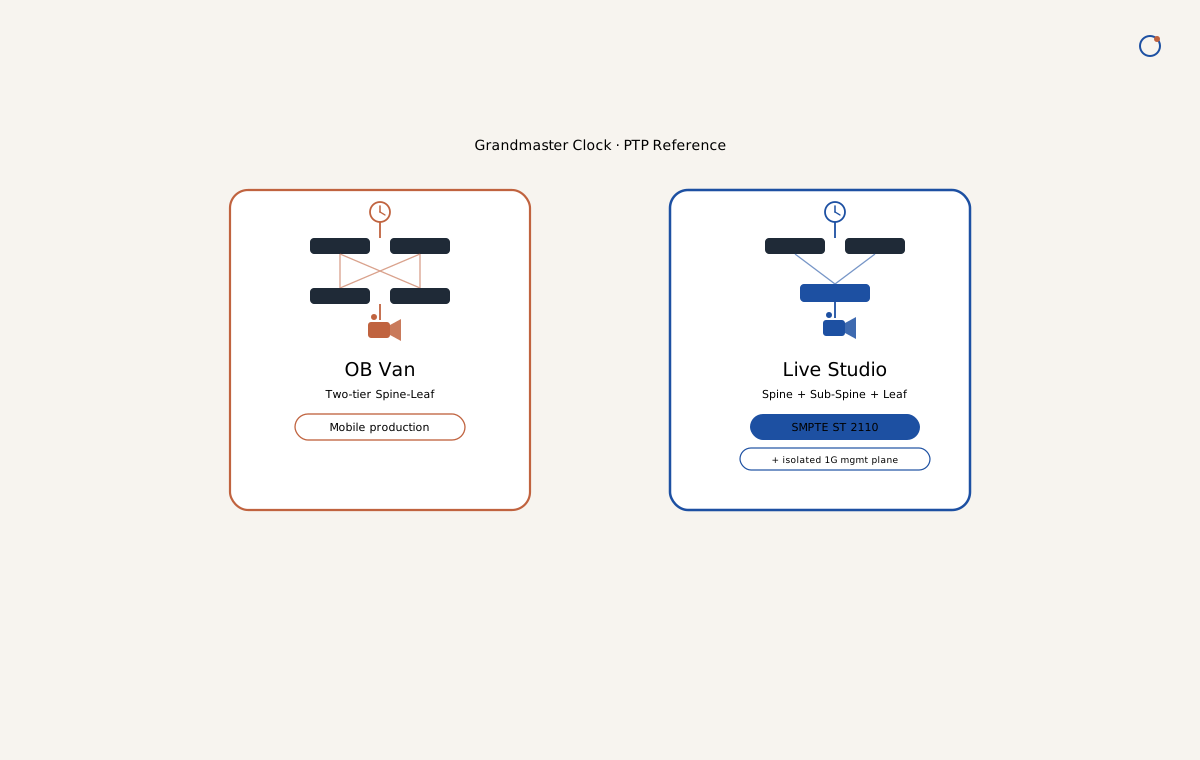
Delivers Class C ultra-high precision PTP (IEEE 1588v2,G.8275.1 / G.8275.2, SMPTE ST 2059-2) with nanosecond-level (32.5ns) hardware timestamping and SyncE. This empowers the appliance to go beyond conventional enterprise WAN Edge deployments, effortlessly serving as a 5G Cell Site Router (CSR), an Industrial Time-Sensitive Networking (TSN) edge, and a Broadcast IP Media Gateway to ensure ultra-precise clock alignment for mission-critical flows.
Why Does It Effortlessly Double as a Border Router?
Conventional edge routers collapse under heavy inter-domain transit workloads. The RT Series, however, matches and often exceeds the benchmarks of traditional Border Routers:
1.Massive Routing Scale (Million-Prefix Full Table Capacity):
With its 32GB memory profile, the RT Series supports up to 4 million IPv4/IPv6 routes. This enables it to function seamlessly as a DC Border Leaf or Enterprise ASBR, swallowing global Internet BGP Full Tables while executing complex route-maps, community tagging, and prefix filtering.
2.Data Center-Grade Interconnects (EVPN-VXLAN / MPLS / VRF):
Featuring comprehensive EVPN-VXLAN termination and multi-tenant VRF isolation, it serves as a robust routing pivot between private clouds, public clouds, and multi-DC interconnect (DCI) perimeters.
3.High-Density 10G/25G/100G Ports & 256-Way ECMP:
High port density paired with ultra-wide 256-way ECMP forwarding provides the backbone scale required to aggregate massive traffic flows across medium-to-large campuses and AI/compute cluster perimeters.
Summary: How to Accurately Position the RT Series
One-Sentence Positioning:
A high-performance Border and Aggregation router cloaked in stateful Edge service capabilities.
Southbound (Facing Branches & Users): A hardened Secure WAN Edge & BNG Gateway that effortlessly terminates thousands of encrypted tunnels, high-concurrency NAT sessions, and subscriber access authentication.
Northbound (Facing Backbones & Cloud): A robust DC/Campus Border Router that bridges inter-domain core networks with a 4M route capacity, EVPN-VXLAN, and BGP peering.
Primary Target Scenarios
Tier-2 / Tier-3 Telcos & Regional ISPs: An all-in-one Core/Egress Gateway consolidating BGP Border, BNG, and CGNAT onto a single box.
Mid-to-Large Enterprises & Global Enterprises: A high-performance WAN aggregation and secure perimeter engine featuring 100G uplinks and massive IPsec/WireGuard tunnel termination.
Conclusion
The ultimate endgame of network architecture evolution is never about stacking more hardware boxes—it is about breaking down legacy boundaries with an agile, flexible hardware and software foundation.
If your network is caught in the squeeze between rising service complexity and massive traffic scale, you no longer have to compromise between underpowered edge access appliances and rigid, expensive legacy border gateways. Anchored by DPU hardware acceleration and the Enterprise SONiC-VPP open ecosystem, the Asteraix RT Series fuses deep, stateful service access with horizontal inter-domain throughput—truly delivering "One Box to Converge All Edge and Border Scenarios.