
Beyond High Accuracy: The Need for Continuous PTP Synchronization
Precision Time Protocol (PTP, IEEE 1588v2) is foundational for high-precision timing across 5G transport, professional broadcast, industrial automation, and power grids. In production environments, networks are dynamic: media endpoints come online or go offline, base stations scale, and operators must routinely adjust PTP priorities, message intervals, or port configurations.
This raises a critical operational question: Does modifying a PTP parameter on one port disrupt established time synchronization on other active ports?
In mission-critical timing chains, if a localized configuration change forces the entire PTP instance to restart or re-converge, active ports will suffer temporary lock loss. In 24/7 networks, synchronization continuity during configuration changes is just as vital as steady-state synchronization accuracy.
How Configuration Changes Disrupt Traditional PTP (e.g., ptp4l)
In traditional LinuxPTP implementations (like ptp4l), many configuration changes cannot be applied dynamically at runtime. To update parameters like message intervals or priorities, operators must reload the configuration file or restart the ptp4l process.
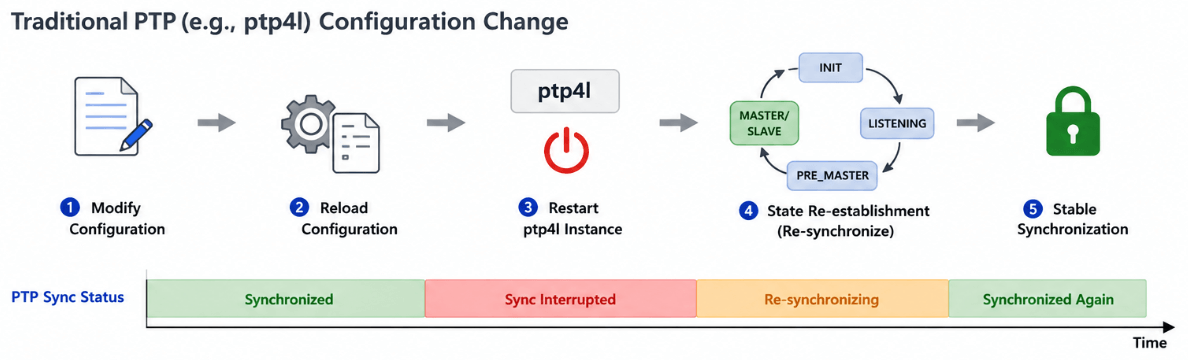
This restart breaks active timing relationships:
The device temporarily loses its upstream timing reference.
Downstream Slaves drop out of locked state.
The system is forced into a complete re-selection (BMCA), re-synchronization, and re-locking cycle, sending timing disturbance downstream.
Architectural Insight: How AsterNOS Achieves Hitless PTP Updates
To eliminate synchronization disruptions, Asterfusion switches running AsterNOS introduce Hitless PTP Configuration.
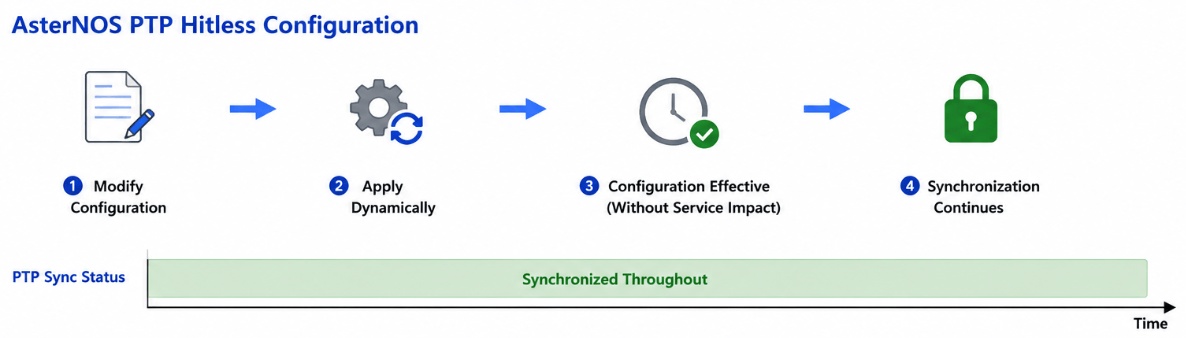
Unlike monolithic PTP daemons that require process restarts, AsterNOS decouples the PTP control plane from the hardware timing engine:
Dynamic IPC & Database Sync: Configuration changes made via CLI/REST API are updated dynamically in the system database and passed to the running PTP engine via non-disruptive IPC.
Continuous Hardware Clocks (PHC): The Physical Hardware Clock on the switching ASIC maintains its phase-locked loop (PLL) with the Grandmaster throughout the update, preventing any phase jumps or timing loss.
As a result, operators can modify supported PTP settings or toggle individual ports without interrupting active timing services on other interfaces.
Real-World Verification: Test Setup & Results
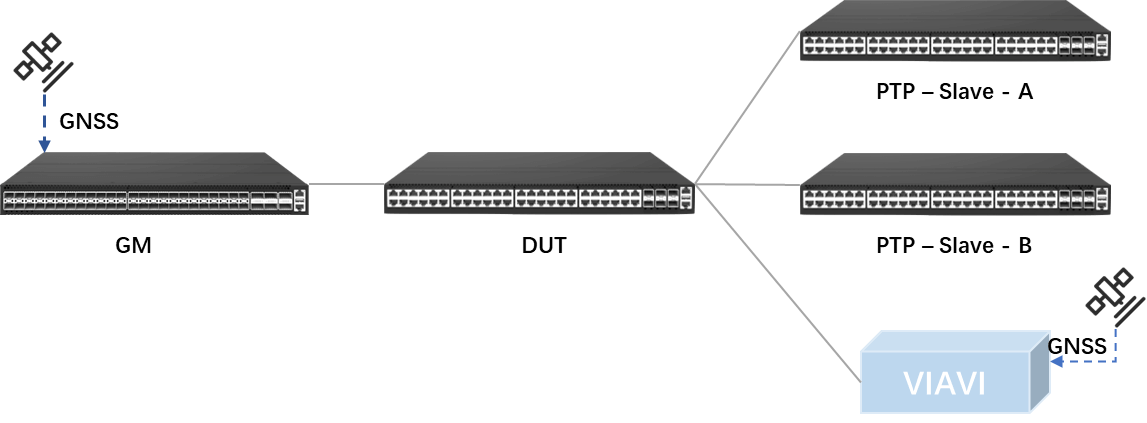
To evaluate Hitless PTP performance under live configuration changes, we deployed a multi-stage Boundary Clock (BC) topology:
Test Equipment | GM: CX306P-48Y-M |
|---|---|
DUT: CX206Y-48GT-M | |
Slave: CX206Y-48GT-M | |
Test Center VIAVI5800 | |
Software Version | AsterNOS-V5.2R017P01 |
Test Execution & Telemetry Results
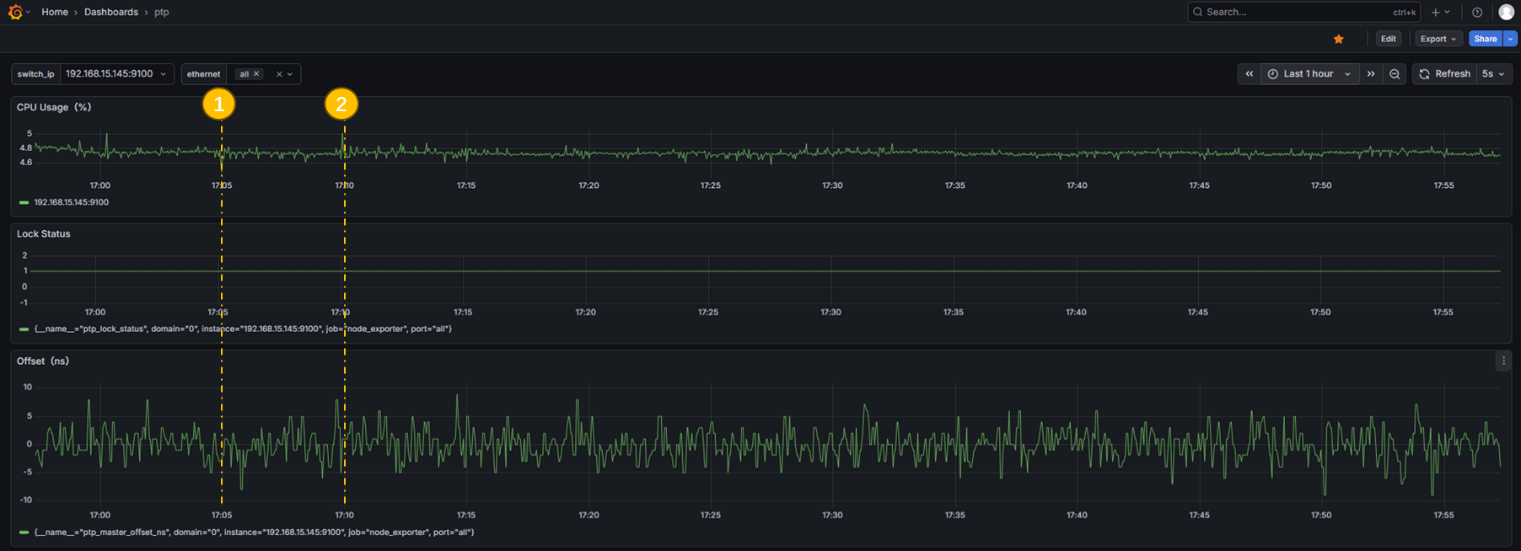
While the DUT actively synchronized downstream devices, two live configuration changes were performed:
Port Shutdown (Point 1 on Grafana Dashboard): Shut down an active port connected to a PTP Slave to test per-port isolation.
Interval Modification (Point 2 on Grafana Dashboard): Dynamically changed the
Announcemessage interval on an active Master port.
Key Telemetry Observations:
Point 1 (17:05 - Interface Shutdown): As shown on the timeline, shutting down a PTP port had zero ripple effect on other active ports. The
Lock Statusstayed locked at1, andOffset from Masterremained stable within ±5 ns.Point 2 (17:10 - Parameter Change): Dynamically updating the
Announce Intervalcaused no phase jump, no clock drift, and zero re-locking delay.
Independent VIAVI 5800 Performance Measurement
The VIAVI 5800 test instrument independently validated the physical time error output:
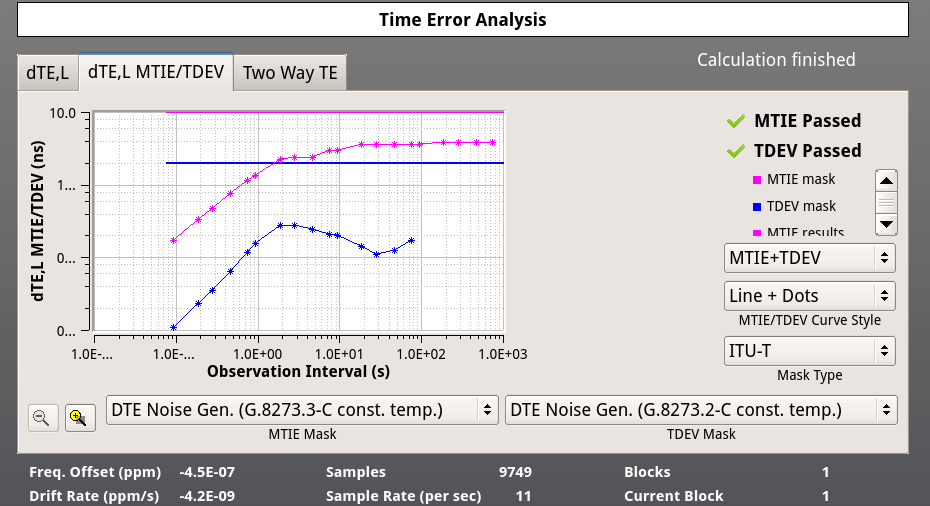
Both MTIE (Maximum Time Interval Error) and TDEV (Time Deviation) tests returned PASSED against ITU-T G.8273.2 masks, confirming that AsterNOS maintains strict sub-microsecond timing accuracy throughout live maintenance operations.
Scope of Hitless PTP Configuration
While operational parameters can be updated dynamically, changes that inherently alter the underlying timing architecture will naturally trigger a re-selection cycle (by design):
Configuration Category | Parameter Name | Hitless Support | Operational Impact |
Clock Attributes | Priority1 / Priority2, Clock Class, Accuracy | Yes (Hitless) | Dynamic update; no state reset |
Message Intervals | Sync / Announce / Delay_Req Interval | Yes (Hitless) | Adjusted on the fly without loss of lock |
Port Operations | Add / Remove Port, Admin Up/Down, TLVs | Yes (Hitless) | Isolated to target port; zero impact on active peers |
Architectural Changes | PTP Profile, Clock Type (GM/BC/TC), Domain ID | No (Re-sync Required) | Triggers BMCA re-election & re-lock cycle |
Conclusion
In modern production networks, timing availability is measured not just in steady state, but during everyday maintenance. AsterNOS Hitless PTP Configuration bridges the gap between high accuracy and high availability, allowing network engineers to perform live parameter tuning and port changes with zero fear of timing disruption.