Summary
What AVB is: Audio Video Bridging is a set of IEEE 802.1 mechanisms that add three things to Ethernet: a common clock (802.1AS, gPTP), per-stream bandwidth admission (802.1Qat, SRP/MSRP), and queue shaping for reserved traffic (802.1Qav, FQTSS with a credit-based shaper).
What it replaces: dedicated SDI (Serial Digital Interface, the SMPTE coax standard for broadcast video) circuits and router crosspoints for audio and bandwidth-bounded media inside one Layer 2 domain. Class A streams target a network transit latency of 2 ms or less over 7 hops.
What it does not replace: multi-Gbps uncompressed video. 8K60 10-bit 4:2:2 is about 39.8 Gbps of active video, while the default cap on reservable bandwidth is 75% of port rate, which is 0.75 Gbps on a 1GbE port.
Fit: conferencing and multipurpose rooms, sound reinforcement, recording and monitoring, with every bridge on the path AVB-capable and at most 7 hops.
Not a fit: uncompressed broadcast video distribution, routed (Layer 3) or WAN paths, and paths that include non-AVB bridges.
Assumptions and Scenario
One Layer 2 domain, with every audio video bridging switch on every stream path implementing 802.1AS, SRP/MSRP, and FQTSS.
Path length of 7 hops or fewer. The latency targets (2 ms and 50 ms) are defined for a typical seven-hop network that meets link-rate, topology, and traffic requirements.
Endpoints are AVB Talkers and Listeners. Analog devices (microphones, loudspeakers) attach through an AVB-capable DSP or audio I/O device, which acts as Talker on input and Listener on output.
Migration is phased: SDI equipment connects through media gateways, and network-native devices connect directly to AVB ethernet switches.
Three Engineering Conflicts
Conflict 1: A dedicated circuit is deterministic, a shared link is not
An SDI link carries one unidirectional signal on its own coax run, so delay and bandwidth are fixed by construction. An Ethernet link is shared. With best-effort forwarding, queuing and congestion add variable delay and can drop packets. Replacing an SDI port with an Ethernet port therefore requires three things the SDI circuit gave for free:
SDI property | Ethernet requirement | AVB mechanism |
|---|---|---|
Common timing across the plant | Shared time reference across endpoints and bridges | 802.1AS (gPTP) |
Fixed bandwidth per circuit | Per-stream admission and reservation | 802.1Qat (SRP/MSRP) |
Fixed, bounded delay | Bounded queuing under shared load | 802.1Qav (FQTSS, CBS) |
Conflict 2: SDI scales by adding links, Ethernet scales by link rate, and AVB caps the reservable share
Example: 8K 60p, 10-bit 4:2:2 over quad-link 12G-SDI needs four links per signal. Excluding redundancy, going from single to quad link quadruples the cable count on both source-to-router and router-to-destination connections, and all four links must switch together.
On Ethernet one link can carry many streams, but reserved traffic is bounded. Using the standard default of 75% reservable bandwidth per port (standard; configurable by implementation):
Port rate | Reservable at 75% | Versus 8K60 4:2:2 10-bit active video (≈39.81 Gbps) |
|---|---|---|
1 GbE | 0.75 Gbps | 53× short |
10 GbE | 7.5 Gbps | 5.3× short |
100 GbE | 75 Gbps | Fits one stream by bandwidth; the AVB frame format and class timing still apply |
Active video rate = 7,680 × 4,320 × 60 × 20 bits = 39.81 Gbps. A single HD-SDI signal (1.485 Gbps) also exceeds the 0.75 Gbps reservable on a 1GbE port. The bandwidth math is the first filter for any "SDI replacement" claim.
Conflict 3: Embedded audio alignment vs. independent streams
SDI carries video, embedded audio, and ancillary data together, so the router switches them as one. Sending camera audio to a mixing console requires de-embedding, and returning processed audio requires re-embedding. On Ethernet the streams are separate, so alignment moves from the container to time: each Listener buffers early-arriving media and plays it at the specified presentation time, which only works if all devices share the gPTP clock.
Decoupled Architecture
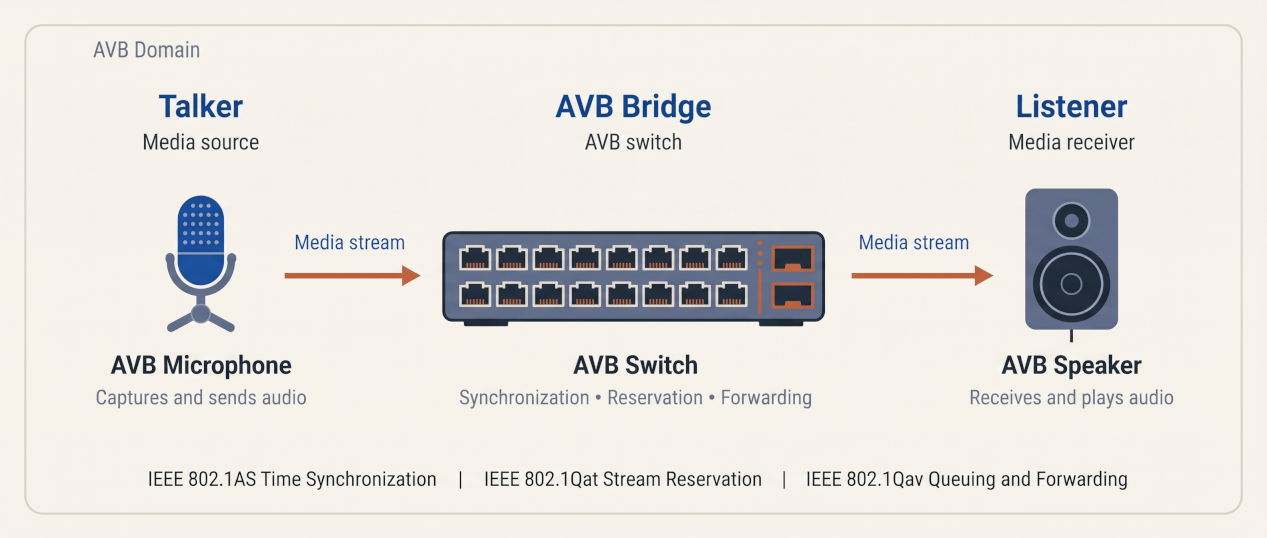
AVB splits the problem into three mechanisms that run independently on every bridge and are tied together by the stream:
 Talker            AVB Bridge (each hop)            Listener
   |                                                   |
   |==== 802.1AS gPTP: common time (all nodes) ========|
   |                                                   |
   |-- MSRP Talker Advertise ->  check egress BW  -->  |
   |                             update latency        |
   |<- MSRP Listener Ready  <--  reserve BW  <-------- |
   |                             L2 multicast state    |
   |                                                   |
   |== media frames ==> [SR queue + CBS] =======> play at
   |                    [best-effort queue]       presentation time
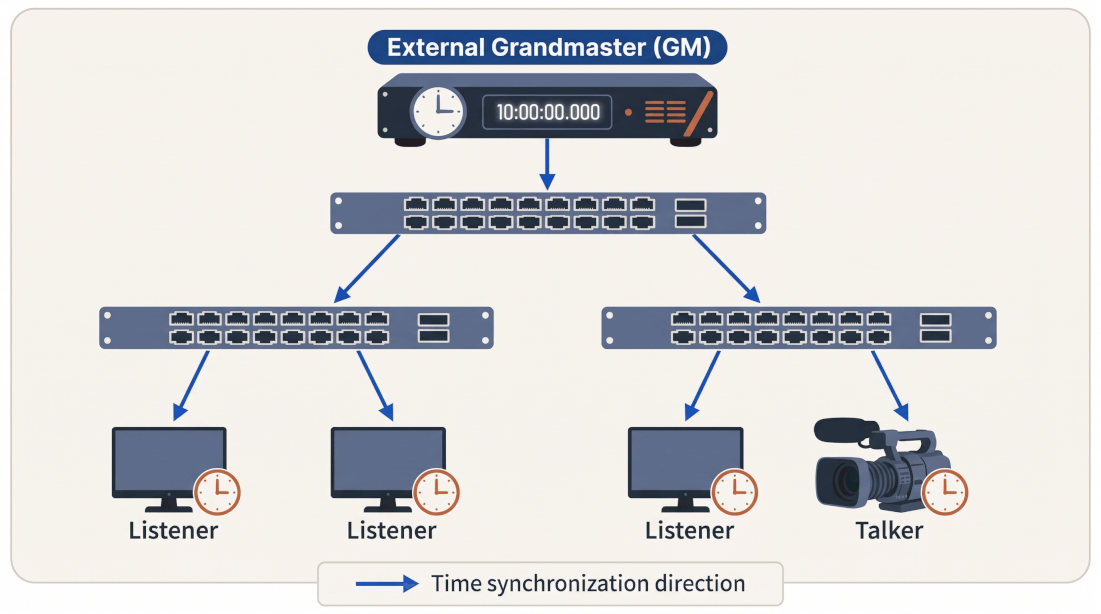
Time plane (802.1AS): Announce messages and the Best Master Clock Algorithm (BMCA) select the grandmaster; port roles distribute time downstream. Neighbors measure mean link delay and neighbor rate ratio with Pdelay_Req, Pdelay_Resp, and Pdelay_Resp_Follow_Up. Each bridge corrects for propagation delay, residence time, and clock rate difference. The standard's accuracy target is 1 µs over 7 hops.
Reservation plane (MSRP): declarations travel hop by hop, and each bridge checks egress bandwidth against the stream's TSpec before forwarding the declaration.
Forwarding plane (FQTSS/CBS): reserved traffic is mapped to shaped egress queues; other traffic uses the remaining transmission opportunities.
Decoupling means a bridge can fail the reservation without touching time sync, and the shaper enforces what MSRP admitted, not what the Talker later sends.
How Each Mechanism Works
4.1 gPTP (IEEE 802.1AS)
Time-aware devices exchange clock attributes in Announce messages, run BMCA to select the grandmaster, and build a synchronization hierarchy. Each hop measures its own link delay and compensates residence time, so endpoints recover time aligned with the grandmaster. Every bridge on the path must be time-aware. Pdelay frames are link-local and are not relayed by non-AVB bridges, so a non-AVB bridge breaks timing on that segment.
4.2 MSRP (IEEE 802.1Qat)
A Talker Advertise declaration carries:
Field | Purpose |
|---|---|
Stream ID | Unique stream identifier |
Destination MAC and VLAN ID | Stream destination (typically multicast) and VLAN |
Priority and Rank | Traffic priority and reservation ranking |
TSpec | Maximum frame size and maximum frames per measurement interval, for bandwidth calculation |
Accumulated Latency | Path latency so far, evaluated by the Listener |
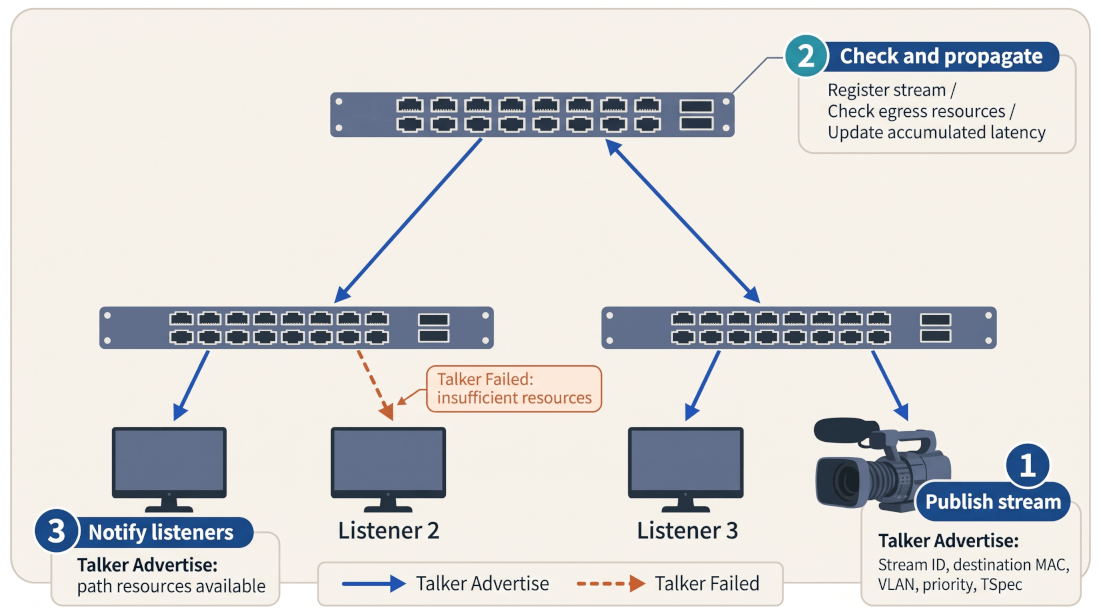 Declaration outcomes:
Declaration | Meaning |
|---|---|
Talker Advertise | No resource shortage identified from the Talker to this node |
Talker Failed | A bridge on the path lacks resources; carries the failure reason and the reporting bridge |
Listener Ready | Listeners request the stream and all represented paths have the resources |
Listener Asking Failed | Listeners request the stream but none of the represented paths has the resources |
Listener Ready Failed | At least one ready Listener and at least one Listener whose path cannot support reception |
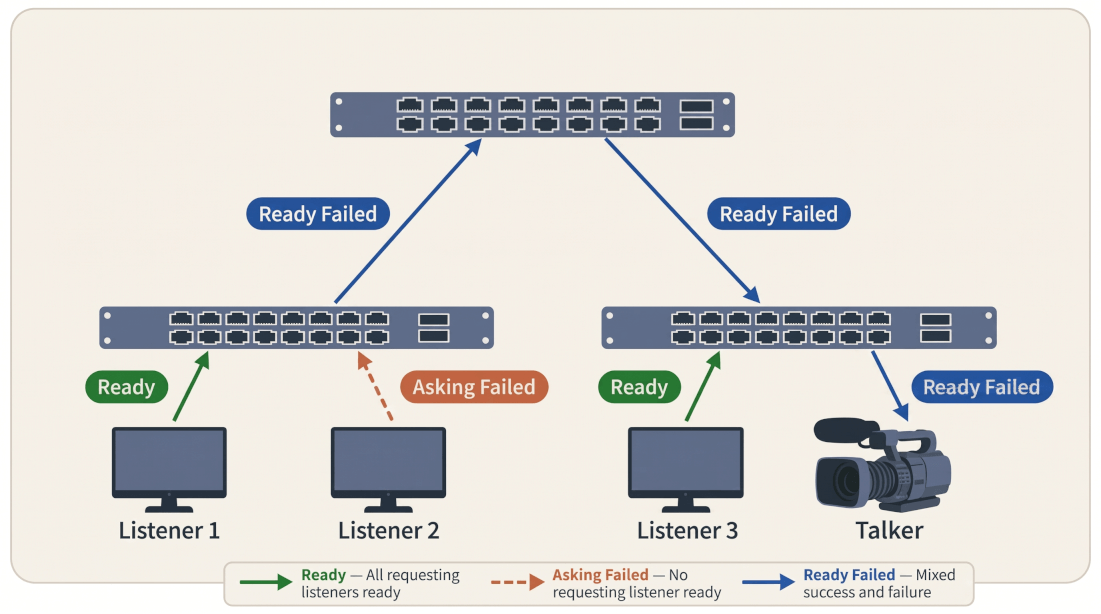
A successful reservation installs the Layer 2 multicast forwarding state in the bridges. Associated VLAN registration keeps VLAN membership on the relevant ports without manual configuration.
4.3 FQTSS and the Credit-Based Shaper (IEEE 802.1Qav)
Class | Role | Worst-case network latency target over 7 hops | Per-hop budget |
|---|---|---|---|
SR Class A | Higher-priority reserved media | 2 ms | ≈ 0.29 ms |
SR Class B | Lower-priority reserved media | 50 ms | ≈ 7.1 ms |
Control | gPTP, MSRP | Needs appropriate priority treatment | — |
Best effort | Non-reserved traffic | Uses remaining transmission opportunities | — |
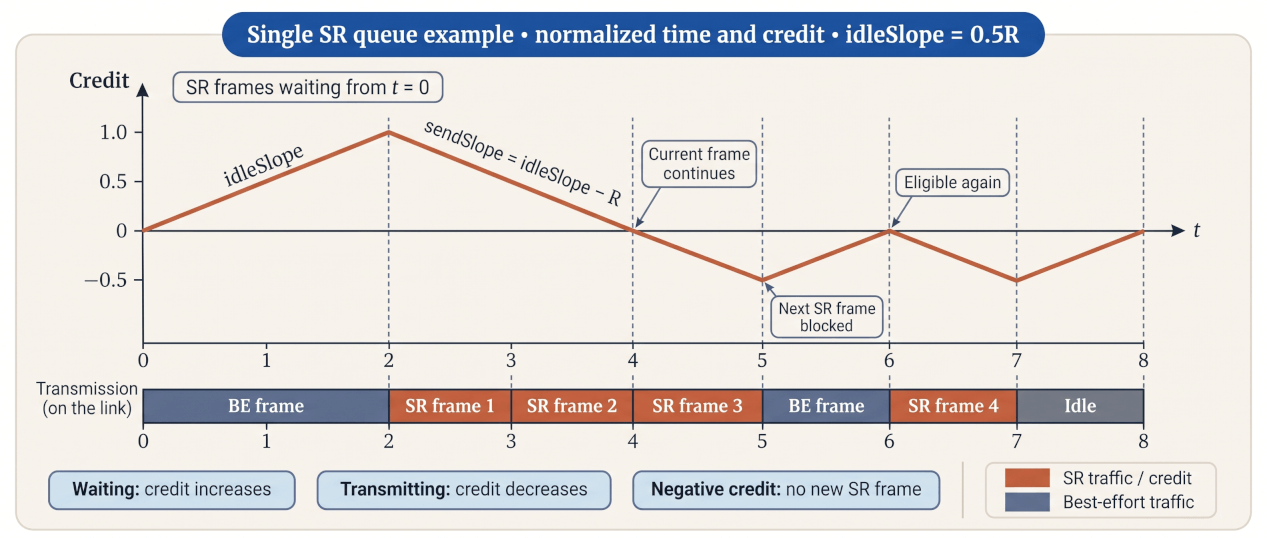
Class A uses a 125 µs observation interval (8,000 frames per second per stream) and Class B uses 250 µs. The shaper behaves as follows:
While frames wait and the port sends other traffic, the queue's credit rises at
idleSlope, which equals the bandwidth allocated to the queue.When credit is non-negative, the queue may transmit; during transmission credit falls at
sendSlope = idleSlope − port transmit rate.If credit is negative when a frame ends, the queue waits while credit recovers at
idleSlope, and other eligible queues can send. This limits consecutive bursts from the SR queue.
Example: on a 1 Gbps port with one 16.5 Mbps stream allocated, sendSlope = 16.5 − 1000 = −983.5 Mbps.
Capacity Arithmetic for Audio Streams
Reservation counts L2 overhead. Per-frame wire cost = AVTP payload + 24 B AVTP header + 42 B Ethernet overhead (preamble, IFG, MAC addresses, VLAN tag, EtherType, FCS).
Example stream: Class A, 48 kHz, 8 channels, 32-bit samples.
Item | Value |
|---|---|
Samples per channel per 125 µs | 6 |
AVTP payload | 8 × 6 × 4 B = 192 B |
Frame cost on the wire | 192 + 24 + 42 = 258 B = 2,064 bits |
Bandwidth per stream | 2,064 bits ÷ 125 µs = 16.5 Mbps |
Streams at 750 Mbps reservable (1GbE, 75%) | 45 |
Channels at 750 Mbps reservable | 360 |
These counts bound reservation, not switch capability. Number of MSRP streams a given switch can hold is a separate limit.
Selection Matrix: SDI, AVB, SMPTE ST 2110
Dimension | SDI | AVB (IEEE 802.1 + AVTP) | SMPTE ST 2110 |
|---|---|---|---|
Medium and layer | Coax, BNC, point-to-point | Ethernet, Layer 2 | Ethernet, IP/UDP/RTP |
Switching | Router crosspoints | Ethernet switches, L2 multicast state from MSRP | Ethernet/IP switches, IP multicast |
Timing | Plant reference | 802.1AS gPTP | PTP profile per ST 2059-2 |
Bandwidth assurance | Fixed per circuit | Per-stream reservation (MSRP) with CBS | No per-stream reservation in the standard suite; fabric is dimensioned and managed externally |
Latency bound | Fixed | Class A ≤ 2 ms, Class B ≤ 50 ms over 7 hops | Set by fabric design and receiver buffering |
Scaling unit | Add links (quad-link for 8K) | Link rate, with reservable share capped | Link rate |
Uncompressed multi-Gbps video | Native (up to quad-link 12G) | Bounded by reservable bandwidth | Native (ST 2110-20) |
Typical use | Production, distribution, playout | Conferencing, sound reinforcement, recording, in-vehicle | Networked media production and distribution |
AVB carries media between AVB-capable devices using automatic reservation and a shared time reference, and SDI equipment can join through gateways.
Applicability and Boundaries
Fits
A single Layer 2 domain with 7 or fewer hops and AVB-capable bridges throughout.
Multichannel audio: meeting rooms and multipurpose spaces, theaters and venues (stage boxes, consoles, loudspeaker systems), recording and monitoring (audio interfaces, digital consoles, workstations), and in-vehicle infotainment (head units, amplifiers, displays).
Systems where per-stream bandwidth and latency must hold while ordinary traffic shares the link.
Evaluate Before Committing
Situation | Reason |
|---|---|
Mixed-vendor endpoints | Interoperability depends on the profile each device implements; test Talker/Listener pairs |
Utilization above the reservable share | Admission control rejects streams past the cap; plan link rates, not average load |
Redundancy requirements | Redundancy is not part of the mechanisms described here; discuss the options with our engineers |
Large stream counts | MSRP stream capacity and CBS queue resources differ per switch model; check them for the selected model |
Wireless or routed segments | AVB mechanisms operate per hop at Layer 2 |
In-vehicle media | In-vehicle infotainment (head units, amplifiers, displays) is an AVB application. Component selection for this case depends on vehicle Ethernet requirements, which you can discuss with our engineers |
Out of Scope
Requirement | Reason |
|---|---|
Uncompressed 4K/8K video replacing SDI | Bandwidth arithmetic in Section 2; evaluate ST 2110 for this role |
Paths through non-AVB bridges | gPTP, MSRP, and shaping must be present on every hop |
Routed or WAN transport | Reservation and timing are Layer 2 mechanisms |
Asteraix AVB Switches
Asteraix AVB network switches provide wire-speed forwarding, hardware timestamping for clock synchronization, and AVB resource reservation and traffic shaping, for meeting rooms, live events, recording, and in-vehicle media. Port counts, latency, timestamp accuracy, CBS queues per port, and MSRP stream capacity are model-specific; check the datasheet of the selected model.
Validation Checklist
gPTP: grandmaster election behavior, time error across 7 hops against the 1 µs target, and recovery after grandmaster loss.
MSRP: maximum concurrent streams per switch and per port, behavior on Talker Failed, and teardown time.
CBS: configured
idleSlopeagainst the reserved sum, and Class A / Class B queue mapping.Latency: measured Class A transit over 7 hops under full best-effort load, against 2 ms.
Reservable share: configured percentage and the resulting stream count per port.
Endpoint interoperability: Talker/Listener pairs from each vendor in the system.
Gateways: SDI-to-network gateway latency and the audio embed/de-embed path.
Conclusion
AVB gives Ethernet the three properties SDI had by construction: a shared clock, reserved bandwidth, and bounded queuing. It fits audio-centric and bandwidth-bounded media in a single Layer 2 domain of 7 hops or fewer, where each bridge is AVB-capable. It does not carry uncompressed multi-Gbps video: 8K60 4:2:2 10-bit needs about 39.8 Gbps against a 0.75 Gbps reservable share on 1GbE. For SDI replacement in video, size the stream rates first and decide between AVB and ST 2110 on that number.