

/
48 x 25Gb SFP28, 6 x 100Gb QSFP28, Network Packet Broker
24 MB
Packet Buffer
2.0 Tbps
Broker Throughput
4.5K
Wildcard Filter
OCTEON DPU
Optional
The PX306P-48Y-M is a 1U network packet broker
that delivers 48× 25G SFP28 ports plus 6× 100G QSFP28 (40G QSFP+ compatible) uplinks for 2.0 Tbps of processing capacity, with a forwarding rate of 2.6 Bpps for non-blocking core-layer performance. Built on the Marvell Prestera Falcon ASIC and running PB-APP, Enterprise SONiC (AsterNOS), the PX306P-48Y-M each 100G port further breaks out to 4×25G or 4×10G, so a single packet broker can fan out to a large number of downlink connections with flexible topology choices.
Two-tier packet broker: PB-APP on the switch, FusionNOS on the DPU
The PX306P-48Y-M runs PB-APP on the Marvell Prestera Falcon switch ASIC, the same containerized packet-broker application used across Asterfusion's CX-M switch family, handling wire-speed traffic identification, filtering, replication, and load balancing across 48× 25G/10G and 6× 100G/40G ports. Up to two optional Marvell OCTEON CN103 DPU modules sit alongside the switch ASIC on the same 1RU chassis, each running FusionNOS to add deep packet inspection functions — application-layer protocol matching, signaling-protocol decoding, packet deduplication, and SSL decryption — without moving traffic off-box to a separate appliance.
This two-tier design is aimed at metropolitan area networks, internet data centers, and enterprise environments where PB-APP's baseline aggregation and filtering are needed everywhere, but deep, protocol-aware processing on the DPU is only needed on a subset of flows.
Multi-level concurrent policy processing
Traffic policies can be applied independently at the inbound interface, at intermediate links, and at the outbound interface of the same pipeline, with L2/L3/L4/L7 filtering rules combined at each stage. Traffic replication can apply either a single unified filtering policy or independent policies per replica, so the same source traffic can feed different backend systems with different subsets of fields.
Intelligent signaling and user-plane correlation
For mobile core deployments, the PX306P-48Y-M decodes and tracks signaling protocols across interfaces, extracts and reconstructs specified signaling packets for delivery to backend analytics systems, and marks correlation between signaling-plane and user-plane traffic — allowing filtering and distribution decisions to be made on the correlated pair rather than either plane alone.
Resilient load balancing and high reliability
Load balancing can be applied by source/destination IP, port, 5-tuple, or MAC, including hashing on inner IP N-tuples for tunneled traffic, with configurable hash seeds and weighted distribution. A fault-tolerant protection mechanism redirects traffic from a failed link in a load-balancing group onto the remaining links without disturbing traffic already on those links. Separately, interface and link-group master/backup pairs support automatic failover and recovery, and interface/link-group linkage lets a group of interfaces go down together when a designated interface fails.
Timing and management
1PPS and Time-of-Day (ToD) PTP interfaces, plus a GNSS antenna input, provide high-accuracy time synchronization for time-sensitive applications. The platform is managed through CLI, Web UI (with graphical, multi-user, decentralized or centralized management), RESTful API, SNMP/SNMP Trap, and Ansible, with RADIUS/TACACS+ centralized authentication for third-party tool integration.
Optional DPU: Advanced Traffic Processing
The PX306P-48Y-M ships with 2 DPU extension slots. Left empty, the switch runs PB-APP alone, handling wire-speed filtering, replication, and load balancing on the Falcon ASIC. Installing one or two Marvell OCTEON CN103 modules — each an 8-core Arm v9 processor running Asterfusion FusionNOS — adds a second, protocol-aware processing layer in-line, without sending traffic off-box to a separate appliance.
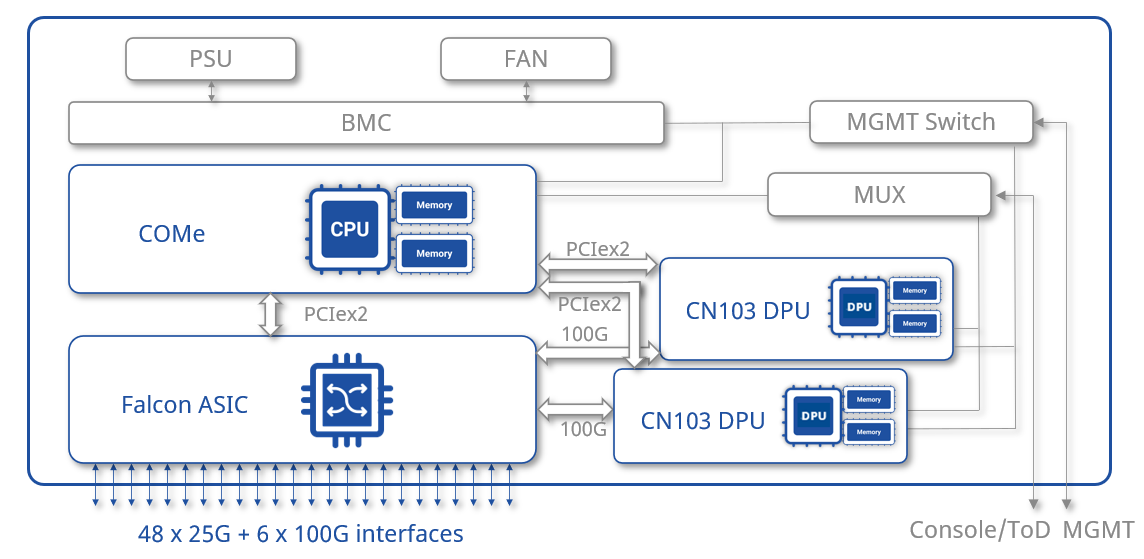
What the DPU adds on top of PB-APP
Application and signaling awareness — decodes mobile-core signaling protocols (S1AP, Diameter, SIP, GTPv0/v1/v2, NGAP, HTTP2/REST) and application-layer protocols (HTTP, HTTPS, Email, FTP, POP3, SMTP, DNS, RADIUS, CoAP), where PB-APP alone matches on header fields
Targeted extraction — matches traffic against a specific IMSI or a specific URL (full Host field), and against SIP/RTP/RTCP messages for VoLTE signaling- and media-plane traffic
Centralized decryption and deduplication — optional SSL encryption/decryption and packet deduplication performed once, in-line, instead of repeated on every downstream analysis tool
Payload-level signatures — signature rules at a fixed L2/L3/L4 offset, a fixed position, or within a floating-window range, with rules combinable into compound match conditions
Deeper preprocessing — IP fragment reassembly, field masking, configurable-rate flow sampling, and header-only output limited to the network and transport layers
When it's needed
A base PX306P-48Y-M without DPU modules is enough where filtering, replication, and load balancing on standard header fields cover the monitoring requirement — the same scope as Asterfusion's PX-M packet broker family. Adding DPU modules makes sense once backend tools need visibility into decrypted payloads, application- or signaling-layer content, or de-duplicated, session-correlated traffic — typically mobile-core, security-inspection, or compliance-driven deployments where header-level filtering alone isn't sufficient. DPU modules can be added at time of order or installed later, up to the platform's 2 slots.
PB-APP + FusionNOS
PB-APP is Asterfusion's network packet broker application, running as a containerized service on AsterNOS — Asterfusion's enterprise SONiC distribution — directly on the Marvell Prestera Falcon switching silicon, handling aggregation, filtering, replication, and load balancing at line rate across the platform's 48x 25G/10G and 6x 100G/40G ports. PB-APP ships preloaded with a perpetual software license and runs independently of the platform's optional DPU modules.
FusionNOS is Asterfusion's software layer for the platform's optional Marvell OCTEON CN103 DPU modules, adding a protocol- and payload-aware processing layer in-line — signaling and application-layer decoding, packet deduplication, and SSL decryption — on top of PB-APP, without moving traffic off the chassis. Both are configured and monitored through an intuitive Web UI. FusionNOS ships preloaded on each installed DPU module.
PB-APP — Interface Features
— Header Stripping & Hash Capabilities
— Traffic Filtering & Matching (Ingress/Egress)
— Forward Policy & Load Balancing
— Rule & Policy Management
— Mgmt & Monitoring
FusionNOS — Advanced Protocol & Application Matching
— Signaling & User-Plane Correlation
— Enhanced Rule Matching
— Deep Packet Processing
— Statistics
Marvell® Prestera® Falcon 2.0T–12.8T (Prestera 98CX85xx family)
The CX-N-V2 data center switch family is built on Marvell’s 9th-generation, 16nm Prestera Falcon packet processors, scaling from 2.0 Tbps leaf platforms through 3.2 Tbps spine/leaf designs to 12.8 Tbps high-radix spine switches within the same merchant-silicon architecture. Falcon pairs large shared L2/L3 forwarding and LPM tables with a globally shared, dynamic-threshold packet buffer for superior microburst absorption under heavy east-west load. Exposing the standard SAI and TAM APIs, it is what lets open SONiC-based AsterNOS run consistently across the entire CX-N-V2 line — with no proprietary forwarding stack and no feature licensing.
Architecture & performance
9th-generation, 16nm Marvell Prestera Falcon — 2.0 Tbps to 12.8 Tbps wire-speed switching across the 98CX85xx family
Large shared tables: 128K MAC, 288K IPv4 / 144K IPv6 prefixes, high-scale multi-tenant L2/L3
Globally shared packet buffer with dynamic thresholds for microburst (µBurst) absorption
Cut-through switching and dynamic load balancing (DLB) across the fabric
Virtualization & overlays
eBridge unified virtualization architecture with hardware-based interface/domain virtualization
Programmable header editor: hardware-accelerated VXLAN, VXLAN-GPE, Geneve and NSH
MPLS and IPv6 segment routing for flexible transport
RDMA, telemetry & openness
RoCEv2-aware congestion management for lossless RDMA storage and AI/ML traffic
In-band network telemetry built into the data path — sFlow, IPFIX, remote port analysis
Open Switch Abstraction Interface (SAI) + Telemetry & Monitoring (TAM) APIs — merchant-silicon foundation for SONiC/AsterNOS
| Network packet broker family datasheet | PX306P-48Y-M Network Packet Broker Datasheet (PDF) |
| Quick start guide for AsterNOS CLI | AsterNOS Documentation |
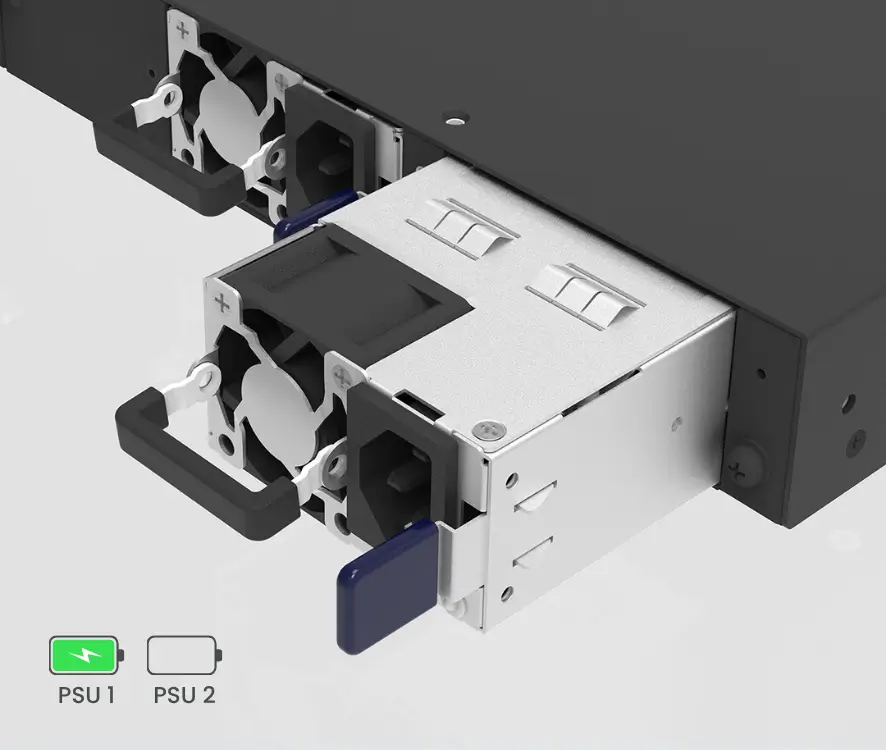
The dual 1+1 hot-swappable power supplies ensure continuous operation by allowing replacement without system shutdown.
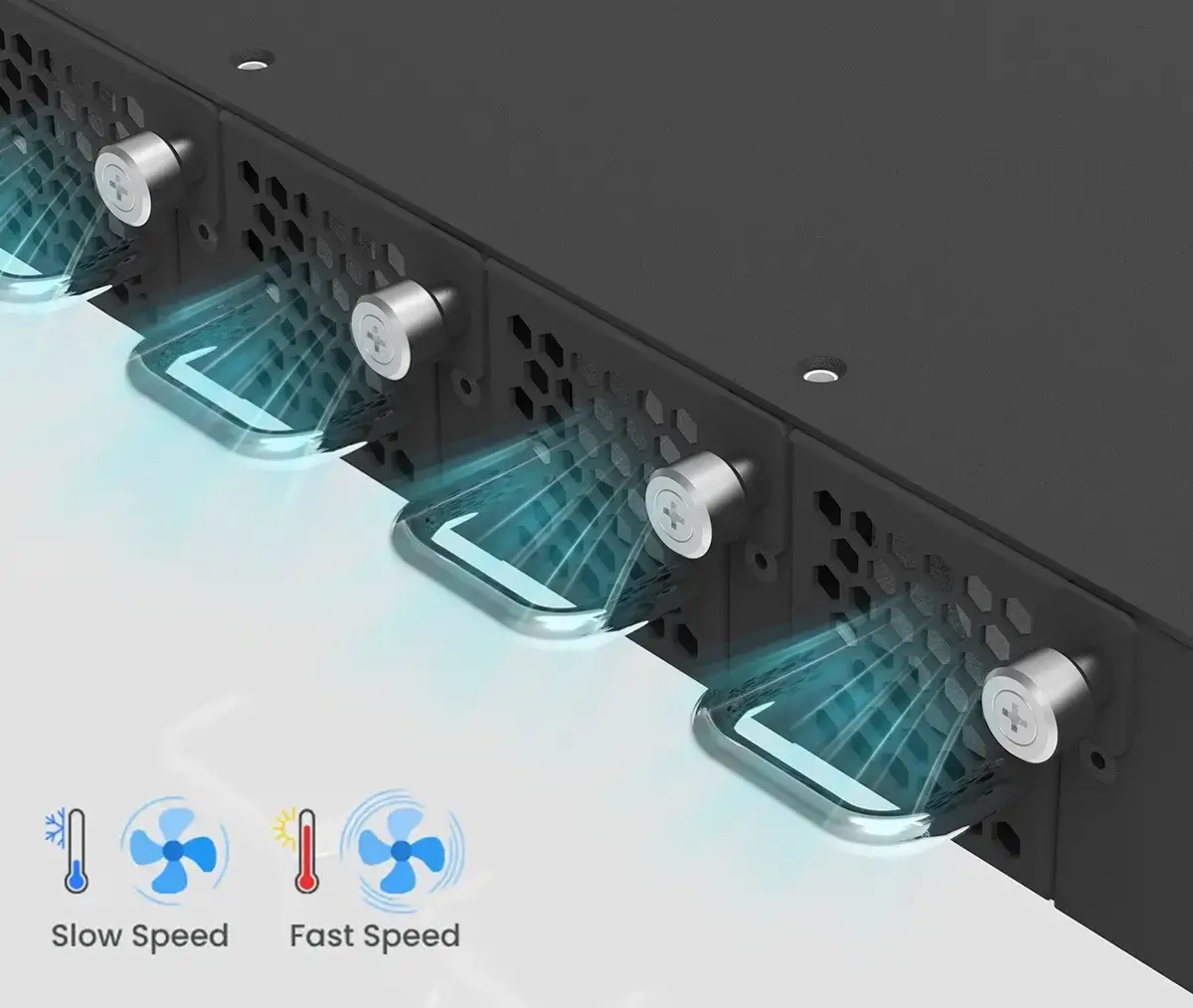
Equipped with 3+1 hot-swappable fan modules, the system delivers reliable cooling performance to maintain stability and efficiency under demanding workloads.
| CERTIFICATE |  ISO 9001 ISO 9001 |  ISO 14001 ISO 14001 |  ISO 45001 ISO 45001 |  ISO 27001 ISO 27001 |  FCC FCC |  CE CE |
| SCOPE | Quality management system | Environmental management | Occupational health and safety | Information security management | US radio frequency compliance | EU health, safety and environmental compliance |