
Wi-Fi 7E:
The Real Story
Nobody Told You
You searched for Wi-Fi 7E. There's a reason it doesn't officially exist — and understanding why will change how you think about your next wireless upgrade.
QUICK ANSWER
Wi-Fi 7E does not officially exist as a separate standard. Unlike the jump from Wi-Fi 6 → Wi-Fi 6E (which added the 6 GHz band to an existing standard), Wi-Fi 7 (IEEE 802.11be) was engineered from day one to operate natively across all three bands — 2.4 GHz, 5 GHz, and 6 GHz — with Multi-Link Operation (MLO). There was no need for an "Extended" edition. Wi-Fi 7 is already the extended version. The 6 GHz story doesn't end there, though: the unlicensed upper 6 GHz spectrum (6.425–7.125 GHz) is an ongoing regulatory battleground that will shape what Wi-Fi 7 — and Wi-Fi 8 — can ultimately deliver.
Why Everyone Expects a "Wi-Fi 7E"
The confusion is perfectly reasonable. The Wi-Fi Alliance established a naming pattern that conditioned people to expect an "E" edition for every generation:
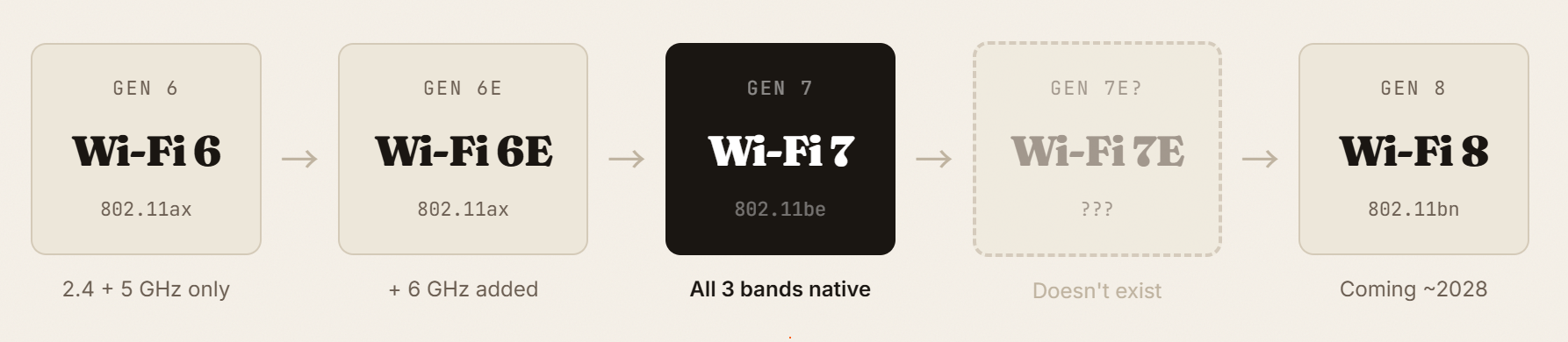
Wi-Fi 6E existed because the 6 GHz band opened after Wi-Fi 6 had already been standardized. It was an amendment to an existing standard — the same 802.11ax, just with a new band unlocked. The Wi-Fi Alliance called it "Extended" to distinguish the hardware.
Wi-Fi 7 (802.11be) was a completely new standard built from scratch. The 6 GHz band was baked in from the first draft in 2021. There was no "Wi-Fi 7 without 6 GHz" to extend. The "E" concept simply had no engineering reason to exist.
✓ What This Means for You
If you're buying a Wi-Fi 7 access point, it already is the "E" version. You're getting the 6 GHz band, plus Multi-Link Operation, 320 MHz channels, and 4096-QAM — all in a single product. No waiting for a future extended edition.
The 6 GHz Band: Why It Changed Everything
To understand why "Wi-Fi 7E" would have been the wrong name — and why Wi-Fi 7 is so significant — you have to understand what the 6 GHz band actually opened up.
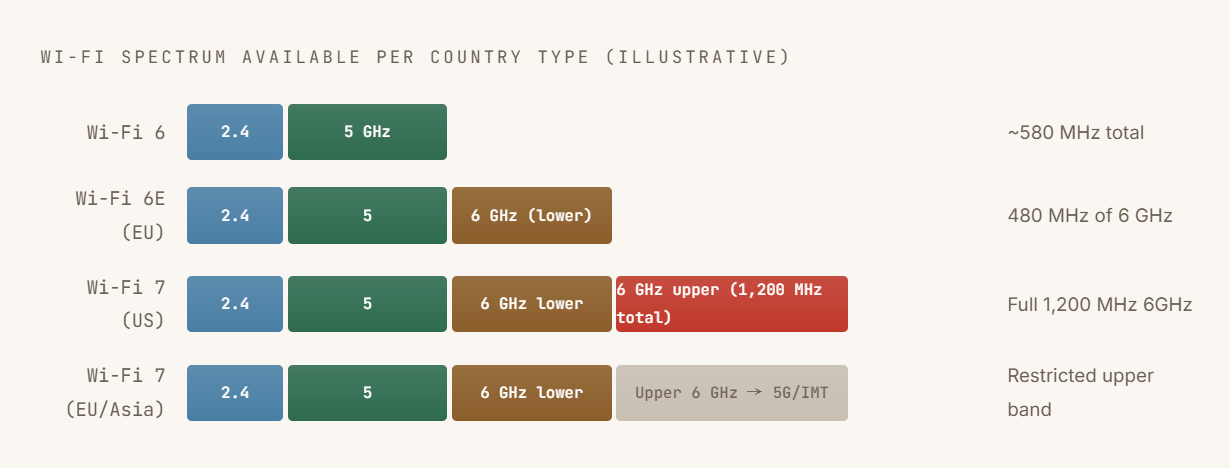
The United States, Canada, Brazil, and South Korea allocated the entire 6 GHz band (5.925–7.125 GHz) for unlicensed Wi-Fi use — giving Wi-Fi 7 access to a full 1,200 MHz of clean, uncrowded spectrum. This is where those 320 MHz channels actually live.
The European Union, most of Asia (including China), and many other markets currently only allow the lower 480 MHz portion of the 6 GHz band for Wi-Fi. The upper half is contested between Wi-Fi and 5G/IMT operators — a debate that is still playing out at regulatory bodies worldwide following the 2023 World Radiocommunication Conference (WRC-23).
⚠ Regional Note
If you're deploying Wi-Fi 7 access points outside the US, verify your local 6 GHz regulatory allowance before planning 320 MHz channel deployments. In some EU and Asian regions, only 160 MHz channels in the lower 6 GHz band may be available — still significantly better than Wi-Fi 6E, but not the full 320 MHz potential.
"Wi-Fi 7E doesn't exist because Wi-Fi 7 already ate what it would have been — and then went much further."
Wi-Fi 7E Myths vs. Facts
Given how widespread the confusion is, let's put the most common misconceptions to rest directly.
✗ Myth
"Wi-Fi 7E is the version of Wi-Fi 7 that adds the 6 GHz band, like 6E added it to Wi-Fi 6."
✓ Fact
Wi-Fi 7 already uses all three bands natively — including 6 GHz. There is no stripped-down "Wi-Fi 7 without 6 GHz" that needs an "E" upgrade path.
✗ Myth
"I should wait for Wi-Fi 7E before upgrading my business network."
✓ Fact
There is no Wi-Fi 7E coming. The next step after Wi-Fi 7 is Wi-Fi 8 (802.11bn), expected around 2028. Waiting means missing 2–3 years of real performance gains.
✗ Myth
"Wi-Fi 7E and Wi-Fi 6E are essentially the same thing."
✓ Fact
Wi-Fi 6E is a real standard (802.11ax with 6 GHz). Wi-Fi 7E is not a real standard. They can't be compared because only one of them actually exists.
✗ Myth
"Wi-Fi 7 is just Wi-Fi 6E with a number bump."
✓ Fact
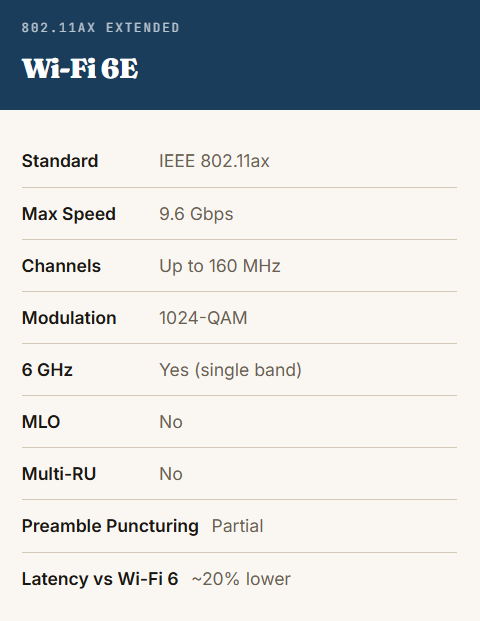
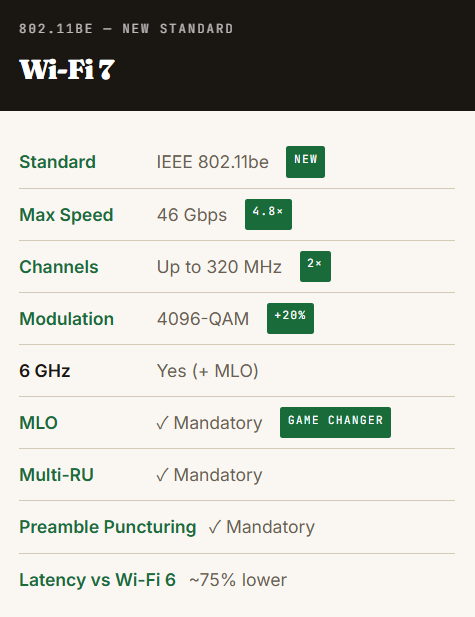
Wi-Fi 7 is built on a completely new standard (802.11be vs 802.11ax). Multi-Link Operation, 4096-QAM, 320 MHz channels, and MRU are all architectural advances that don't exist in Wi-Fi 6E.
Wi-Fi 6E vs. Wi-Fi 7: What You Actually Need to Compare
Since "Wi-Fi 7E" doesn't exist, the comparison most searchers are really looking for is Wi-Fi 6E vs. Wi-Fi 7. Here's the comprehensive breakdown.
| Feature | Wi-Fi 5 | Wi-Fi 6 | Wi-Fi 6E | Wi-Fi 7 |
|---|---|---|---|---|
| IEEE Standard | 802.11ac | 802.11ax | 802.11ax | 802.11be |
| Max Throughput | 3.5 Gbps | 9.6 Gbps | 9.6 Gbps | 46 Gbps |
| Frequency Bands | 2.4 + 5 GHz | 2.4 + 5 GHz | 2.4 + 5 + 6 GHz | 2.4 + 5 + 6 GHz |
| Max Channel Width | 80 MHz | 160 MHz | 160 MHz | 320 MHz |
| Modulation | 256-QAM | 1024-QAM | 1024-QAM | 4096-QAM |
| Multi-Link Operation | ✗ | ✗ | ✗ | ✓ Mandatory |
| Simultaneous Multi-Band | ✗ | ✗ | ✗ | ✓ MLO |
| Preamble Puncturing | ✗ | ✗ | Partial | ✓ Mandatory |
| Multi-RU (MRU) | ✗ | ✗ | ✗ | ✓ Mandatory |
| WPA3 Security | ✗ | ✓ | ✓ | ✓ Enhanced |
| OFDMA | ✗ | ✓ | ✓ | ✓ Improved |
| Backward Compatible? | N/A | ✓ | ✓ | ✓ Yes |
The key insight in this table: Wi-Fi 6E and Wi-Fi 7 share the same frequency bands, but they are fundamentally different standards. Wi-Fi 6E is still one-band-at-a-time; Wi-Fi 7 breaks that limitation entirely with MLO. For any buyer evaluating an upgrade from Wi-Fi 6E infrastructure, the meaningful comparison is MLO and 320 MHz channels — not just "is 6 GHz included?" (because both have it).
The Full 6 GHz Opportunity: UNII-5 Through UNII-8
The 6 GHz band isn't a single monolithic block. In the United States, the FCC designated four sub-bands across 5.925–7.125 GHz for unlicensed Wi-Fi use:
UNII-5 (5.925–6.425 GHz) — 500 MHz. Available in the US, EU, and many other countries. This is what Wi-Fi 6E primarily uses, and what most "global" Wi-Fi 7 APs are designed around.
UNII-6 (6.425–6.525 GHz) — 100 MHz. US-only. Added to Wi-Fi 7's available spectrum for Indoor Access Points in the US.
UNII-7 (6.525–6.875 GHz) — 350 MHz. US/Canada. The band that makes full 320 MHz channel deployments genuinely practical at scale.
UNII-8 (6.875–7.125 GHz) — 250 MHz. US/Canada (standard power outdoor). Part of the regulatory expansion that is driving the 5G vs. Wi-Fi spectrum battle globally.
Together, UNII-5 through UNII-8 give US Wi-Fi 7 deployments access to 1,200 MHz of clean 6 GHz spectrum — enough for three simultaneous non-overlapping 320 MHz channels. This is architecturally significant for high-density deployments where you need multiple APs to coexist without interference.
📡 The AFC Factor
Automated Frequency Coordination (AFC) is an optional Wi-Fi 7 feature that allows access points to dynamically query a database of licensed users in the 6 GHz band and increase their transmit power accordingly. In practice, AFC can give Wi-Fi 7 APs outdoor range comparable to 5 GHz — addressing the main real-world limitation of 6 GHz deployments. Not all Wi-Fi 7 APs support AFC yet; check product specifications if outdoor coverage range is a priority for your deployment.
The 3 Reasons Wi-Fi 7 Makes Wi-Fi 6E Genuinely Obsolete
If you're currently on Wi-Fi 6E and wondering whether to upgrade — or evaluating your first serious enterprise wireless deployment — here's why Wi-Fi 7 isn't just a minor iteration.
1. Multi-Link Operation Is a Structural Shift
Wi-Fi 6E can use the 6 GHz band. But it can only use one band at a time per device. A Wi-Fi 6E client on the 6 GHz band isn't also using 5 GHz simultaneously — it's just on 6 GHz, with the other bands as fallbacks. When congestion hits or a device moves out of range of the 6 GHz signal, there's a handoff delay. In video calls, that's a frozen frame. In gaming, it's a packet loss spike.
Wi-Fi 7's MLO eliminates this entirely. An MLO-capable device maintains simultaneous active connections on multiple bands and routes each packet on whichever path is fastest at any given moment. The network appears seamless because it genuinely is seamless — not because the device switches quickly, but because switching isn't happening at all.
2. 320 MHz Doubles Throughput vs. 6E's Best
Wi-Fi 6E's best channel is 160 MHz in the 6 GHz band. A single Wi-Fi 7 channel at 320 MHz carries twice the data in the same time — and this isn't just a spec sheet number. For applications that are genuinely throughput-limited (high-resolution video production, AR/VR streams, large file transfers, backup over wireless), doubling the channel width is immediately noticeable. The 6 GHz band was specifically designed with enough spectrum headroom to make 320 MHz practical without immediate congestion — which is exactly why the spectrum battle with 5G operators has been so fierce.
3. Preamble Puncturing Changes Dense Deployment Economics
In a multi-AP deployment — an office floor, a hotel, a university campus — every AP is a potential interference source for its neighbors. Wi-Fi 6E's interference management is binary: if a portion of your 160 MHz channel is interfered with, the system backs down to a narrower channel, sacrificing throughput for all users. Wi-Fi 7's mandatory preamble puncturing surgically masks only the interfered sub-channels, keeping the rest fully active. The practical effect is that Wi-Fi 7 APs maintain higher throughput under interference conditions that would have degraded a Wi-Fi 6E deployment significantly, which means you need fewer APs to achieve equivalent coverage performance in challenging RF environments.
The Wi-Fi Generation Timeline: Where We Are Now
To understand why "Wi-Fi 7E" would have been the wrong name — and why Wi-Fi 7 is so significant — you have to understand what the 6 GHz band actually opened up.
2019
Wi-Fi 6 (802.11ax)
Introduced OFDMA, MU-MIMO, Target Wake Time. Focused on efficiency in dense environments. 2.4 + 5 GHz only.
2021
Wi-Fi 6E (802.11ax + 6 GHz)
Same 802.11ax standard, newly unlocked 6 GHz band added. First access to 1,200 MHz of clean spectrum in the US. First products shipped Q4 2021.
2024 — Now
Wi-Fi 7 (802.11be) ← You Are Here
Wi-Fi Alliance certification launched January 2024. 269 million devices shipped in 2024 alone. MLO, 320 MHz, 4096-QAM. The "Wi-Fi 7E" that never needed to exist. Enterprise deployments accelerating through 2025–2026.
~2028
Wi-Fi 8 (802.11bn) — Coming Next
Currently in early standardization. Expected to introduce Multi-AP Coordination at a new level, Extremely High Throughput beyond 100 Gbps, and potential operation in higher spectrum bands. This — not "Wi-Fi 7E" — is the next chapter.
Wi-Fi 7 Access Points — Built for the Full 6 GHz Era
No Wi-Fi 7E. No waiting. Every Asteria Wi-Fi 7 AP ships with the full tri-band platform — 2.4 GHz + 5 GHz + 6 GHz — with native MLO and cloud management included.
Ceiling Mount
AP7330
Ceiling-plate AP for hotel rooms, dorms, and per-room deployments where aesthetics and multi-gigabit connectivity with 10 GbE uplink matter.
Standard
Wi-Fi 7 (802.11be)
Max Speed
9 Gbps
Bands
2.4 + 5 + 6 GHz
Uplink Port
10 GbE
Best For
Hospitality / MDU
Indoor
AP7360
The workhorse of enterprise deployments. Tri-band Wi-Fi 7 with 18 Gbps max throughput and PoE++ (802.3bt) and 10GbE SFP+ uplink.
Standard
Wi-Fi 7 (802.11be)
Max Speed
18 Gbps
Bands
2.4 + 5 + 6 GHz
Uplink Port
10 GbE
Best For
Office / Enterprise
Wi-Fi 7E Questions — Answered Directly
Is Wi-Fi 7E a real standard?No. Wi-Fi 7E is not a standard recognized by the Wi-Fi Alliance or IEEE. The "E" suffix (for "Extended") was specifically used for Wi-Fi 6E to mark the extension of 802.11ax to the 6 GHz band. Since Wi-Fi 7 (802.11be) was designed from scratch to natively support all three bands including 6 GHz, there was no need for an "Extended" edition. Searches for "Wi-Fi 7E" are typically from people expecting the naming pattern to repeat — but the pattern broke intentionally at Wi-Fi 7.
What's the difference between Wi-Fi 6E and Wi-Fi 7?Wi-Fi 6E and Wi-Fi 7 both operate on the 2.4, 5, and 6 GHz bands, but that's where the similarities end. Wi-Fi 6E is still the 802.11ax standard — it can only connect to one band at a time per device, tops out at 160 MHz channels, and uses 1024-QAM modulation. Wi-Fi 7 is a completely new standard (802.11be) that introduces Multi-Link Operation (simultaneous multi-band connections), 320 MHz channels (2× the width), 4096-QAM modulation (20% more data per symbol), mandatory preamble puncturing, and Multi-Resource Unit allocation. In real-world terms, Wi-Fi 7 is 4–5× faster, has substantially lower latency under load, and handles interference dramatically better than Wi-Fi 6E.
Will there be a Wi-Fi 7E in the future?Almost certainly not under that name. The Wi-Fi Alliance has not announced a Wi-Fi 7E, and there is no ongoing standardization work under that designation at IEEE 802.11. The most likely future scenario is that the upper 6 GHz band (6.425–7.125 GHz) gradually becomes available in more countries as regulatory frameworks settle, which would benefit Wi-Fi 7 and Wi-Fi 8 deployments in those regions — but that would be a regulatory change, not a new standard called "Wi-Fi 7E." The next official generation is Wi-Fi 8 (802.11bn), currently in early standardization.
Is a Wi-Fi 7 access point better than a Wi-Fi 6E access point for my business?For most business deployments in 2026, yes. Wi-Fi 7 APs deliver measurably better performance under load — which is precisely the condition business networks experience during peak occupancy. MLO reduces connection drops during roaming (critical in multi-AP deployments), preamble puncturing maintains throughput when neighboring APs or Bluetooth devices cause interference, and the 320 MHz channel option provides headroom for high-bandwidth workloads. Additionally, Wi-Fi 7 APs are backward compatible with all existing Wi-Fi 6E and Wi-Fi 6 clients, so your existing device fleet continues to work without changes. From a hardware lifecycle perspective, Wi-Fi 7 APs purchased in 2026will remain current-generation for longer than Wi-Fi 6E APs purchased today.
Does Wi-Fi 7 work in countries where only the lower 6 GHz band is available?Yes, Wi-Fi 7 works perfectly in regions where only UNII-5 (the lower 480 MHz of the 6 GHz band) is available — which covers most of the EU and many Asian countries. In these regions, 320 MHz channels are still possible within the available spectrum (480 MHz provides room for one 320 MHz channel with guard bands), though channel planning requires more care. MLO, 4096-QAM, preamble puncturing, and other Wi-Fi 7 features all function regardless of the specific 6 GHz sub-band available. The performance advantage over Wi-Fi 6E remains significant even without access to the full 1,200 MHz of US-allocated 6 GHz spectrum.
What is Wi-Fi 8 and how does it relate to the Wi-Fi 7E question?Wi-Fi 8 (802.11bn) is the next generation after Wi-Fi 7, currently in the early stages of standardization at IEEE. It's expected to be ratified around 2028 and to deliver multi-hundred-gigabit theoretical throughput, Multi-AP Coordination (where multiple APs cooperate to serve clients jointly rather than competing), and potential operation in higher spectrum bands beyond 6 GHz. Wi-Fi 8 is what the "Wi-Fi 7E" searchers are often conceptually anticipating — a further evolution of the 6 GHz platform — but it will arrive as a fully new standard rather than an extended variation on Wi-Fi 7.
Are Wi-Fi 7 access points backward compatible with Wi-Fi 6E devices?Yes, fully. Wi-Fi 7 access points are backward compatible with Wi-Fi 6E, Wi-Fi 6, Wi-Fi 5, and most older clients. A Wi-Fi 6E device connecting to a Wi-Fi 7 AP will connect using the 6 GHz band at Wi-Fi 6E speeds — it just won't benefit from MLO, 320 MHz channels, or 4096-QAM, since those require a Wi-Fi 7 client. The 6 GHz band requires WPA3, so legacy devices without WPA3 support will need to connect on the 2.4 GHz or 5 GHz band — but that's the same limitation they'd face with a Wi-Fi 6E AP. Deploying Wi-Fi 7 APs in a mixed-generation network is safe and recommended — clients upgrade on their own schedule while the AP is already ready for the future.