
Broadcasting Company Achieves Ultra-Low Latency Live Streaming with PTP Solution
North America & Japan | Media & Entertainment | Live Streaming | Ultra-Low Latency
At a Glance
PTP Class C precision (<10ns) ensures nanosecond-level time synchronization for ST2110 media streams across multiple data centers.
VXLAN Multicast with BGP EVPN enables efficient multi-tenant media distribution while isolating different broadcast streams.
Dual data center architecture with geo-redundancy provides seamless failover for uninterrupted live broadcasting.
Mobile campus access allows outside broadcast vehicles to connect seamlessly to the main network fabric.
Supports 288K L2/L3 multicast entries (48K multicast groups in standard configurations) for large-scale live streaming operations.
Leaf-Spine architecture with EVPN multi-homing eliminates single points of failure for maximum network resilience.
Customer Background
A top-three live streaming media company in the United States and a major broadcasting organization in Japan required ultra-low latency network infrastructure to support professional live broadcasting and rebroadcasting scenarios. In the mass media industry, time synchronization accuracy and latency directly impact production quality, especially for distributed networks spanning multiple sites and regions. The customers needed a solution that could achieve synchronized distribution of ST2110 media streams across geographically dispersed locations while maintaining broadcast-level quality standards.
Challenges
- Time Synchronization Requirements: Professional broadcasting systems require nanosecond-level time alignment between video frames, audio streams, and ancillary data to ensure smooth program production and playback. Traditional network infrastructure could not meet SMPTE 2059 and ST2110 standards for IP-based media production.
- High-Bandwidth Multicast Distribution: Live media streams generate high-bandwidth, multi-destination multicast traffic that must be efficiently transmitted across multi-tenant, multi-site networks without interference or degradation.
- Geographic Redundancy: Live broadcasting cannot tolerate downtime. The customers required seamless failover between primary and backup data centers across different geographic regions.
- Mobile Production Support: Outside broadcast vehicles and temporary venue setups needed to connect to the main network infrastructure with the same precision timing and multicast access as permanent studio facilities.
- Scalability Constraints: The network needed to support massive multicast group counts while maintaining low latency and high reliability across the entire infrastructure.
Solution
Network Architecture Design
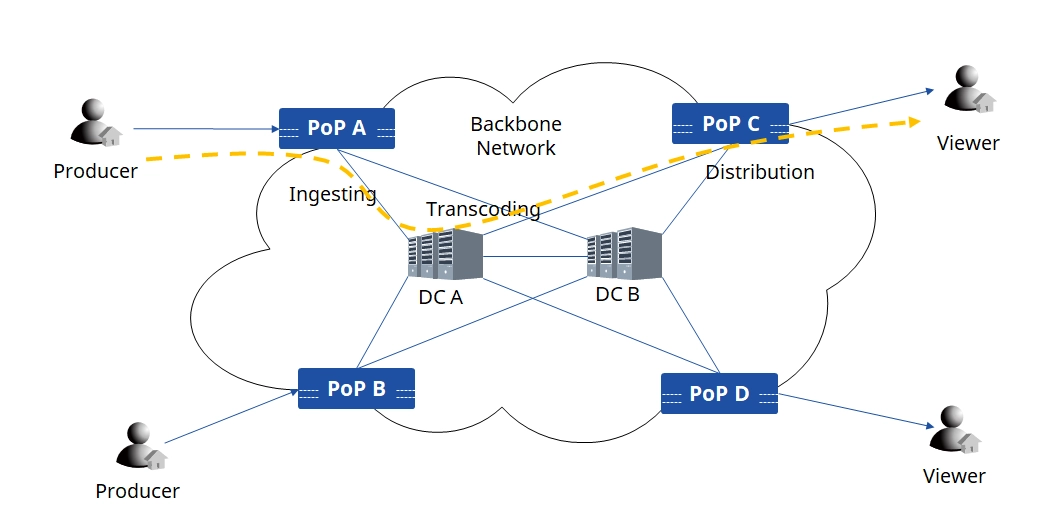
We deployed a comprehensive Leaf-Spine architecture with primary and backup data centers, plus three edge campus sites to improve geographic redundancy and reduce latency. The network utilizes BGP EVPN control plane with VXLAN multicast for efficient traffic distribution and scalable bandwidth utilization.
PTP Class C Time Synchronization
The CX732Q-N-V2 Falcon switches deployed at the Spine layer provide hardware-level PTP timing capabilities with IGMP v2/v3 support, implementing the ST2110 standard over IP networks. Configured as Boundary Clocks, these switches achieve end-to-end PTP precision of less than 10ns Class C, forwarding high-precision time signals from the Grandmaster clock to access layer devices.
The solution supports both Boundary Clock and Transparent Clock modes, making it suitable for multi-level clock distribution in Spine-Leaf fabrics. Standard SAI interface support ensures compatibility with mainstream broadcast control systems, with customization options available.
Device Configuration
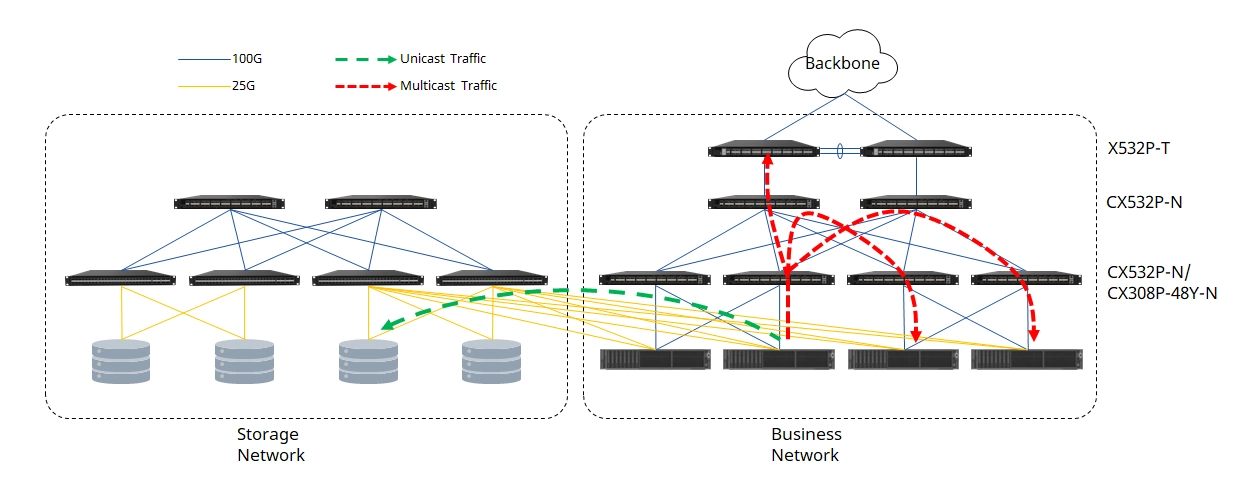
- Access Layer: Multiple CX204Y, CX206Y, and CX206P switches handle 1G and 10G access requirements, supporting burst traffic during live streaming and diverse bandwidth needs from office applications to 4K/8K ultra-high-definition video streams.
- Aggregation Layer: CX308P-48Y-M-H and CX532P-M-H switches provide 25G and 100G connectivity for high-performance traffic aggregation.
- Core Layer: CX732Q-M-H switches deliver 32x 400G ports with PTP Class C precision for ultra-low latency backbone connectivity.
Multicast VXLAN Overlay for Media Delivery
The VXLAN + BGP EVPN solution provides multi-tenant isolation using VNI (VXLAN Network Identifier), allowing different ST2110 media streams to coexist on the same physical infrastructure without interference. Multicast Underlay mode encapsulates BUM traffic (Broadcast, Unknown Unicast, Multicast) into VXLAN and maps it to multicast groups in the underlying IP network.
The Falcon platform supports up to 288K L2/L3 multicast shared entries, with typical configurations accommodating 48K multicast groups. Hardware-level PTP alignment achieves nanosecond-level synchronization between Spine and Leaf in the Overlay clock domain.
Highlights
VXLAN Multicast BUM Forwarding
Efficiently handles all non-unicast traffic within the VXLAN overlay network, using the Underlay network to replicate packets efficiently and reducing repeated copies at the source VTEP.
EVPN Multi-Homing
Provides redundant network paths for the access side, ensuring any single point of failure does not interrupt service and significantly enhancing overall network resilience.
PIM-SM Multicast
IGP establishes IP connectivity while PIM-SM multicast enables Spine switches to replicate traffic efficiently, with each VXLAN segment mapped to a dedicated multicast group for precise delivery.
Dual Data Center and Mobile Campus Architecture
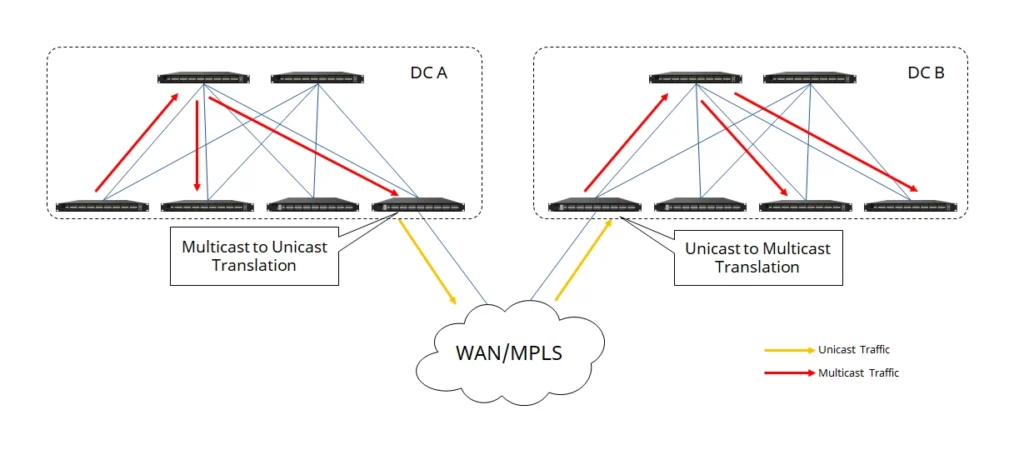
Disaster recovery redundancy between primary and backup data centers is achieved through VXLAN EVPN + MPLS WAN, allowing media streams to seamlessly switch between locations for business continuity. Mobile OB vans and temporary venue nodes connect as remote VTEPs to the main Fabric, ensuring synchronization with the core clock domain, whether in studio or field locations.
Results
Broadcast-Level Time Synchronization: PTP Class C precision (<10ns) ensures perfect alignment of video, audio, and data across all production equipment, eliminating frame misalignment and interaction delays.
Seamless Multi-Site Distribution: VXLAN Multicast with BGP EVPN enables efficient media stream distribution across primary DC, backup DC, and three campus sites with full multi-tenant isolation.
Zero-Downtime Operations: Dual data center architecture with EVPN multi-homing provides automatic failover, ensuring continuous broadcasting even during hardware failures or link outages.
Flexible Mobile Production: Outside broadcast vehicles connect seamlessly to the main network fabric with the same precision timing and multicast capabilities as permanent facilities, dramatically reducing on-site deployment complexity.
Massive Scalability: Support for 288K multicast entries accommodates the customer’s extensive live streaming operations across multiple channels and events simultaneously.
Standards Compliance: Full compatibility with SMPTE 2059 and ST2110 standards ensures integration with existing professional broadcast equipment and workflows.
Customer Testimonial
“Perfectly matches our existing video processing applications. The multicast traffic distribution across multiple data centers and campuses is stable and reliable, helping us successfully upgrade our network infrastructure. Their R&D and customization capabilities have exceeded our expectations.” — Technical Director, Major Broadcasting Organization
Conclusion
This deployment demonstrates Cloudswitch’s expertise in delivering broadcast-grade network solutions for the professional media industry. By combining PTP Class C time synchronization with Multicast VXLAN and BGP EVPN, the solution meets rigorous ST2110 standards while achieving ultra-low latency, high synchronization precision, and geographic redundancy.
The successful commercial deployment in both North American and Japanese markets validates the solution’s stability and performance for mission-critical live broadcasting operations. Cloudswitch continues to collaborate with customers on advanced features, including Multicast NAT to further enhance media stream transmission flexibility and security across carrier networks.
Ready to upgrade your broadcast network? Contact our media solution experts to discuss your live streaming requirements.